LLM Red Teaming: One-Time Snapshot or Continuous Adversarial Testing? A Complete Guide

Why one-time red team reports decay fast for LLMs — and how to build change-driven continuous testing instead.
A Reddit post from an engineer who ran a red team exercise four months ago — and made a dozen prompt/RAG changes since without retesting — exposes a core flaw in how teams approach LLM security. This article explains why the traditional pentest-as-snapshot model breaks down for LLM systems, and outlines a practical layered approach: automated adversarial regression tied to changes, periodic deep manual assessments, and production monitoring.
A Real Dilemma: Is One Test Ever Enough?
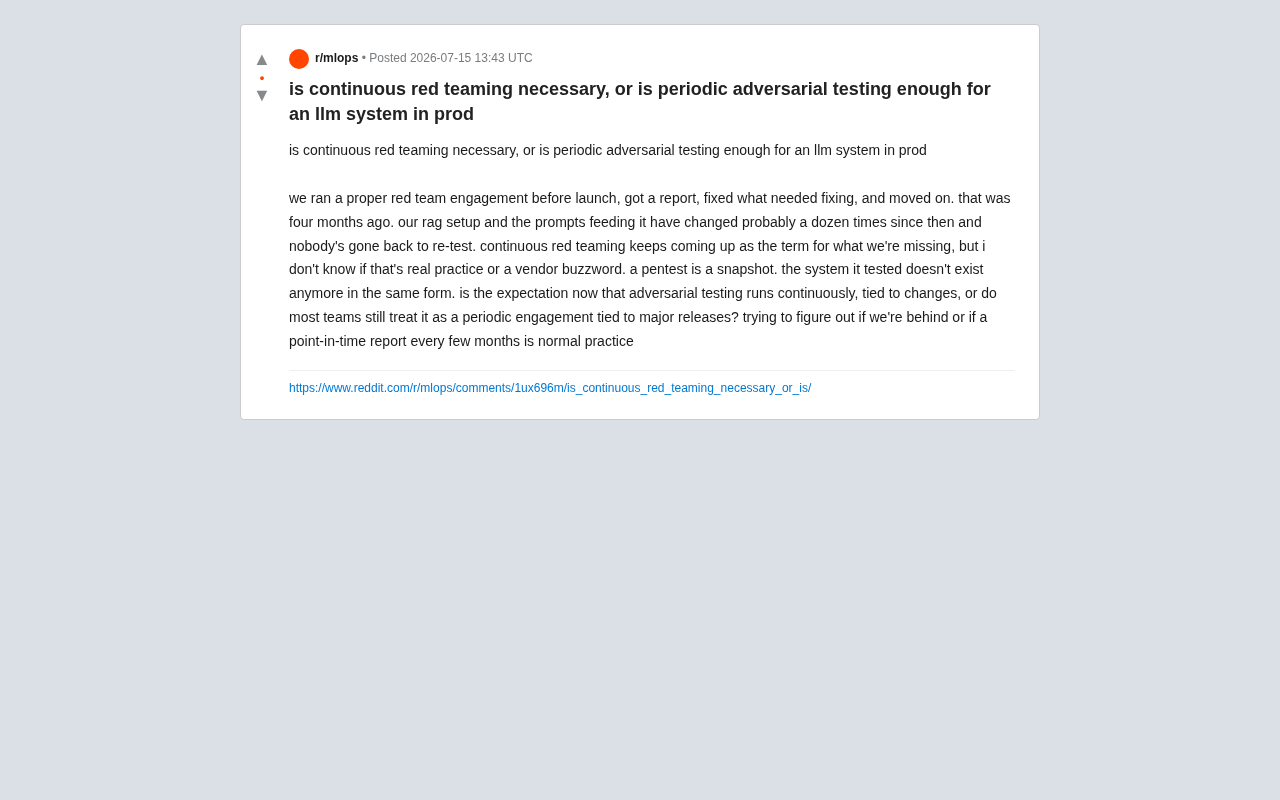
Recently on Reddit, an engineer raised a question that resonated with many LLM application teams: they had conducted a full red team exercise before their product launched, received the report, fixed the issues, and moved on.
The problem? That was four months ago.
In those four months, their RAG (Retrieval-Augmented Generation) architecture and the prompts fed to the model had been revised roughly a dozen times — but no one had gone back to retest. So the engineer asked: is "continuous red teaming" a genuine engineering practice, or just another piece of vendor-manufactured marketing jargon?
At its core, this question exposes a deep tension between traditional security thinking and the nature of AI systems.
Why Traditional Penetration Testing Logic Breaks Down on LLMs
The original poster offered a precise analogy: a penetration test is a snapshot. It tests a system in a specific form at a specific point in time.
For traditional software, this logic mostly holds. A web application's core logic is generally stable between major releases, code changes go through strict CI/CD pipelines and review processes, and the attack surface is relatively contained. So "run a pentest with each major release" is a widely accepted industry norm.
But the fundamental problem with LLM systems is that the system you tested no longer exists.
The Continuous Drift of the LLM Attack Surface
An LLM application's behavior is determined by several highly mutable components:
- System Prompt: A seemingly harmless rewording can reopen a jailbreak path that was previously patched.
- RAG Data Sources: Newly ingested documents or knowledge base updates can introduce new vectors for prompt injection or data poisoning.
- Underlying Model Version: A silent upgrade from your model provider is enough to change how the model responds to the same attacks.
- Tool Calls and Agent Capabilities: Once a model can invoke external tools, the blast radius of an attack expands dramatically.
In other words, risks that would require a code change to introduce in traditional software can be introduced in an LLM system by changing a few words in a prompt. These kinds of changes often bypass rigorous security review — they're frequently made casually by product or operations staff. A dozen changes over four months is actually a pretty common pace in real-world projects.
"Continuous Red Teaming" Is a Buzzword — But the Need Behind It Is Real
Back to the original poster's core question: is this vendor hype?
Frankly, the phrase "continuous red teaming" has been heavily packaged and marketed by security vendors. But the words may be marketing, while the underlying need is genuinely real. These two things need to be evaluated separately.
The real question isn't "should you buy a continuous red teaming product?" It's: does your adversarial testing cadence keep pace with your system's rate of change?
If a point-in-time report covers a system that looks completely different just weeks later, its security assurance value decays rapidly. Four months without retesting, with a dozen changes in between, means the current production environment is effectively in an "untested" state.
"Continuous" Doesn't Mean "24/7 Non-Stop"
There's a cognitive trap here that vendor marketing tends to reinforce. The sensible form of continuous LLM red teaming is not keeping expensive human red team specialists on watch around the clock. Instead, it's a layered approach:
- Automated adversarial tests embedded in CI/CD: Turn known jailbreaks, injections, and privilege escalation test cases into a regression suite that automatically triggers whenever a system prompt or RAG configuration changes. This is where the word "continuous" actually lands — binding adversarial testing to changes, not to a calendar.
- Periodic deep manual red team assessments: Retain quarterly or semi-annual expert evaluations to discover novel attack techniques that automated test cases can't cover.
- Production security monitoring: Continuously observe anomalous inputs and suspicious output patterns in the live environment to create a feedback loop.
Is This Team's Security Posture Actually Behind?
A direct assessment for the original poster:
"Producing a point-in-time report every few months" is perfectly normal in traditional security — but for a high-velocity LLM production system, it genuinely isn't enough. They haven't fallen behind some established industry standard, because the field's best practices are still taking shape; but their testing cadence has become seriously out of sync with the pace of their system's evolution.
A More Pragmatic Path for LLM Security Testing
- Establish a change-to-test binding mechanism: Identify which changes qualify as "security-sensitive" (e.g., system prompts, RAG data sources, newly added tool calls) and enforce automated adversarial regression testing for those changes.
- Convert red team findings into reusable test cases: Don't let that four-month-old report become a one-time expense. Every vulnerability it identified should become a line of defense in your regression suite.
- Retain periodic deep manual assessments: Specifically targeting complex attack chains that are difficult for automation to cover.
- Pay for outcomes, not for concepts: Don't buy the word "continuous" — buy the outcome of "test coverage that keeps up with changes."
The Deeper Lesson: Using the Wrong Mental Model
This post resonated so widely because it surfaces a pervasive cognitive mismatch in AI engineering: many teams are still using the mental model of "deploying a stable artifact" to manage what is actually "a probabilistic system with continuously drifting behavior."
The security of an LLM application is not a state that can be "checked off once" before launch. It's a property that must be continuously maintained as the system evolves. The shift from treating red teaming as a "project milestone" to treating it as "part of the engineering workflow" follows the exact same logic as DevOps shifting security left and automating testing — what might be called AI Security Shift-Left.
Rather than debating whether "continuous red teaming" is a marketing buzzword, ask yourself a more concrete question: If I change the system prompt tomorrow, is there any mechanism that will automatically tell me whether I just reopened a vulnerability that was already fixed? If the answer is "no," that's the missing piece you need to add first.
Related articles

CSS Anchor Positioning: A New UI Positioning Approach Without JavaScript
A deep dive into CSS Anchor Positioning: from anchor-name and position-anchor to the anchor() function, position-area shorthand, position-try-fallbacks, anchor-size, and upcoming anchor queries.

New AI Chart Interaction: Continuous Follow-up Questions and Visualization in Conversation
Explore a new AI interaction method for continuously generating charts in conversation. Use the /visualize command to ask follow-up questions and visualize answers in the same chat window, improving data analysis efficiency.

Cursor Merges Into X Subscription: Paid Plans Share Unified Usage Pool, Grok Model Coding Usage Doubled
Cursor joins The X Subscription with a unified usage pool and doubled Grok coding quota. Third-party models shift to API pricing. Existing users can keep or migrate plans.