LLM WIKI Architecture Explained: Making Agents Truly Understand Enterprise Business

The LLM WIKI architecture lets agents autonomously accumulate business knowledge through three layers: acquisition, organization, and retrieval.
Based on Bilibili creator Lao Xiao's hands-on tutorial, the article explores the real bottleneck in enterprise LLM deployment: business knowledge stays in veteran employees' heads and isn't written down, and business staff don't cooperate with FDE engineers, so agents get built but don't understand the business. It introduces the LLM WIKI architecture, whose core is relying not on humans writing docs but on agents extracting business rules from unstructured data like conversations and work orders, organizing knowledge in a WIKI page-link structure, and retrieving it on demand to inject into reasoning. This approach aligns with RAG but emphasizes structured knowledge accumulation. Using a simulated order customer service line, the article notes that tools, memory, and MCP are just the skeleton—business knowledge is the flesh and blood. Enterprise agent deployment requires both engineering capability and knowledge engineering.
Title
LLM WIKI Architecture Explained: Making Agents Truly Understand Enterprise Business
Meta Description
A breakdown of Bilibili creator Lao Xiao's hands-on AI knowledge base tutorial: how the LLM WIKI architecture solves the problem of agents not understanding enterprise business, from the difficulty of textualizing business knowledge to a real-world order customer service case—an enterprise LLM implementation approach that even beginners can grasp.
Article Content
For enterprises looking to deploy large models into their business lines, the biggest headache is often not technology selection, but the fact that agents simply don't understand the business. In his hands-on tutorial, Bilibili creator Lao Xiao (lead instructor of Mashì Education's large model course) offers a reference-worthy approach using the LLM WIKI architecture.
The Real Bottleneck in Enterprise Agent Deployment: Business Knowledge Isn't Textualized
Lao Xiao opens the video with a realistic scenario: whether it's e-commerce, logistics, manufacturing, or banking, every business line wants to leverage large models to cut costs and boost efficiency. But the hardest part of deployment is making agents understand enterprise business.
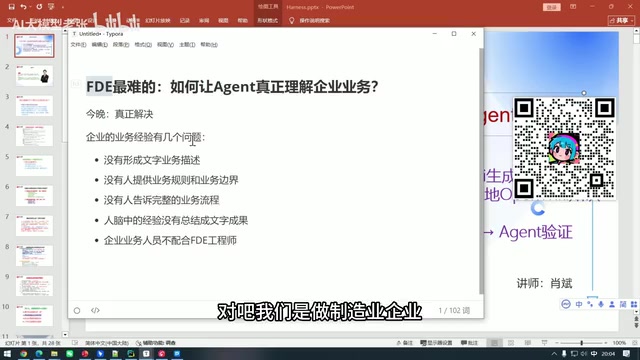
The problem lies in the form in which business knowledge exists. In many enterprises, business rules, boundaries, and processes exist only in the minds of veteran employees and have never been written down. A customer service manager trains two assistants hands-on, and once the training is done, it's over—nobody documents "when you see situation X, handle it this way." More troublesome still, business staff often don't cooperate with FDE engineers (Forward Deployed Engineers), feeling that deployment is the engineers' own responsibility.
The result: the agent gets built, but it doesn't truly understand the business. This judgment is corroborated by discussions in multiple technical communities—the failure rate of enterprise AI projects remains high, and the lack of data and knowledge governance is the number one cause.
FDE (Forward Deployed Engineer) is a role model originating from enterprise software companies like Palantir, in which engineers are stationed directly within the client's business team, working alongside business staff to understand actual processes before designing and implementing technical solutions. Unlike the traditional client-vendor relationship where "the requester submits requirements and the developer delivers," FDE emphasizes engineers proactively diving into the business frontline, transforming vague, word-of-mouth tacit knowledge into executable product logic. In enterprise LLM deployment scenarios, FDEs need both business acumen and engineering capability—they are the key bridge connecting business lines and the technology stack. When Lao Xiao mentions that business staff don't cooperate with FDEs, what it fundamentally reflects is a lack of organizational collaboration mechanisms—the business side views AI deployment as the IT department's job, while FDEs lack sufficient authority and incentives to drive knowledge externalization, causing agent projects to break down at the source of requirements.
The Core Idea of the LLM WIKI Architecture
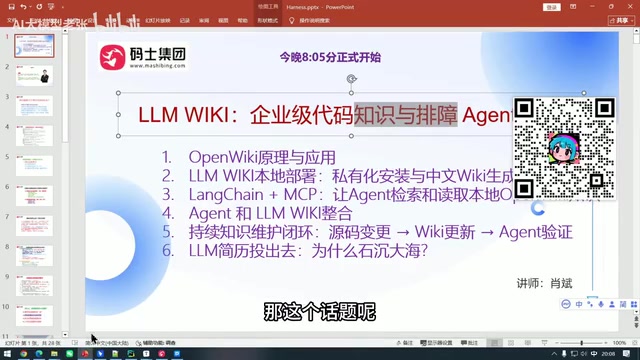
Lao Xiao's solution is the LLM WIKI architecture. Although he doesn't walk through the architecture diagram item by item in the video, the core logic can be inferred from his hands-on simulation of an order customer service business line: rather than relying on business staff to proactively provide text, the agent itself accumulates, associates, and retrieves business knowledge through a WIKI-style knowledge organization structure.
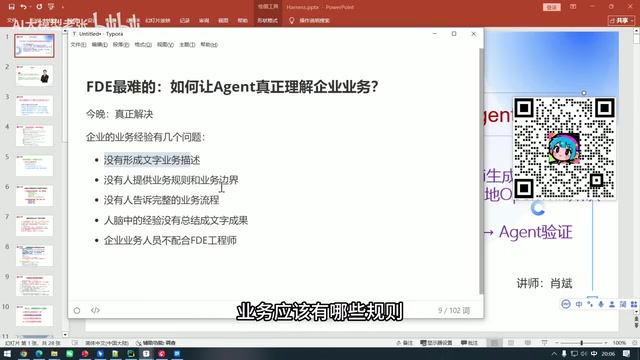
Specifically, this architecture addresses problems at three levels:
- Knowledge acquisition: Extract business rules from unstructured data such as conversations, operation logs, and work orders, rather than waiting for humans to write documentation.
- Knowledge organization: Organize knowledge entries using WIKI's page-link structure, allowing rules to reference each other and form a network.
- Knowledge retrieval: When handling tasks, the agent retrieves relevant WIKI entries on demand and injects them as context into the reasoning process.
This approach is in line with the industry's mainstream RAG (Retrieval-Augmented Generation) solutions, but places greater emphasis on structured knowledge accumulation rather than simply chunking documents and stuffing them into a vector database.
RAG (Retrieval-Augmented Generation) is currently the most mainstream technical paradigm for enterprise LLM deployment: first retrieve document fragments relevant to the user's question from an external knowledge base, then splice these fragments as context into the prompt, letting the large model generate answers based on the retrieved content. Its core value lies in mitigating the model's "hallucinations" and knowledge timeliness issues, enabling the model to cite enterprise private data. However, standard RAG relies on document chunking and vector similarity retrieval, which has clear limitations: chunking destroys the semantic structure of documents, vector retrieval struggles to express logical relationships between rules, and recall performance is unstable for conditional business rules like "when you see situation A, you should perform action B." The page-link knowledge organization emphasized by LLM WIKI is precisely a structural correction to the "flat chunking" flaws of standard RAG, allowing knowledge entries to explicitly reference and jump between each other—closer to how business rules are actually organized.
Hands-on Case: Simulating an Order Customer Service Business Line
To keep the theory from being dry, Lao Xiao directly simulates an order customer service business line—with no ready-made text at all; maintenance rules and handling processes are all figured out by the agent itself.
For those who have studied RAG and agent development, the conventional approach is familiar: define a few tools, build an agent, equip it with short-term and long-term memory, and hook up extension mechanisms like MCP or SKILL.
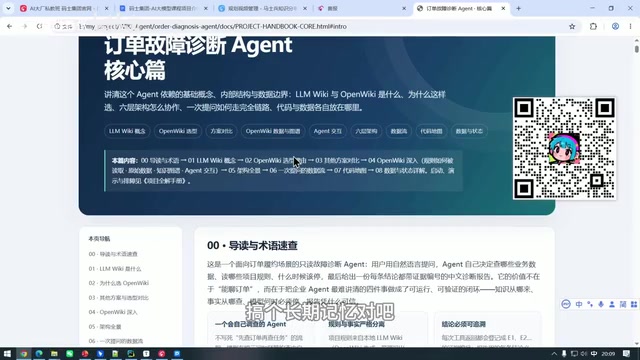
But Lao Xiao emphasizes that simply assembling these components together still leaves you unable to articulate what this order customer service agent is actually supposed to do. Components are the skeleton; business knowledge is the flesh and blood. The value of the LLM WIKI architecture is filling the skeleton with flesh and blood—so that when the agent handles orders, it can look up the handling rules it has accumulated, rather than guessing blindly through generic reasoning every time.
MCP (Model Context Protocol) is a standardized interface protocol proposed and open-sourced by Anthropic, used to let large model applications connect to external tools, data sources, and services in a unified way. You can think of MCP as the "USB-C port for AI applications": whether the underlying system is a database, a CRM system, or an internal API, as long as an MCP server is implemented, the agent can discover and invoke these capabilities through a unified protocol without writing separate adapter code for each tool. The SKILL mechanism typically refers to reusable capability units registered declaratively in an agent framework, describing "which tools to call in which scenarios and what parameters to pass." Combined, the two evolve agents from "only able to chat" to "able to execute operations." Lao Xiao emphasizes that these components are merely the skeleton precisely because MCP and SKILL solve the "can it be called" problem, while "should it be called and by what rules should it be handled" still depends on whether business knowledge has been effectively accumulated.
Takeaways for Developers
Lao Xiao's sharing offers a pragmatic perspective: for enterprise agent deployment, engineering capability is only half the story—the other half is knowledge engineering. Rather than complaining that business staff won't cooperate, it's better to design an architecture that enables agents to proactively learn business knowledge. The LLM WIKI approach is worth validating and iterating on in real projects.
Related articles

Android Developer Verification: Four Paths and Global Rollout Timeline
Android Developer Verification explained: Google unveils four verification paths—Play developers, independent distributors, students/hobbyists, and power users—plus developer console API automation, 24-hour safety delay, and global phased enforcement timeline.

Compose Performance Optimization: A Practical Guide to Outperforming Yourself
A deep dive into Jetpack Compose performance optimization: release-mode measurement, Baseline Profiles, Perfetto composition tracing, computed vs. derived state, effect API costs, and avoiding unnecessary recomposition.

Bitmap Memory Optimization in Practice: 5 Strategies to Reduce App Memory Usage
Based on Google I/O research across ~500 Android apps, this guide covers the Reduce, Reuse, Recycle Bitmap memory optimization strategies—CDN cropping, downsampling, Bitmap Region Decoder, cache deduplication, onTrimMemory handling, Play Console memory metrics, and local profiling toolchains.