LLMOps Tool Selection Guide: An In-Depth Comparison of Tracing, Evaluation, and Governance Capabilities

A practical guide to navigating the fragmented LLMOps tool landscape across tracing, evaluation, and governance.
This article analyzes the LLMOps tool selection challenge through a real engineer's experience, comparing Langfuse, LangSmith, Helicone, and Orq.ai across three core capabilities: tracing, evaluation, and governance. It explains why the ecosystem remains fragmented, evaluates each tool's strengths and limitations, and offers practical selection strategies including prioritizing needs, avoiding ecosystem lock-in, and building composable open-source solutions.
A Real-World LLMOps Dilemma
As large language model (LLM) applications move from prototypes to production, effectively managing the full lifecycle of these applications has become an inescapable challenge for many engineering teams. LLMOps (Large Language Model Operations) is the extension and evolution of MLOps in the era of large language models. Traditional MLOps focuses on end-to-end management of model training, deployment, and monitoring, while LLMOps must additionally address challenges unique to LLMs: version management of prompt engineering, quality evaluation of non-deterministic outputs, fine-grained token cost control, and observability across multi-step reasoning chains. As models like GPT-4 and Claude are widely integrated into enterprise applications, LLMOps has shifted from an optional engineering practice to essential production infrastructure.
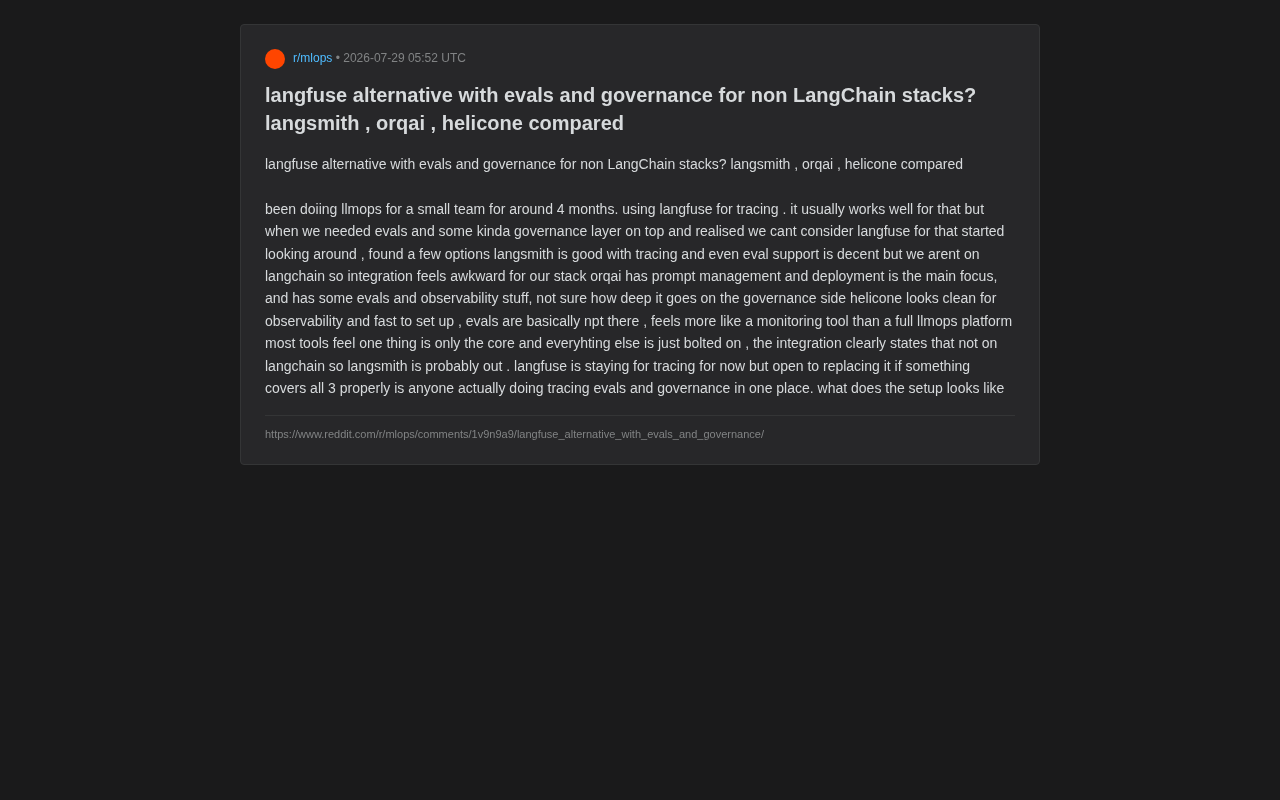
Recently, an engineer who has been responsible for LLMOps in a small team for four months shared his tool selection dilemma on Reddit, sparking widespread community discussion.
His core pain points are highly typical: the team currently uses Langfuse for tracing, which works well. But when requirements expand to evaluation (evals) and governance, the limitations of a single tool become apparent. To make matters worse, the team's tech stack isn't built on LangChain, which significantly diminishes the integration experience with many mainstream tools.
The underlying issue here reflects the reality that the entire LLMOps tool ecosystem is still immature and highly fragmented.
The Three Core Capabilities of LLMOps Explained
Before diving into tool comparisons, it's worth clarifying the three key capabilities mentioned by this engineer, as they represent different dimensions of production-grade LLM application management.
Tracing: The Foundation of LLM Observability
Tracing addresses the "observability" problem. A single LLM call often involves multi-turn conversations, tool calls, Retrieval-Augmented Generation (RAG), and other complex chains. RAG is one of the most common architectural patterns in current LLM applications. Its core idea is to retrieve relevant document fragments from an external knowledge base before the LLM generates a response, injecting them as context into the prompt so the model can generate answers based on the most current and accurate information, effectively mitigating model hallucinations and knowledge staleness. A RAG pipeline typically includes query rewriting, vector retrieval, reranking, and generation—each step can affect the final output quality, which is precisely why tracing capabilities are especially important for RAG applications.
Tracing allows developers to clearly see the inputs, outputs, latency, token consumption, and cost at each step, serving as the foundation for troubleshooting and performance optimization. In the distributed systems domain, this capability aligns with observability standards like OpenTelemetry, except LLM scenarios require additional attention to prompt/completion content, model parameter configurations, and version snapshots of non-deterministic outputs.
Evaluation (Evals): Quantifying Model Output Quality
Evaluation answers the question "how good is the model's output?" It includes quantitative measurement of metrics such as answer accuracy, relevance, hallucination levels, and safety. Evaluation can be based on human annotation or leverage automated methods like LLM-as-a-Judge.
LLM-as-a-Judge is an automated evaluation paradigm that has emerged in recent years. Its core idea is to use a powerful LLM (typically GPT-4 level) as a judge to score another model's output on quality. Evaluation dimensions can include factual accuracy, answer completeness, logical coherence, and safety compliance. Compared to traditional rule-based or human-annotation-based evaluation methods, LLM-as-a-Judge offers advantages in scalability and moderate cost, but also has limitations such as inherent biases of the judging model (e.g., position bias, verbosity preference). In practice, strategies like multi-dimensional scoring, Chain-of-Thought (CoT) reasoning for judgments, and human-machine hybrid calibration are typically employed to improve evaluation reliability.
Without an evaluation framework, teams cannot systematically determine whether model iterations represent progress or regression. In CI/CD pipelines, evaluation should serve as an automated gate, ensuring that every prompt change or model switch passes quality verification before going live.
Governance: Enterprise-Grade Compliance and Control
Governance is the most easily overlooked and most difficult capability to implement well. It encompasses prompt version management, access control, compliance auditing, cost management, and security policies.
In enterprise LLM applications, prompts are essentially equivalent to business logic code in traditional software—changes directly affect model output behavior and quality. Enterprise-grade prompt management needs to support: version history and rollback, A/B testing and canary releases, environment isolation (development/testing/production), change approval workflows, and automated integration with evaluation pipelines. When multiple teams in an organization are developing LLM features in parallel, collaborative prompt management and conflict resolution also become important governance dimensions.
When LLM applications truly enter enterprise production environments, the governance layer often becomes a hard requirement for passing security reviews and meeting regulatory demands. Particularly in regulated industries like finance, healthcare, and legal, model output traceability, data processing compliance, and sensitive information leakage prevention mechanisms are all critical scenarios that the governance layer must cover.
Horizontal Comparison of Mainstream LLMOps Tools
Based on the original poster's hands-on research, we can outline the capability boundaries of several popular tools.
LangSmith: Tightly Bound to the LangChain Ecosystem
LangSmith, built by the official LangChain team, offers excellent tracing capabilities and quite good evaluation support. But as the author stated, "we don't use LangChain, and integration feels awkward." This is LangSmith's biggest weakness—it's deeply coupled with the LangChain ecosystem, and for teams not using a LangChain-based tech stack, integration costs and experience are noticeably compromised.
LangChain is currently one of the most popular LLM application development frameworks, providing high-level abstractions like Chains, Agents, and Tools. However, many teams choose not to use LangChain for reasons including: its abstraction layer increases debugging complexity, frequent version iterations cause API instability, and it over-abstracts certain scenarios. Some teams prefer to call model APIs directly or use lighter-weight libraries (such as LiteLLM, Instructor, etc.), and these teams encounter incompatibility issues with LangChain ecosystem-bound tools when selecting LLMOps solutions.
Therefore, in the author's selection process, LangSmith was essentially ruled out.
Orq.ai: Centered on Prompt Management and Deployment
Orq.ai's primary focus is prompt management and deployment, with some evaluation and observability capabilities included. However, the author expressed doubts about the depth of its governance layer. Tools like this are positioned more as "prompt engineering and release platforms"—they have evaluation and governance features, but they're not deep enough. For teams whose core workflow revolves around prompt iteration, Orq.ai provides a relatively complete develop-test-deploy loop, but when requirements extend to enterprise-grade compliance auditing and fine-grained access control, its capability boundaries become apparent.
Helicone: A Lightweight LLM Monitoring Tool
Helicone's advantage lies in its clean interface and fast deployment, making it a handy observability tool. It intercepts LLM API calls through a proxy mode, achieving near-zero-intrusion request logging, cost tracking, and latency analysis. However, it "basically has no evaluation features," and the author considers it "more of a monitoring tool than a complete LLMOps platform." For teams that only need basic monitoring, Helicone is a solid lightweight choice, but it struggles to support comprehensive operational needs.
Langfuse: Outstanding Tracing, Evaluation and Governance Need Strengthening
Langfuse, which the author is currently using, performs excellently in tracing and is an open-source solution. Langfuse supports self-hosted deployment, which makes it especially appealing to teams with data sovereignty requirements. It provides framework-agnostic integration through SDKs, supports Python and TypeScript, and can capture every span in an LLM call chain, including nested tool calls and retrieval operations. Its open-source nature means the community can contribute integration adapters and build upon it with secondary development—this is its core differentiating advantage over closed-source commercial products.
However, its capabilities in evaluation and governance are not yet sufficient to support the team's full requirements, which is precisely what triggered this tool selection exercise.
Fragmentation: The Common Ailment of the LLMOps Tool Ecosystem
The author hit the nail on the head regarding the core problem in today's market:
"Most tools feel like they only do one thing really well, and everything else feels bolted on."
This statement precisely summarizes the current state of LLMOps tools. Tools that started with tracing have weak evaluation capabilities, those that started with prompt management have limited governance capabilities, and monitoring tools lack evaluation dimensions. When teams want a "tracing + evaluation + governance" all-in-one solution, they often have to resort to multi-tool stitching, which introduces new problems of integration complexity and data silos.
The root cause of this fragmentation is that LLMOps itself is still a rapidly evolving emerging field. Each product is expanding its boundaries from its strongest capability, and it's unlikely that a truly "all-in-one" solution will emerge in the short term. This mirrors the development trajectory of the early cloud computing market and DevOps toolchains—the market will eventually consolidate, but until that consolidation is complete, users need the ability to effectively combine tools within a fragmented ecosystem.
It's worth noting that the OpenTelemetry community is pushing for standardization of LLM observability (such as Semantic Conventions for GenAI), which could lay the foundation for future tool interoperability and reduce the friction costs of multi-tool integration.
LLMOps Selection Recommendations and Practical Approaches
Facing this dilemma, teams can consider the following directions during tool selection:
First, clearly prioritize core requirements. If tracing is already well-served by Langfuse, the next step should focus on whichever is more urgent between evaluation and governance, rather than pursuing a "big and complete" solution at the expense of implementation speed. In practice, using a "requirements matrix" approach is recommended—classifying each requirement into four quadrants by urgency and importance, and prioritizing the capability gaps that are both highly urgent and highly important.
Second, beware of ecosystem lock-in risks. Tools like LangSmith that are tightly bound to specific frameworks, while feature-complete, mean long-term integration burden for teams not on the corresponding tech stack. Tech stack compatibility should serve as a hard filtering criterion. Choosing tools that support open standards like OpenTelemetry can maintain greater migration flexibility as the tech stack evolves in the future.
Third, consider an open-source + composition approach. The extensibility of open-source tools like Langfuse allows teams to build or integrate evaluation and governance modules on top of them. While this requires engineering investment, it delivers greater flexibility and data sovereignty. For example, Langfuse's tracing data can be exported to a self-built evaluation pipeline (based on open-source frameworks like Ragas, DeepEval, etc.), with governance-layer customization needs addressed through internal tooling.
Fourth, scrutinize the actual depth of governance capabilities. Many tools claim to support governance but often only provide prompt version management. For teams with compliance requirements, it's essential to closely examine enterprise-grade capabilities such as access control (RBAC/ABAC), audit logs (tamper-proof operation records), security policies (PII detection and masking, content safety filtering), and cost quota management. It's recommended to develop a specific compliance checklist during the selection phase and verify each tool's actual support level item by item.
Conclusion
This engineer's dilemma is a microcosm of countless teams pushing LLMs into production. The LLMOps tool ecosystem is still in a "warring states" phase where each player has its own strengths, and it's unlikely that a single platform perfectly covering tracing, evaluation, and governance will emerge in the near term.
The pragmatic approach may be: accept the current fragmented reality, build an extensible composite solution around a core tool (like Langfuse), and gradually optimize the tech stack as your own needs become clearer and the market matures. After all, in this rapidly changing field, maintaining architectural flexibility may be more important than trying to get everything right in one shot. As industry standards are gradually established and the market naturally consolidates, today's fragmentation will eventually be replaced by more mature solutions—but until that day arrives, the ability to make sound technical decisions amid uncertainty is itself a team's most important competitive advantage.
Related articles

Jaithon 3: Analyzing an Experimental Programming Language in Pursuit of Perfect Syntax
An in-depth analysis of Jaithon 3, an experimental language promising "perfect syntax" and high performance, exploring its design philosophy, technical challenges, and community reception.

Gemini 3.5 Pro Rebranded as 3.7 Flash? Decoding the LLM Naming Maze
Reddit users spotted a Gemini 3.5 Pro checkpoint briefly appear on Arena AI before being renamed 3.7 Flash High. We analyze the product strategy and industry naming chaos behind the change.

Sanders Sends Letter to OpenAI and Other AI Giants: Pause Development or Face Legislative Regulation
Senator Sanders sent an open letter to OpenAI, Anthropic, and Meta demanding an immediate AI development pause or face Senate legislation. Analysis of the letter's context and regulatory prospects.