LLMs Are Not Superhuman: The Ability to Read and Write Neural Network Weights Is Overestimated
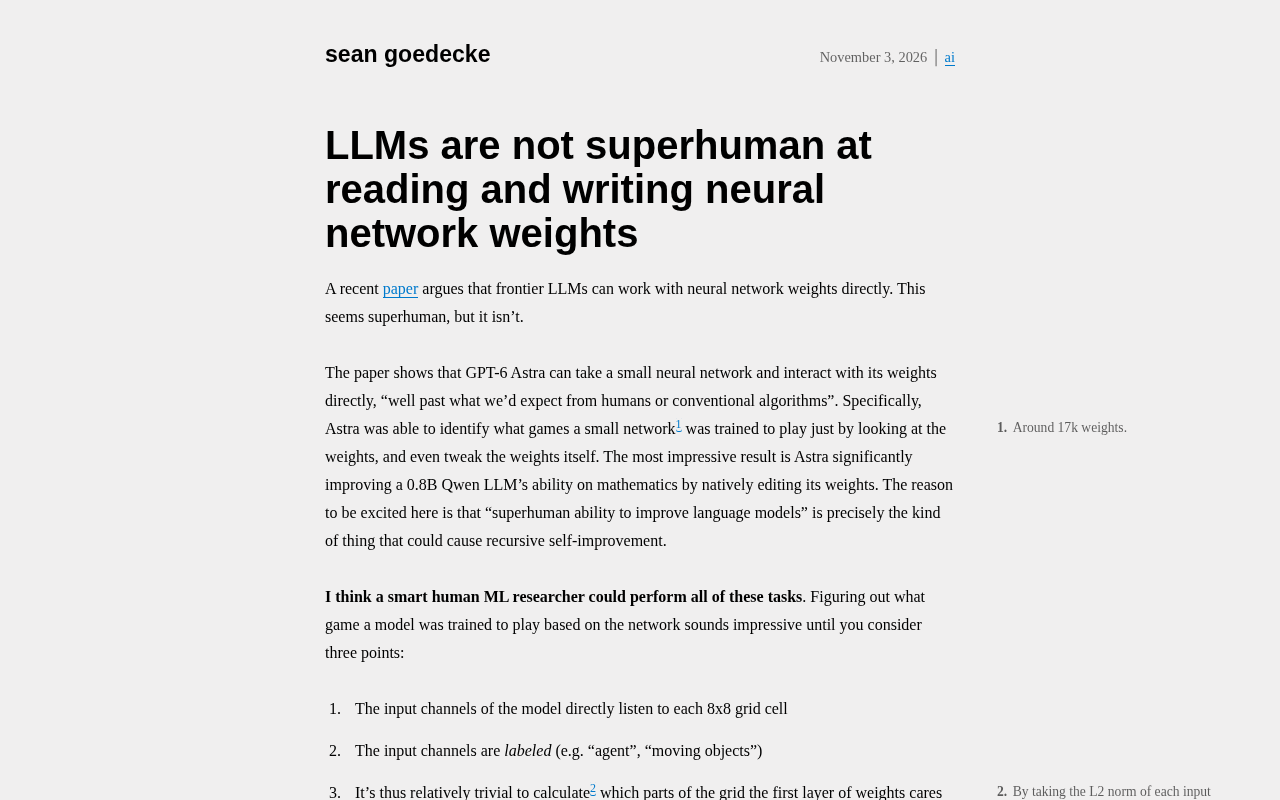
LLMs perform far below expectations in reading and writing neural network weights and are not superhuman.
Based on Hacker News discussion, the article notes that LLMs perform far below expectations on directly reading and writing neural network weights and lack superhuman ability. The core reason is that weights are high-dimensional continuous numerical values lacking semantic structure, making LLM textual pattern reliance hard to transfer. Experiments show LLMs are even worse than simple baselines, warning against overreliance on LLMs for weight editing and model merging.
Introduction: An Overlooked Capability Boundary
Large language models (LLMs) demonstrate impressive capabilities on many tasks, but does that mean they can "read" and "write" neural network weights as easily as they process text? A study recently discussed on Hacker News gives a negative answer: LLMs do not possess superhuman-level ability when it comes to directly manipulating neural network weights. This conclusion challenges blind optimism about LLM generality and reveals an important aspect of model capability boundaries.
Why "Reading and Writing Weights" Is a Special Challenge
Neural network weights are parameter matrices composed of massive numbers of floating-point values, and their numerical distributions and structural relationships are fundamentally different from natural language. LLMs excel at capturing statistical patterns in text, but weight space lacks human-readable semantic structure. Asking an LLM to directly understand or generate weights is equivalent to making it process a high-dimensional numerical language with no grammar and no context. The research points out that even as model scale increases, this capability shows no significant improvement, indicating that it is not simply a matter of "insufficient data."
The High-Dimensionality of Weight Space and LLM Tokenization
When processing text, LLMs rely on tokenization—mapping strings to discrete vocabulary IDs and then converting them into vectors through an embedding layer. This mechanism is naturally suited to discrete, ordered language symbols with grammatical structure. Neural network weights, by contrast, are tensors composed of continuous floating-point numbers; a single weight value can fall anywhere in the real-number interval, and its meaning depends entirely on its relative relationship with other weights (for example, the dot-product patterns of the Q/K matrices in attention heads). Serializing weights into text (such as printing floating-point numbers) loses numerical precision and introduces enormous sequence lengths, far exceeding the LLM's context window. More critically, LLM attention mechanisms are fragile when dealing with long-range, high-dimensional numerical dependencies, making it difficult to reconstruct hierarchical computational graph structures from flattened weight lists. Therefore, the difficulty LLMs face in reading and writing weights stems not only from insufficient training data, but also from a fundamental mismatch between their architecture and numerical representations.
Experimental Findings: LLMs Perform Far Below Expectations
According to the analysis cited by the Hacker News community, researchers compared LLM performance on weight reading and writing tasks with that of human experts and specialized algorithms. In tasks such as reading weights and predicting model behavior, or generating weights from descriptions, LLM accuracy was significantly lower than expected—even worse than some simple baseline methods. This suggests that LLM "understanding" may depend heavily on textual patterns rather than genuine numerical reasoning ability.
Representativeness of Baseline Methods and Evaluation Tasks
The "simple baseline methods" mentioned in the article usually include linear probes, regression prediction after PCA dimensionality reduction, and heuristic rules based on weight statistics (such as norm and sparsity). Although simple, these methods often outperform zero-shot LLMs on specific prediction tasks (such as determining whether a layer has been fine-tuned or estimating the order of magnitude of model parameters). The design of evaluation tasks generally falls into two categories: first, "reading weights"—given part of a weight tensor, predict the model's output or behavioral metrics on specific inputs; second, "writing weights"—generate or modify weight fragments based on natural language descriptions. The low accuracy of LLMs on these two types of tasks indicates that their internal representations do not spontaneously give rise to general reasoning ability over numerical weights, even after extensive pretraining on code and mathematical data.
Implications for AI Research and Applications
This finding has direct implications for directions such as model interpretability, weight editing, and model merging. If LLMs cannot reliably read and write weights, then tools that rely on LLMs for automated weight manipulation need to be reevaluated. At the same time, it reminds researchers that LLM "superhuman" performance is often limited to language tasks, and in areas involving underlying numerical representations, specialized methods remain irreplaceable.
Technical Background on Weight Editing and Model Merging
Weight editing refers to directly modifying model parameters to change specific behaviors (such as detoxification or knowledge injection). Typical methods include ROME and MEMIT, which rely on targeted updates to weight matrices rather than LLM generation. Model merging combines the weights of multiple fine-tuned models through arithmetic operations (such as Task Arithmetic and TIES-Merging) to obtain multi-task capabilities at low cost. The core of these methods is numerical optimization and linear algebra, not language understanding. If LLMs are introduced into these processes (for example, having an LLM generate editing instructions or merging strategies), their reliability is limited by their perception of weight space. The study suggests that LLMs are better suited as high-level planners (generating descriptions of editing goals), while underlying numerical operations should still be carried out by specialized algorithms.
Conclusion: Taking a Rational View of LLM Capability Boundaries
LLMs are not omnipotent. They perform excellently in text processing, but in non-text, high-dimensional numerical domains such as neural network weights, they still have clear shortcomings. Future research needs to define the applicable boundaries of LLMs more clearly and avoid overgeneralizing their capabilities. For developers, this means that in tasks involving weight manipulation, specialized algorithms should be prioritized rather than relying blindly on LLMs.
One-line Summary
LLMs perform far below expectations in reading and writing neural network weights and do not possess superhuman-level ability.
Paragraph Summary
Based on research discussed on Hacker News, the article points out that large language models perform far below expectations on tasks involving directly reading and writing neural network weights and do not possess superhuman capabilities. The core reason is that weights are high-dimensional continuous numerical values lacking semantic structure and fundamentally different from natural language, making it difficult for LLMs' reliance on textual patterns to transfer. Experimental comparisons show that LLMs are even worse than simple baselines on weight reading and generation tasks. This finding raises warnings for automated tools that rely on LLMs, such as weight editing and model merging, and reminds researchers to take a rational view of LLM capability boundaries and prioritize specialized algorithms in numerically intensive tasks.
Related articles

Qwen 3.8 Beats Opus at Coding—But Can Your Mac Run It?
Open-source Qwen 3.8 beats Opus 4.6 at coding at just 18GB, but how much Mac memory do you need? 24GB crashes; 32GB is the sweet spot. Full config guide inside.

Claude Code + Agent: Building a Fully Automated AI Testing Loop
Bilibili course breakdown: how test developers can use Claude Code terminal-based Agents to build a fully automated AI testing loop. Compares permission boundaries of terminal vs. device Agents, explains why enterprise projects choose Claude Code over Open Claude-type tools, and outlines the Node.js environment setup and DeepSeek model integration path.

Working with AI Agents Requires Nerves of Steel
The more autonomous AI agents become, the heavier the user's psychological burden. Drawing from a Hacker News discussion, this article analyzes black-box anxiety, behavior drift, and monitoring fatigue in agent collaboration, and offers practical approaches like sandbox isolation, permission control, and task granularity management to reduce cognitive load.