LLMs Can Detect Prior Concept Injections: Unpacking the Latent Introspection Mechanism
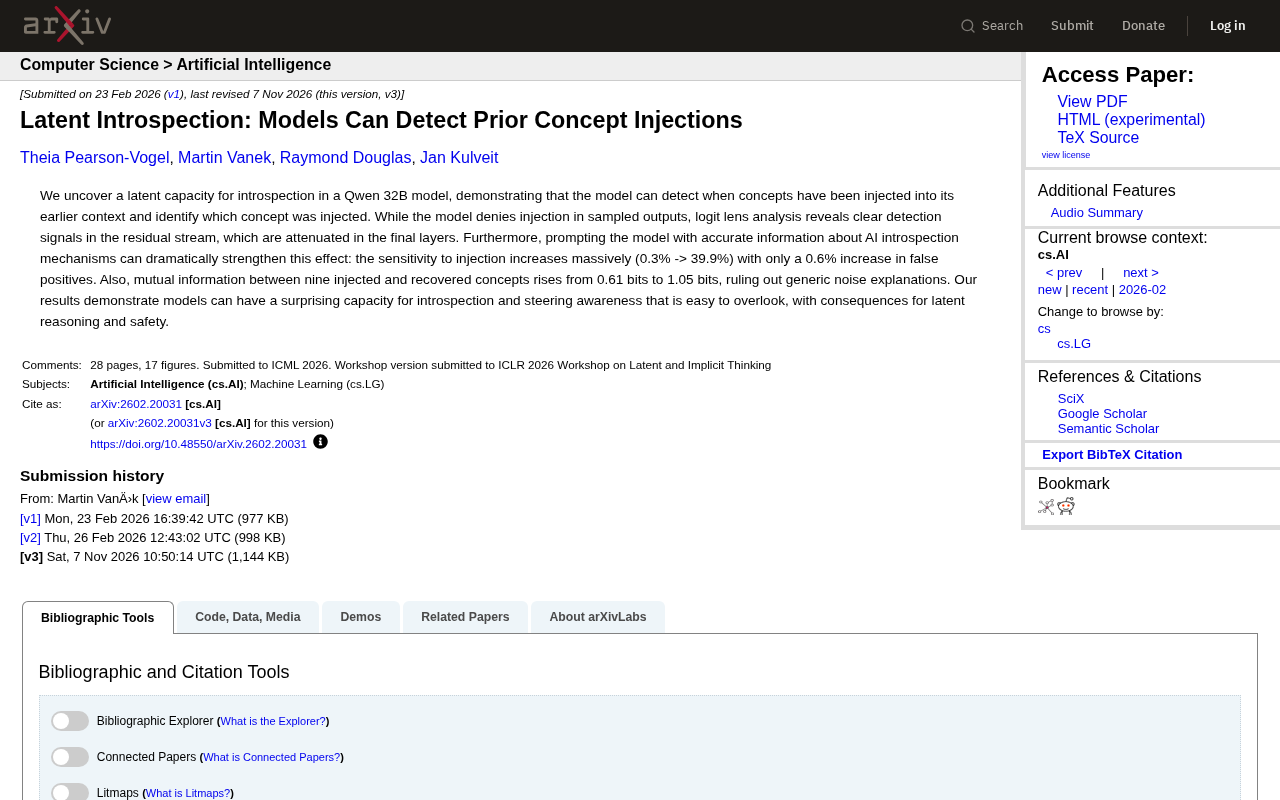
LLMs may be able to detect concepts injected into their internal representations through latent introspection, offering new ideas for AI safety.
Centered on the research title *Latent Introspection: LLMs Can Detect Prior Concept Injections*, the article explores whether large language models can perceive external interventions on their internal states. It first explains the technical means of concept injection (e.g., activation steering, variants of prompt injection) and their risks, then proposes the "latent introspection" mechanism—models identify anomalous injections by self-monitoring shifts in hidden states. The article analyzes the value of this capability for improving model robustness and interpretability, while noting limitations such as false introspection reports and adversarial manipulation. Finally, drawing on Hacker News community discussion, it looks ahead to future directions such as quantifying detection accuracy and exploring architectural differences, and emphasizes that the current research is still in its early stages and requires more experimental validation.
Introduction: The Self-Awareness of LLMs
A recent study that sparked discussion on Hacker News, Latent Introspection: LLMs Can Detect Prior Concept Injections, raises a thought-provoking question: can large language models (LLMs) perceive that their internal states have been externally intervened upon? The title gets straight to the point—LLMs possess a kind of "latent introspection" capability that allows them to detect concepts that were previously injected. This finding challenges our conventional understanding of model transparency and self-monitoring, and opens up new directions for AI safety and interpretability.
What Is Concept Injection?
Concept injection refers to the use of specific technical means to forcibly introduce a concept or semantic direction into a model's latent representations, thereby influencing its subsequent generation behavior. Common implementations include activation steering, variants of prompt injection, and interventions on hidden states during inference. These operations are typically used to control the style of model outputs, steer the direction of a conversation, or study the causal role of internal representations in a model.
However, concept injection also carries risks: malicious attackers could manipulate a model by injecting harmful concepts while the model itself remains completely unaware. Therefore, whether a model can detect such interventions becomes a key indicator for evaluating its robustness.
Activation Steering is a technique that controls model behavior without retraining. Its principle is to add a direction vector (steering vector) to the hidden state of a specific layer during the forward pass. This vector is usually computed from the activation difference between contrastive sample pairs (e.g., sentences with "positive sentiment" versus "negative sentiment"). By adjusting the injection strength and position of this vector, one can steer model outputs toward a target concept—for example, making the model more inclined to generate a certain style or topic. The key difference between activation steering and prompt injection is that the former directly intervenes in the model's internal representations, while the latter only modifies the input text. This also makes activation steering more covert and harder for the model to detect by inspecting the input, which highlights the necessity of latent introspection capabilities.
Latent Introspection: How Models "Perceive" Injected Concepts
According to the study's title, LLMs can detect previously injected concepts, a capability referred to as "latent introspection." The core idea is that the model not only passively receives the injection but can also actively access its own internal representations and identify anomalous signals that differ from the normal state.
Latent introspection may rely on the model's self-monitoring mechanism over hidden states. When external intervention causes certain neurons or representation directions to shift, the model can compare the current activation pattern with the expected pattern, producing a sense of "inconsistency" and thereby flagging the injected concept. This mechanism is analogous to human metacognition—being aware that one's own thinking has been influenced by external factors.
You may not have noticed that this research is still in its early stages, and the discussion on Hacker News remains at the title level, lacking detailed experimental data. But the value of this direction cannot be ignored: it implies that LLMs may possess intrinsic anomaly detection capabilities, providing a new avenue for building safer AI systems.
Probe Classifiers are a tool commonly used to analyze a model's internal representations: a simple linear classifier (such as logistic regression) is trained on the hidden states of a certain layer to predict some property (e.g., "whether a certain concept is present"). A probe classifier itself does not change model behavior; rather, it serves as a "readout" method to test whether specific information can be linearly decoded. In the context of latent introspection, probe classifiers can be viewed as an externally assisted introspection mechanism—researchers use them to probe whether signals of an injected concept remain in the model's hidden states. The model's own introspection capability is closer to dynamically training or invoking similar probes internally to monitor whether its own activation patterns deviate from the norm. Combining the two can provide an experimental basis for evaluating the reliability of model self-monitoring.
Sparse Autoencoders (SAEs) are a popular tool in recent interpretability research, aimed at decomposing a model's large and dense activation vectors into sparse, interpretable feature directions. An SAE uses a bottleneck layer to force most neurons to be inactive, thereby extracting a small number of active features, each often corresponding to a human-understandable concept (e.g., "legal terminology," "code syntax"). In latent introspection, SAEs can be used to identify the specific features activated by concept injection and determine whether they differ from naturally activated feature patterns. If a model can use sparse representations similar to SAEs for self-monitoring, then introspection-based detection has an actionable micro-level foundation. However, SAEs are costly to train and deploy, and feature completeness remains an open problem.
Significance for AI Safety and Interpretability
Improving Model Robustness
If LLMs can detect concept injection, developers can build real-time monitoring systems that raise alarms when a model is subjected to malicious intervention. For example, in adversarial attacks, attackers attempt to bypass safety guardrails by injecting specific concepts, and the model's introspection capability can identify the anomaly and refuse to comply. This is more proactive than post-hoc output filtering.
Enhancing Interpretability
Latent introspection reveals a certain degree of "understanding" by the model of its own internal states. Traditional interpretability research mostly observes model behavior from the outside, whereas the introspection perspective lets the model participate in the process of explaining itself. This helps researchers locate the source of concept representations and understand the model's decision pathways.
Challenges and Limitations
However, latent introspection is not a panacea. Models may produce false introspection reports or fail to distinguish natural activations from artificial injections. In addition, the introspection capability itself could be exploited by attackers—through adversarial training that makes the model insensitive to introspection signals. These issues require further research.
Adversarial Training is a common method for improving model robustness: during training, adversarial samples (e.g., inputs with small perturbations) are actively generated, and the model learns to correctly classify or reject these samples. In the context of latent introspection, attackers might exploit this idea in reverse—by constructing specific adversarial objectives to train the model to become "desensitized" to introspection signals, i.e., to no longer produce anomalous activations or report anomalies when concept injection occurs. This type of attack is called an "introspection evasion attack." Defending against such attacks requires designing more robust introspection mechanisms, such as introducing randomized probes, multi-level consistency checks, or cross-validation with external monitors. This also shows that introspection capability itself is not a one-time, permanent safety guarantee.
Multi-Source Perspectives: Community Discussion and Future Directions
On Hacker News, the study received 5 points and no comments, indicating that discussion is not yet sufficient. However, given the AI community's ongoing attention to interpretability and safety, this topic is likely to become a hot spot. Some researchers speculate that latent introspection may rely on techniques such as Sparse Autoencoders or Probe Classifiers, but the original text does not provide specific methodological details.
In the future, this research can be deepened along the following directions: quantifying the accuracy and false positive rate of introspection-based detection; exploring differences in introspection capability across model architectures; studying whether introspection mechanisms can be adversarially manipulated; and integrating introspection capabilities into AI systems actually deployed in practice.
Conclusion
Latent Introspection: LLMs Can Detect Prior Concept Injections puts forward a forward-looking proposition: LLMs can not only be injected with concepts but can also become aware of such injections. Although current information is limited, it points to an important trend—AI systems are evolving from passive tools into agents with self-monitoring capabilities. For AI safety researchers, this is both an opportunity and a challenge.
(Note: This article is written based on the Hacker News title and limited information; specific experimental details should be referred to in the original paper.)
Related articles
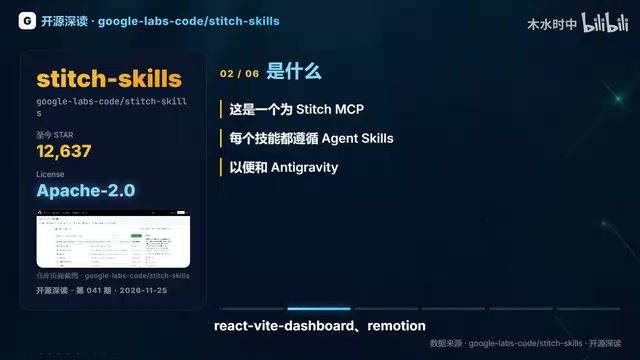
Google Stitch Skills: Connecting Coding Agents to the Design Workflow
Google Stitch Skills is an Agent Skills library following the open standard, adding a design-to-code workflow to the Stitch MCP Server. This article breaks down its three skill groups, SKILL.md directory structure, installation paths, and dependency pitfalls.

40.5-Inch Color E-Paper Art Frame: An Art Display You Charge Once a Year
The Ink Poster Tella 40.5-inch color e-paper art frame uses the E Ink Spectra 6 full-color solution: A1 format, no backlight, no noise, about one charge a year, 2,000+ licensed artworks built in, and automatic adaptation of phone photos.

Jingle Jam Memories: RT's Awkward First Encounter with Lewis
RT shares his awkward first Jingle Jam experience: unexpectedly pushed into the studio, meeting Lewis and Yogg's cast, and Toddy appearing in armor.