Local AI Agent in Action: Auto-Record World Cup Highlights and Stop Staying Up to Watch Soccer

Flowin AIPC's AiKanQiu Agent auto-records and extracts World Cup highlights so you never miss a moment.
The AiKanQiu Agent on Flowin AIPC lets soccer fans pre-schedule matches, auto-record live streams, and use local multimodal AI to detect and extract highlights — all without manual intervention. Powered by Intel Core Ultra's NPU, it runs entirely on-device for low latency and minimal disruption, showcasing what AIPC and persistent local AI Agents can deliver in everyday life.
The Real Pain Point for Soccer Fans: Too Much Content, Too Little Time
The 2026 World Cup is both a celebration and a headache for fans. You want to watch the games, but kickoff is always in the early hours of the morning. Staying up through a full match means the next day is basically a write-off. Catching highlight reels tells you the score but fails to capture the flow of the game. Recording your screen yourself still means scrubbing through two hours of footage to find the good parts.
This is a textbook case of "Information Overload." The concept was first systematically articulated by futurist Alvin Toffler in his 1970 book Future Shock, describing the decision paralysis and efficiency loss humans experience when confronted with more information than they can cognitively process. In the streaming era, this phenomenon is further amplified — videos uploaded to YouTube every day worldwide would take over 500 years to watch, and a single soccer match broadcast routinely runs 90+ minutes. Too much content, too little time: what users truly need is key information that has been automatically distilled.
This is precisely the kind of problem that today's AI Agents are best equipped to solve. Unlike traditional AI assistants that passively respond to user commands, Agents (intelligent agents) possess autonomous perception, planning, and execution capabilities — they can complete multi-step tasks without supervision, transforming the information overload problem into a "precision delivery" experience.
This article draws on hands-on testing by Bilibili creator "一晚七" to introduce the "AiKanQiu Agent" (AI Soccer Watching Agent) within Flowin AIPC, and explores how local AI computing power can turn "staying up to watch soccer" into "catching highlights in minutes."
The Core Logic of the AiKanQiu Agent
The workflow addresses nearly every pain point soccer fans face:
- Before the match: Directly schedule the games you want to watch;
- When the game starts: The software automatically opens the live stream and begins recording;
- During the match: Continuously analyzes the footage in the background, automatically marking timestamps and generating highlight clips when key moments are detected;
- The next morning: Open your laptop — no need to scrub through a progress bar. Review all the important moments from the entire match in just a few minutes.
From scheduling and opening the stream to recording, recognizing, and organizing highlights, users barely need to intervene manually. AI handles the vast majority of the work. For people with busy schedules or late-night game times, this "managed" experience is a genuine relief.
Worth noting is its Feishu (Lark) message push integration — it sends a reminder when a match begins, and pushes video clips directly to your phone the moment a highlight is detected. Even if your laptop is sitting at home, you'll know what's happening on the pitch in real time.
Deployment and Testing: Hardware and Software Setup
Why Does This Require an AIPC?
For a long-running Agent like this to operate stably, local AI inference capability is essential. This review was conducted on a Xiaomi laptop 2026 powered by the Intel Core Ultra 300 processor.
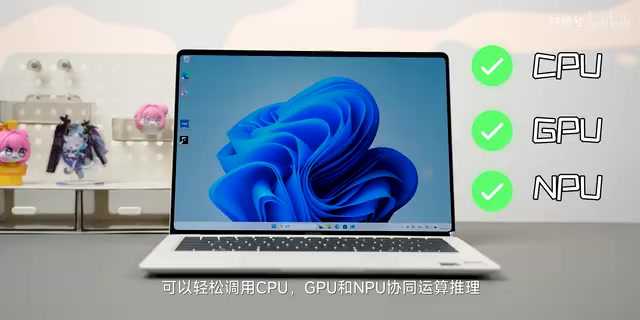
The Intel Core Ultra series (internally codenamed across Meteor Lake, Lunar Lake, Arrow Lake, and others) is Intel's heterogeneous computing platform designed specifically for the AIPC era. Its key innovation is integrating a Neural Processing Unit (NPU) as a dedicated compute module within the processor package. The NPU is fundamentally a hardware accelerator optimized for matrix multiplication and convolution operations — exactly the computational bottlenecks at the core of deep learning inference. Compared to using a GPU for AI inference, the NPU typically consumes only 1/5 to 1/10 of the power, allowing AI tasks to run in the background on a laptop for extended periods without significantly impacting battery life or device temperature. The Core Ultra 300 series NPU delivers over 40 TOPS (trillion operations per second), meeting the certification threshold for Microsoft Copilot+ PCs.
The processor's core advantage lies in the coordinated operation of CPU, GPU, and NPU: the CPU handles task scheduling, the GPU manages graphics and parallel computation, and the NPU is dedicated to accelerating AI inference. This co-scheduling is managed by Intel's OpenVINO framework, which allows developers to assign different operators of the same AI model to whichever compute unit is best suited for them, dramatically improving overall efficiency.
Software Installation Process
The setup process is straightforward — just follow the steps:
- Download and install Flowin AIPC, then log in after the first launch;
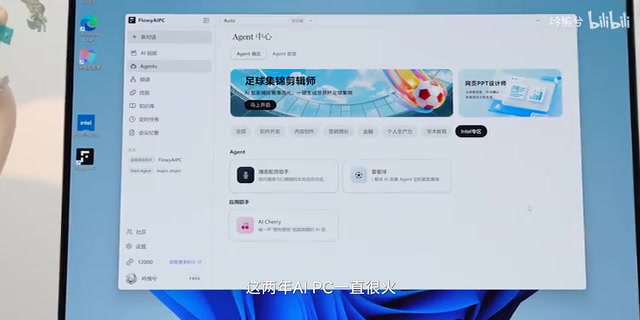
- Go to the Agents page on the left sidebar, find "AiKanQiu Agent" in the Intel section, and click Install;
- The first installation requires downloading the runtime environment, which takes roughly ten or more minutes depending on your connection;
- Once installed, open "AiKanQiu AI Assistant" in the Agent management page and type "打开爱看球" to enter the main interface.
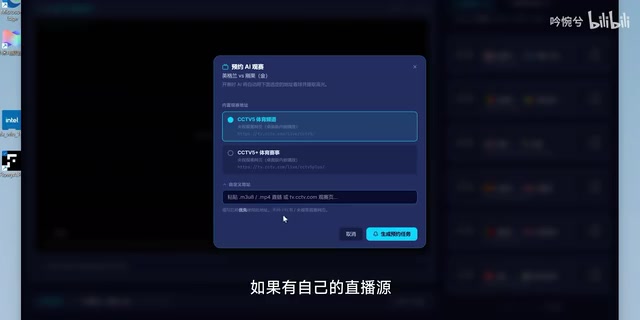
After launching, the software automatically loads current and upcoming matches. Live games can be handed off to AI monitoring immediately; upcoming ones can be pre-scheduled so the stream opens and records automatically at kickoff. Custom stream URLs are supported, and completed matches can be found under the "Ended" section.
The overall onboarding experience is extremely low-friction, with virtually no learning curve.
Local AI Processing: Where AIPC Really Makes a Difference
What makes this application genuinely valuable is the way it's implemented under the hood.
The AIPC concept has been a hot topic for the past two years, but many people share the same question: what actually makes an AIPC better than a regular PC?
That question used to be hard to answer — most AI applications rely on cloud-based large models, with the local machine only handling input and display.
But long-running Agents like AiKanQiu are entirely different. They need to continuously analyze footage and recognize content in real time, while minimizing interference with the user's regular PC activities. If all data had to be uploaded to the cloud, it would create strong network dependencies and significantly degrade real-time performance.
The core capability of the AiKanQiu Agent — automatically identifying exciting moments in a match — relies on a combination of computer vision and multimodal AI. Traditional video summarization techniques typically rely on low-level visual features like shot-change frequency and motion vector variation, with limited accuracy. Modern multimodal models can simultaneously understand frame content, player movements, on-field positional relationships, and even combine audio from commentary and crowd noise to assess event significance. Key events like goals, red cards, and penalty kicks are often accompanied by specific visual patterns (such as player celebration gestures and referee signals) and audio signatures (sudden shifts in commentator tone, crowd cheering) — multimodal fusion judgment can dramatically improve recognition accuracy. In local deployment scenarios, these models typically need to undergo INT8 or INT4 quantization compression to fit the memory and compute constraints of consumer-grade hardware while maintaining acceptable inference precision.
Flowin uses a local AI processing approach: frame analysis, multimodal recognition, and highlight detection are all executed using local computing power. This delivers three clear advantages:
- Lower latency: No round-trip time to and from the cloud;
- Reduced network dependency: Remains functional even during network fluctuations;
- Smaller impact on everyday work: AI tasks are distributed across dedicated compute units like the NPU.
This is the core value of AIPC over a regular PC — local computing power makes "long-resident, continuously running" Agents genuinely viable.
A Shift in How We Use AI: From Passive Response to Active Execution
This application points to a clear directional shift in how AI is evolving.
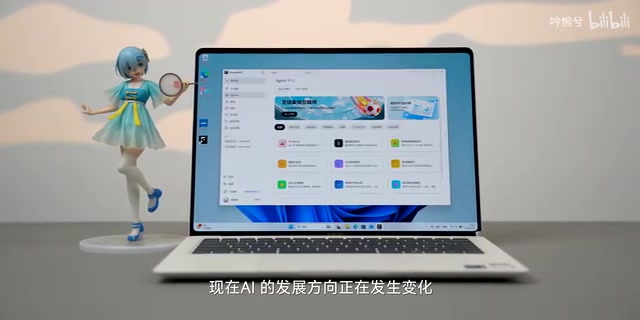
The evolution of AI interaction paradigms has broadly gone through three stages: early rule-based systems (if-then logic), conversational prompt-based interaction exemplified by ChatGPT, and the currently emerging Agentic AI. In the past, people mostly proactively opened an AI tool to ask a question, then closed it when done.
The defining characteristic of Agentic AI is its closed-loop "perceive-plan-execute" capability, along with the ability to call external tools (such as browsers, file systems, and API interfaces) to complete complex tasks. In academic circles, this transition is often described using the "ReAct" framework (Reasoning + Acting) — the model doesn't just generate text; it triggers real-world actions based on its reasoning. Today, more and more Agents are long-resident on devices: pre-scheduling tasks, continuously perceiving their environment in the background, and delivering results directly to the user at the right moment.
This shift from "passive response to active execution" means AI is gradually evolving from a tool into a persistent "intelligent assistant" running quietly in the background. The dependence on local compute is also far greater than for cloud-based Q&A — because Agents need to occupy computational resources for extended periods of environmental perception. This is precisely where AIPC holds a core competitive advantage over ordinary PCs for this class of applications. The potential of this paradigm extends far beyond watching soccer:
- Meeting notes: Automatically record and extract key takeaways;
- Video organization: Batch-extract important clips;
- Content creation: Assist with material selection and curation;
- And many more scenarios requiring long-term automated execution.
Summary
Looking back on this hands-on test, its value can be appreciated from two angles.
From a soccer fan's perspective: It solves a very real problem — you don't have to stay up all night, and you won't miss the exciting moments from the match.
From an AIPC perspective: It offers one of the clearest, most intuitive demonstrations yet of what local AI computing power can actually change about everyday experience. As more and more Agents make it into real-world applications, local computing platforms with coordinated CPU, GPU, and NPU capabilities will play an increasingly important role.
The World Cup is just an entry point. The deeper significance of local Agents is that "AI working for you continuously" has, for the first time, become genuinely within reach.
Key Takeaways
Related articles

Ponytail: Giving AI Coding Agents a Senior Engineer's Mindset
Ponytail is a free GitHub tool that injects a senior engineer's mindset into AI coding agents, making them ask whether code is even necessary first. According to TamilDeck, it can compress 200 lines of AI-generated code to 30, cutting token costs, with support for Cursor rules and Claude Code skill integration—though security review still requires human oversight.

Complete Guide to Connecting Cursor AI to the GitHub MCP Server
A step-by-step guide to connecting Cursor AI to the GitHub MCP server: create a personal access token, configure mcp.json, store the token in the ENV block, and verify with a PR query.

AI Agent Hacks? Don't Get Swept Up in the Hype
AI agent hacking news is everywhere, but Reddit users liken the hype to Y2K panic—lacking real attack cases and possibly driven by IPO and regulatory arbitrage motives.