Local Decision Models Cost Just 0.1 Cents per 1,000 Runs, JevAI Challenges 5-Cent Pricing

Local inference costs under 0.1 cents per 1,000 decisions in electricity—far below the 5-cent cloud quote.
Based on a YouTube share, the article uses JevAI to compare cloud API and local inference costs. The core finding: excluding hardware and counting only electricity, running 1,000 decisions locally costs under 0.1 cents versus a 5-cent cloud quote—dozens of times cheaper—and this holds in the US, UK, and even high-price Germany. The article notes cloud pricing includes hosting, operations, and elastic scaling, so direct comparison overstates local advantages; a fair comparison must include hardware depreciation and labor. Local cost advantages only truly emerge under high-frequency, stable loads, reminding teams to calculate their own electricity bill before signing per-call contracts.
A YouTube share has sparked fresh discussion about the cost of local AI deployment. Using JevAI as an example, the presenter compared the electricity overhead of local inference against cloud APIs: when someone quotes 5 cents per 1,000 decisions, running the model locally costs less than one-tenth of a cent in actual electricity. That gap isn't marketing spin—it's calculated directly from marginal costs beyond the device itself.
The Cost Floor of Local Inference: Electricity Only
When discussing AI inference costs, hardware purchases are typically depreciated separately, while the biggest variable in daily operation is electricity. The core point in the video is clear: if you don't amortize hardware costs and look only at electricity, the power cost of running a thousand decisions is low enough to be negligible.
The value of this perspective is that it splits "can we afford to run the model" into two questions: one-time investment and ongoing overhead. For teams that already own compute hardware, the marginal cost is essentially just electricity—and electricity isn't a barrier in most regions.
Marginal cost is the key economic concept behind this comparison: it refers to the added cost of producing one more unit of output, excluding fixed investment that has already been sunk. In local inference, once a GPU server is purchased, its acquisition cost is a fixed cost that gets amortized whether you run one decision or a million; the extra electricity consumed per additional decision is the true marginal cost.
This is why "not amortizing hardware costs" in the video isn't a trick—it's answering a specific question: for a team that already owns compute hardware, how much extra does one more inference request cost? The answer is that bit of electricity. For a team buying equipment from scratch, fixed costs must be included, unit costs rise significantly, and the marginal-cost advantage only emerges once call volume is large enough to dilute fixed costs. Distinguishing these two types of cost is the prerequisite for judging whether local deployment pays off.
The Conclusion Holds Across Global Electricity Prices
The presenter deliberately emphasized regional differences: the conclusion is consistent under US and UK electricity prices; even in Germany, where electricity is "absurdly expensive," the power cost for a thousand decisions remains below one-tenth of a cent.

This means the economics of local deployment don't depend on being in a low-electricity-price region. Germany is often cited as the extreme case for European electricity prices—if the cost line holds even there, other markets have even less reason to be deterred by electricity bills.

Germany was chosen as the "extreme case" for real-world reasons: driven by energy transition policies, carbon trading costs, and grid surcharges, German residential and industrial electricity prices have long ranked among the highest in Europe and are often used as a reference ceiling for European electricity prices. Using German electricity prices as a stress test is logically equivalent to asking "does the conclusion still hold under the most unfavorable electricity price conditions?"
It's worth noting that the reason electricity for a thousand decisions can be pushed this low is that the inference workload is sufficiently light—the floating-point operations and VRAM footprint per decision are limited, so power consumption is measured in watt-hours or even milliwatt-hours. For long-context inference with large-parameter models or high-frequency batch generation, per-run power consumption rises noticeably, and the order of magnitude of this conclusion may need re-estimation. So "under 0.1 cents" should be understood as a typical value for lightweight decision-making tasks, not a universal upper bound for all local inference scenarios.
5 Cents vs. 0.1 Cents: Misaligned Pricing Anchors
The video opens by noting that the other party's quote was 5 cents per 1,000 decisions, which the presenter calls "actually a pretty good price." But the local cost given right after is under 0.1 cents—a difference of dozens of times.
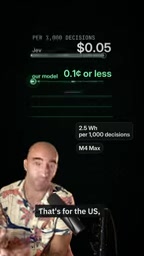
This isn't to say the cloud API isn't worth 5 cents. The cloud price includes hosting, operations, elastic scaling, and the convenience of zero maintenance—tangible value for teams without infrastructure. The local model's advantage is that when decision volume is large enough and hardware already exists, unit cost gets anchored to an extremely low level by electricity prices.
The dozens-of-times gap between per-call cloud API pricing and local electricity costs essentially stems from different pricing anchors. A cloud vendor's unit price covers not just compute itself but also data center construction and depreciation, cooling and network bandwidth, redundant disaster recovery, model version maintenance, SLA guarantees, and sales and compliance costs—all amortized into every call. In other words, 5 cents buys a whole package of "don't worry about it yourself."
Local electricity costs, by contrast, are anchored only to energy prices; all the above costs are either already sunk as fixed investment or converted into the team's own labor. So directly comparing the two numbers overstates the advantage of local deployment—a fair comparison should factor in operations labor, hardware depreciation, and failure risk. Only when call volume is large enough and the fixed overhead of an in-house team and equipment is sufficiently diluted does the marginal electricity advantage translate into a real total-cost advantage.
How to Do the Math
Excluding equipment costs is a deliberate simplification. Real decisions must account for hardware depreciation, labor for operations, and model updates. But the video provides a clear reference point: if your business volume is large, the marginal cost ceiling for local inference is electricity—and that overhead has been verified as under 0.1 cents per 1,000 runs across the US, UK, and Germany.
For high-frequency decision scenarios—such as automated workflows, real-time classification, and batch judgments—a gap of this magnitude becomes significant as call volume scales. Per-call cloud billing is friendlier for low-frequency scenarios, while local models show a cost advantage under high-frequency, stable loads. JevAI's comparison is essentially a reminder to teams: before signing a per-call contract, run the electricity bill for running it yourself.
Related articles

AI Historical Comic Drama Goes Viral: Why the Zhu Yuanzhang Theme Outperforms Real Actors
An AI-generated historical comic drama went viral on Bilibili, with viewers saying its acting beats real people. We analyze its tech pipeline, narrative logic, and industry impact.

Bin's Live Stream Highlights: Hilarious Interactions from "You Came at the Right Time" to "I'll Support You From Now On"
Bin's hilarious live stream highlights: from "You came at the right time" to "I'll support you from now on," featuring Championship skins, wigs, and other game memes that showcase Bilibili's unique streaming culture.

Hunter Rescues Educated Youth: The Mountain-Chasing System Launches a New Warm-Hearted Viral Drama Formula
Bilibili's early-access period short drama *Everyone Thinks I'm a Poor Hunter* opens with a snowy-night rescue of an educated youth. Hunter Chen Shan activates the mountain-chasing system, using realistic hypothermia first-aid details and mutual-probing character dynamics to deliver a warm-hearted period drama without the sleaze.