Local Deployment of Qwen3 Tested: Even a 27B Small Model Can Write Games
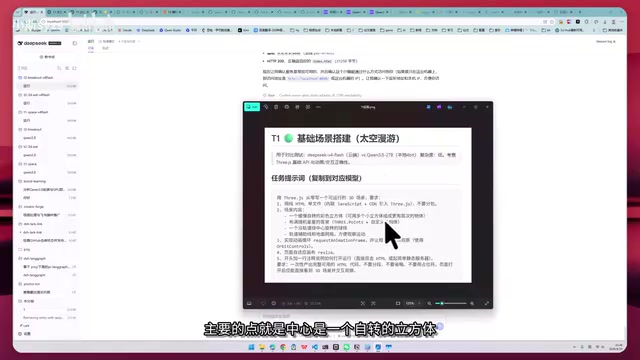
Hands-on test: locally deployed Qwen3 27B outperforms cloud-based DeepSeek V4 Flash on Three.js game dev tasks.
Based on a Bilibili creator's hands-on testing, this article compares locally deployed Qwen3 27B (4-bit quantized via llama.cpp) against cloud-based DeepSeek V4 Flash across three Three.js game development tasks. Qwen3 27B outperformed on the space roaming scene and breakout game — particularly in visual completeness and collision detection logic — while the two tied on the countdown/scoring system. Total VRAM usage was ~32GB, with inference running at ~10 tokens/s. Despite the speed gap versus the cloud's 140 tokens/s, the creator found it sufficient for daily development, validating the practical viability of 27B-scale local models for game code generation.
Introduction: Can Local Small Models Handle Game Development?
As large language model capabilities continue to advance, code generation has become a key benchmark for measuring practical utility. Among programming tasks, game development places particularly demanding requirements on a model's overall capabilities — it requires not just correct logic, but also physics simulation, rendering, UI interaction, and more.
This article is based on a hands-on video from a Bilibili creator, focusing on one central question: Under the constraints of local 4-bit quantized deployment, can a model with just 27B parameters handle Three.js game development tasks? Through three comparative experiments against the cloud-based DeepSeek V4 Flash, we arrived at a surprisingly instructive answer.
Qwen3 27B Specs and the Comparison Model
The star of this test is the Qwen3 27B model from the Tongyi Qianwen series. According to the creator, its core specs are as follows:
- Parameter count: 27B (27 billion parameters)
- Context length: Native 260K tokens, expandable to 1M tokens
- Performance tier: Broadly surpasses the previous-generation Qwen3 Plus
The comparison model is DeepSeek V4 Flash on the DeepSeek platform — a cloud-based model optimized for high throughput, capable of around 140 tokens/s inference speed. Interestingly, the creator speculated that V4 Flash may be a unimodal model, which may partly explain differences in visual and spatial reasoning observed in the tests.
Three Three.js Game Development Tests
Test 1: Space Roaming Scene
The first test asked both models to generate a space roaming scene, with these key requirements: a self-rotating cube at the center, orbiting spheres in the background, and a helper grid.

DeepSeek V4 Flash's output failed to generate the background elements, resulting in a visually underwhelming scene.

Qwen3 27B, on the other hand, fully implemented the rotating background and hit every key requirement, with noticeably better visual results. In this round, the local small model clearly came out ahead.
Test 2: Countdown Timer and Scoring System
The second test introduced game mechanics by requiring a countdown timer and a scoring system — placing more emphasis on UI logic.
The results here were fairly close. DeepSeek V4 Flash completed the basic functionality, and Qwen3 27B handled the UI and score display equally well. This round was essentially a tie.
Test 3: Breakout (Ball and Brick) Game
The third test was a classic breakout game — and the scenario most likely to expose physics logic issues.

DeepSeek V4 Flash's version had a noticeable collision detection bug — some bricks would not be properly destroyed after being hit by the ball. Qwen3 27B's implementation handled this correctly.
After all three tests, the creator's verdict was clear: Qwen3 27B edges out the competition on game development tasks. This outcome likely relates to DeepSeek V4 Flash's unimodal nature — the lack of multimodal understanding may limit its grasp of visual and spatial logic.
Hardware Costs and Inference Performance for Local Deployment
The most significant takeaway from this test isn't which model is stronger — it's validating the feasibility of local small models for game development.

Deployment Configuration
The creator's setup is worth noting:
- Inference backend: llama.cpp
- Model version: Unsloth's 4-bit quantized build
- VRAM usage: ~32GB total
- Hardware distribution: Spread across multiple GPUs, roughly 16GB each
Inference Speed
In terms of speed, local inference with Qwen3 27B runs at approximately 10 tokens/s. The creator estimated that with a higher-end GPU with 50GB VRAM, speeds could potentially reach 30–40 tokens/s (this is an estimate, not tested directly).
By comparison, the cloud-based DeepSeek V4 Flash achieves around 140 tokens/s — a clear speed advantage. That said, the creator noted: in actual day-to-day use, 10–20 tokens/s is already sufficient for most development workflows.
Conclusion: The Practical Value of Local Small Model Deployment
This hands-on test sends a clear signal: with mature 4-bit quantization techniques, 27B-scale models can now run smoothly on consumer-grade or prosumer hardware and handle real-world code generation tasks.
For developers who prioritize data privacy, want to reduce API costs, or need offline development capabilities, deploying a high-quality mid-sized model locally is becoming increasingly practical. Of course, cloud models still hold an irreplaceable advantage in inference speed — the two approaches are best seen as complementary rather than mutually exclusive.
It's worth noting that the conclusions here are based on a small sample of three experiments from a single source. Actual performance will vary depending on specific tasks, prompts, and hardware configurations, so readers are encouraged to test within their own context.
Related articles
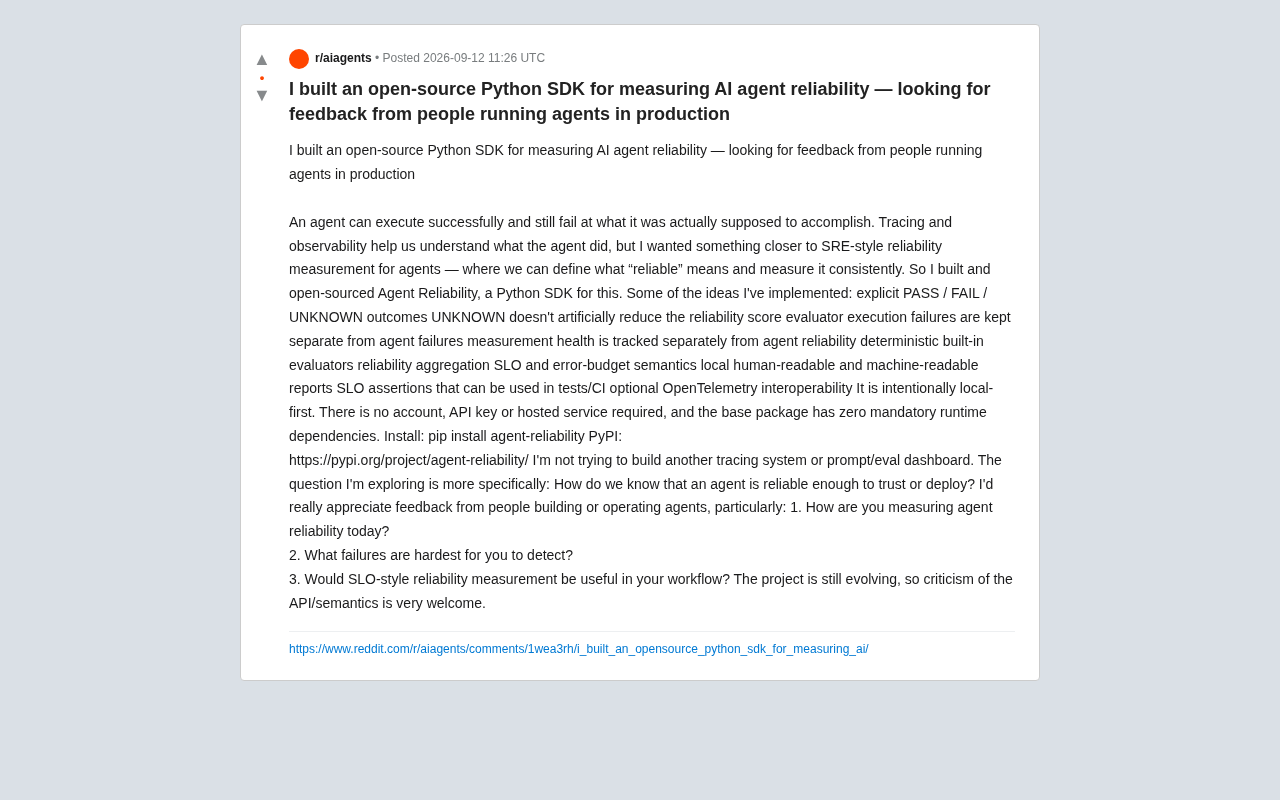
Open-Source Python SDK: Measuring AI Agent Reliability with SRE Principles
Agent Reliability is an open-source Python SDK that applies SRE's SLO and error budget concepts to AI Agent evaluation, with PASS/FAIL/UNKNOWN states, CI assertions, and zero forced dependencies.

MiniMax RefMod: A Complete Guide to Training-Free Reusable Identity Workflows
MiniMax RefMod offers training-free reusable identity workflows for image, video, and audio generation. Includes Runpod template and tutorial for quick setup.

Invalid Source Material Notice
The source material provided lacks substantive information and is unrelated to AI/tech topics, making it impossible to produce a complete professional article.