Local Models vs Jev AI: The Hardware Truth Behind 27ms Decision Latency

Real-world tests show local AI latency ranging from 27ms to 1.5s—hardware determines the experience.
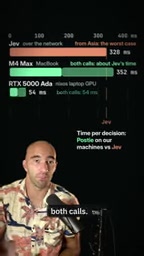
A YouTube creator compared local AI models with the cloud service Jev AI. Accessing Jev AI from Asia took about 328ms, while local models varied widely: an RTX 5000 Nix machine took just 27ms, an M4 MacBook 176ms (already better than the cloud), and an older M1 MacBook Air up to 1.5s. The article concludes that cloud latency is tied to geography, local performance depends heavily on hardware, and M4-class mobile devices already match the cloud. Whether local AI is worth deploying depends on your device; as chips improve, the barrier is lowering.
Why Latency Is the Key Metric for AI Decisions
In real-time AI applications, latency directly determines how smooth the user experience feels. A recent YouTube creator compared the response speed of local models against the cloud service Jev AI, and the results revealed a often-overlooked fact: hardware configuration affects local AI performance far more than expected.
Located in Asia, the creator got a response latency of about 328 milliseconds when using Jev AI. He admitted it was "not too bad, but not great either," which reflects the inherent constraint that geographic distance places on cloud services. When switching to local models, performance varied dramatically across devices, forming the core focus of this comparison.

Latency in AI systems typically refers to the end-to-end time from input data to model output decision, including stages such as data preprocessing, model inference, and post-processing. For real-time interactive scenarios (like voice assistants, autonomous driving, and game NPCs), latency directly affects user experience and system usability. The industry commonly uses percentiles (such as P50 and P95) to describe latency distributions rather than just looking at averages. Cloud AI latency is mainly composed of network round-trip time (RTT) and server queuing time, and geographic distance significantly increases RTT—for example, RTT between Asia and the North American West Coast typically ranges from 150 to 250 milliseconds. Local AI eliminates the network transmission step, so latency depends mainly on chip compute power, memory bandwidth, and model optimization.
Local Model Benchmarks: A Span from 27ms to 1.5s
M4 MacBook: 176ms, Slightly Better Than the Cloud
On a MacBook with the M4 chip, local model latency was 176 milliseconds, already better than Jev AI's 328 milliseconds in Asia. The creator noted that if two decision calls are considered together, the local model's total time is roughly on par with Jev AI. This means that on mobile devices, local AI is already capable of competing with cloud services.

The M4 chip is a system-on-chip (SoC) based on the Arm architecture that Apple launched in 2024. It uses a second-generation 3-nanometer process and integrates the CPU, GPU, and Neural Engine. Its Unified Memory architecture lets the CPU and GPU share the same memory pool, reducing data copy overhead, which is especially beneficial for local AI inference. The M4's Neural Engine delivers 38 trillion operations per second (38 TOPS), enough to run small-to-medium-scale large language models or decision models on-device. By comparison, the M1 chip's Neural Engine delivers 11 TOPS, which is one of the hardware reasons the M1 MacBook Air has significantly higher latency.
RTX 5000 Nix Machine: An Impressive 27ms
The real performance leap came on a Nix machine equipped with an RTX 5000 graphics card. The local model needed only 27 milliseconds per decision, for a total of 50 milliseconds across two calls. The creator described the result as "unbelievable" and "super impressive." This shows that with a high-end GPU, local AI response speed can reach the millisecond level, far exceeding current cloud services.

RTX 5000 is a series of NVIDIA graphics cards for the professional workstation market (such as the RTX 5000 Ada Generation), with FP32 and Tensor Core compute far beyond consumer-grade cards and typically 32GB of GDDR6 memory, making it suitable for running larger local models. A Nix machine refers to a computer running NixOS—a Linux distribution based on the Nix package manager, known for declarative configuration and reproducible builds, and popular among developers and tech enthusiasts. NixOS's lightweight nature reduces background system overhead, helping to lower inference latency. A 27-millisecond latency means the machine can complete about 37 full decision calls per second, meeting the needs of the vast majority of real-time applications.
M1 MacBook Air: The 1.5-Second Weak Spot
However, local models don't run smoothly on every device. The creator's older M1-chip MacBook Air performed poorly, with each decision taking up to 1.5 seconds—more than 50 times the RTX 5000 setup. This is a reminder to users: the local AI experience depends heavily on hardware, and older devices can become bottlenecks.
Hardware Determines Experience: The Limits of Local AI
Several key conclusions can be drawn from this comparison. First, cloud AI latency is constrained by geographic location; the 328 milliseconds Asian users get from Jev AI is usable but struggles to meet extreme real-time demands. Second, local AI performance is strongly tied to hardware; an RTX 5000-class graphics card can deliver an extreme 27-millisecond response, while an M1 Air may be as slow as 1.5 seconds—a huge gap.
Third, M4-chip mobile devices can already deliver a cloud-equivalent experience, with 176-millisecond latency that is almost imperceptible in everyday use. For most users, choosing between local and cloud requires weighing hardware cost, use case, and sensitivity to latency.
This real-world test also indirectly answers a common question: is local AI worth deploying? The answer depends on your device. If you have a high-end GPU, local models have an overwhelming latency advantage; if you're using an older laptop, cloud services may still be the safer choice.
The trade-off between local AI and cloud AI involves multiple dimensions: latency, privacy, cost, maintainability, and model capability. The advantages of local deployment are that data never leaves the device (privacy protection), there's no network dependency (offline availability), and there's zero marginal cost per call; the disadvantages are high hardware investment, limited model size, and manual updates and maintenance. The advantages of cloud services are elastic compute, access to very large models, and automatic updates; the disadvantages include network latency, data privacy risks, and pay-per-use costs. For latency-sensitive scenarios where hardware allows (such as real-time game AI and industrial quality inspection), local inference is often better; for scenarios requiring very large models or elastic scaling, the cloud is still the first choice. Hybrid architectures (local small models handling high-frequency simple decisions, cloud large models handling complex low-frequency tasks) are becoming a compromise.
Future Outlook: The Barrier to Local AI Is Lowering
As chip performance continues to improve, the hardware threshold for local AI is gradually coming down. The progress from M1 to M4 has already shown the enormous potential of mobile chips, while RTX 5000-class desktop graphics cards demonstrate the performance ceiling. As more devices can run local models at acceptable latency, the line between cloud and local will blur further, and users will have more flexible choices.
One-line Summary
Real-world tests show local AI latency ranging from 27 milliseconds to 1.5 seconds, with hardware determining the experience.
Paragraph Summary
A YouTube creator compared the response latency of local AI models against the cloud service Jev AI. Accessing Jev AI from Asia gave latency of about 328 milliseconds, while local models varied dramatically across hardware: a Nix machine with an RTX 5000 graphics card needed only 27 milliseconds, an M4 MacBook took 176 milliseconds (already better than the cloud), and an older M1 MacBook Air took up to 1.5 seconds. The article concludes that cloud AI latency is constrained by geographic location and local AI performance is strongly tied to hardware, with M4-class mobile devices already able to deliver a cloud-equivalent experience. The conclusion is that whether local AI is worth deploying depends on device conditions: users with high-end GPUs gain an overwhelming latency advantage, while those with older devices are better off with cloud services. As chip performance improves, the hardware threshold for local AI is lowering.
Related articles

A 19-Year-Old's Rental Horror Story: Ceiling Collapse, Bug Infestation, and the Lessons It Taught Me
At 19, my first off-campus rental brought bug infestations, no heat, a collapsed ceiling, and a ruined laptop with no renter's insurance. Here are the hard-won lessons for first-time student renters.

Veda Nurse's Cranial Nerve Exam: Why ASMR Role-Play Is Going Viral
Bilibili creator Veda's cranial nerve exam ASMR video goes viral, blending humor and sensory triggers through nurse role-play. This article analyzes its unique appeal and the audience psychology behind ASMR role-play.

LG Cinebeam AI Review: 120-Inch Giant Screen + 3000 Lumens, a New Choice for the Living Room Theater
LG Cinebeam AI projector review: 3000 ANSI lumens, 4K, 100 inches from about 8 cm and 120 inches from about 18 cm. Built-in webOS, AI Concierge voice recommendations, AI Sound Pro 11.1.2 virtual surround, and Game Optimizer—positioned for fixed living room installation, complementing the portable Cinebeam S.