Lofi Cities: A Browser-Generated Pixel Cityscape with Lofi Music

Lofi Cities is a browser-based generative pixel city and lofi music experience that won over Hacker News.
Lofi Cities is a web app that generates pixel-art city nightscapes and lofi background music entirely in the browser, earning 164 upvotes and 73 comments on Hacker News. Its standout feature is that everything is browser-generated: music is synthesized procedurally via the Web Audio API, while visuals are rendered in real time with Canvas or WebGL — no pre-recorded assets, no loops, no server load. It requires no installation or sign-up, perfectly matching the Hacker News community's taste for elegant, instantly usable projects. It's both a nod to lofi culture and a practical showcase of generative art and music for frontend developers.
A Lofi City Nightscape Running Right in Your Browser
A project called Lofi Cities recently gained notable traction on Hacker News, earning 164 upvotes and 73 comments shortly after being posted. It's a quintessential "Show HN" submission — a developer sharing their independent project with the tech community to get feedback and let people experience it firsthand.
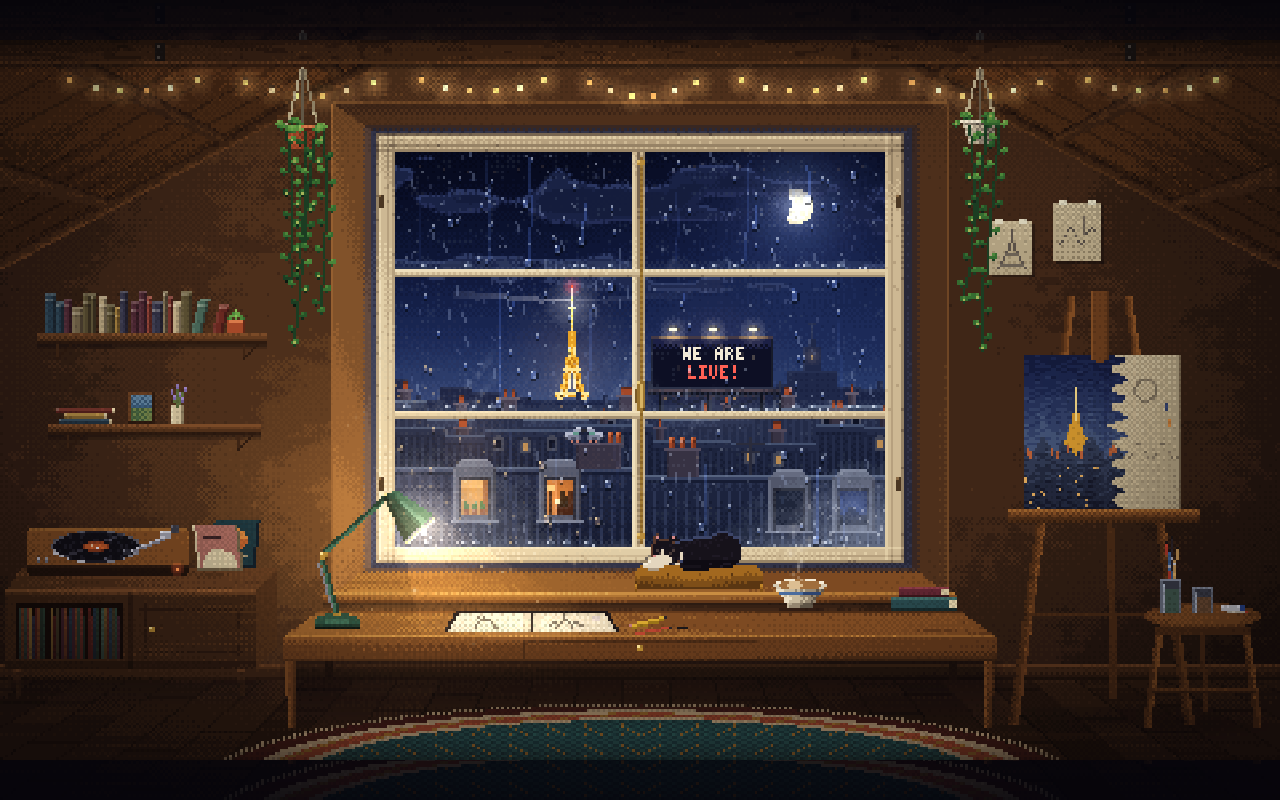
The core concept behind Lofi Cities is simple yet clever: it generates a pixel-art city nightscape in real time directly in your browser, accompanied by lofi (lo-fi) background music that's also generated locally in the browser. Open the page, and you'll see a glowing pixel city slowly come to life under the night sky, while a mellow electronic beat flows in the background. This immersive blend of visuals and audio makes it a great ambient backdrop for work, study, or winding down.
Why "Browser-Generated" Is the Real Highlight
The most technically interesting aspect of this project is that it's browser-generated — both the music and the visuals are not pre-recorded static assets, but computed in real time on the client side.
For the music, this typically means using the Web Audio API to synthesize sound on the client, algorithmically arranging notes, chords, and rhythms to produce a dynamic experience where what you hear is slightly different every time. Compared to simply streaming a fixed MP3 file, procedurally generated music can run indefinitely without any noticeable loop, and it dramatically reduces the amount of audio data that needs to be transferred.
The pixel city visuals can similarly be drawn procedurally using Canvas or WebGL, with details like randomly flickering window lights and moving traffic creating a sense of a "living" city. This generative approach allows a purely frontend project to deliver a richly varied experience.
Web Audio API is a native browser interface for audio processing that lets developers synthesize, process, and analyze sound entirely on the client side — no plugins required. Its core abstraction is the "Audio Node Graph": developers connect functional modules like oscillators (
OscillatorNode), gain controls (GainNode), and reverb (ConvolverNode) together like building blocks, routing the final output to the speakers. For lofi-style music, a common technique is to use oscillators to generate base tones, layer on a low-pass filter to simulate the warmth of magnetic tape, and combine that with preset chord progressions and randomized note durations — producing a continuous, subtly varied background track. The entire process runs in real time on the user's CPU/GPU, requires no server bandwidth, and sidesteps copyright concerns entirely, making it the most cost-effective way for indie developers to deliver an "infinitely non-repeating" music experience.
Show HN Culture and the Indie Developer Spirit
Lofi Cities is also a great window into Hacker News community culture. The "Show HN" section is dedicated to developers showcasing things they've built themselves — ranging from weekend toy projects to serious startup products. These submissions rarely chase commercial monetization; they're driven more by creative passion and technical curiosity.
A score of 164 is quite well-received for a Show HN post, reflecting that "small but beautiful" web projects — ones that are instantly accessible and require no sign-up — can still resonate deeply with a discerning technical audience. There's no need for a lengthy README; the product's value is communicated the moment you open the link. That in itself is a demonstration of excellent web product design.
Why Projects Like This Matter
Lofi music has built a massive following over the past few years — streams like "lofi hip hop radio - beats to relax/study to" consistently draw enormous audiences. Lofi Cities takes that ambient experience and turns it into a standalone web app that doesn't depend on any third-party platform. It's both a nod to popular culture and a lightweight exercise in generative art and algorithmic music.
For developers looking to learn frontend audio and graphics techniques, projects like this are a great source of inspiration: how to use the Web Audio API for procedural music, how to efficiently render dynamic pixel scenes with Canvas, how to balance performance and aesthetics in the browser. These are transferable skills that apply to all kinds of creative projects.
Generative Art refers to creative works — visual or auditory — produced autonomously through algorithms, rules, or randomized processes. Its roots go back to computer art pioneers of the 1960s. On the web, the Canvas 2D API and WebGL are the primary tools for pixel-level procedural rendering: Canvas is well-suited for frame-by-frame 2D drawing, while WebGL leverages GPU parallelism for more complex lighting and shading effects. Details like randomly lit windows and traffic animations in a pixel city are typically driven by a pseudo-random number generator (PRNG) seeded with timestamps, ensuring that each user's view follows a consistent logic while never being quite identical. This idea of "finite rules producing infinite variation" is the core appeal of generative art — and the key reason it can deliver rich, engaging experiences even within the computational constraints of a browser.
Wrapping Up
Lofi Cities packages pixel art, generative music, and a relaxing atmosphere into a single, minimal webpage. It demonstrates that a purely browser-based, install-free, instantly usable project can still earn widespread recognition in the tech community. Whether you're looking for a quiet background companion or you're curious about frontend generative techniques, it's well worth opening up and experiencing for yourself.
Note: This article is based on information from the Show HN post on Hacker News. For specific technical implementation details, refer to the official project site.
Related articles

Gaussian Process Bandit Optimization: Exploration Strategies and Inference Regret Guarantees
Cumulative regret guarantees in Bayesian optimization fail to reflect final recommendation quality. This article examines a new study that provides inference regret guarantees for Gaussian process bandit optimization through exploration query strategies and fill distance analysis, validated on hyperparameter optimization and control tasks.

The Most Detailed Codex Guide on Bilibili: From Installation to Real-World Practice
The most detailed Codex guide on Bilibili: from app store installation to daily work mode configuration, with a real coffee shop project demonstrating file organization, data extraction, dashboard creation, and other practical tasks. Learn to use Plan Mode and desktop pets to leverage Codex efficiently.

Appearance Compensation in Volume Rendering: Why RGB Accuracy Cannot Guarantee Density Correctness
Volume rendering research reveals that volumetric data perfectly reproducing external RGB views may still contain density errors: appearance compensation can double central density and keep external rays unchanged even when L2 error exceeds 14.52%. Density recovery depends on appearance capacity, spatial resolution, and measurement design.