Lofi Cities: Browser-Generated Pixel City Nights with Infinite Lofi Music

Lofi Cities generates infinite Lofi music in your browser alongside 16 pixel city nights — free, no login, offline-ready.
Lofi Cities is an immersive focus atmosphere app that runs entirely in the browser, built by indie developer Safa Elmali. Its key differentiator: music isn't streamed from a fixed library but synthesized locally in real time via the Web Audio API — theoretically never repeating — with 9 Lofi styles to choose from. Visually, it features 16 hand-drawn animated pixel city nightscapes with weather switching and ambient sound mixing. Built-in focus and sleep timers, plus light async social features like floating reactions and lantern releases, create a companionship-driven focus experience without distraction. Completely free, no registration required, and offline-capable after first visit.
When Focus Tools Meet Pixel Art
In a world overflowing with productivity tools and background music apps, Lofi Cities takes a differentiated approach: blending dynamic pixel art, real-time generated Lofi music, and light social interaction into a registration-free browser app. After launching on Product Hunt, it landed at #9, earning 20 upvotes and 16 comments — a quintessential "small but beautiful" ambient product.
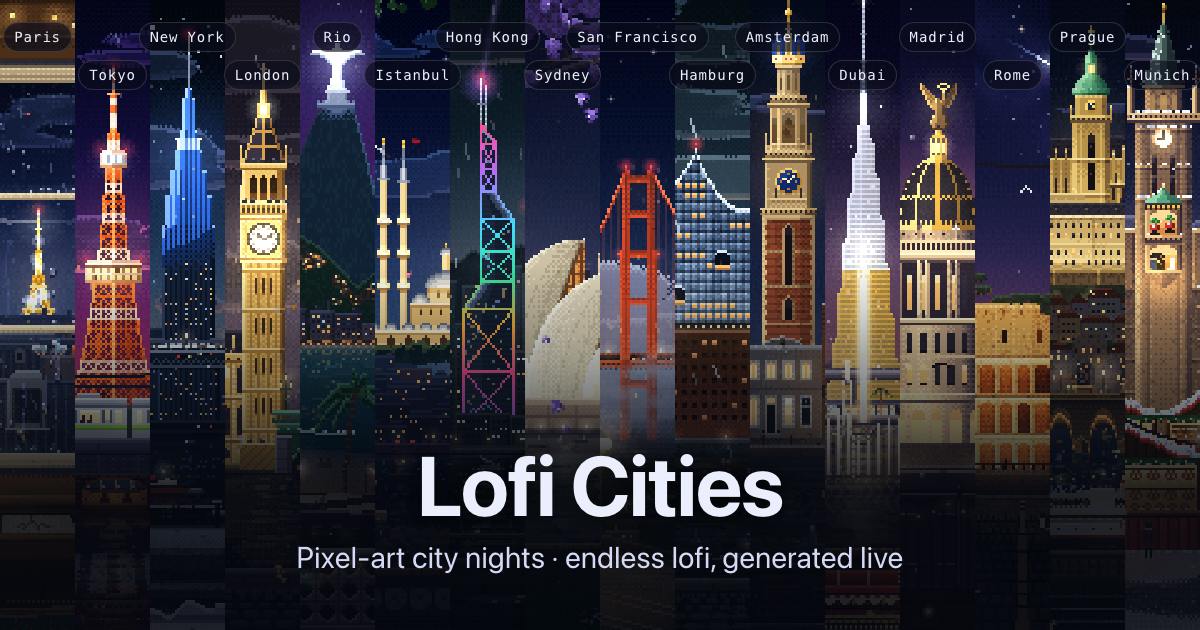
Its core pitch is refreshingly simple: open your browser, step into one of 16 hand-drawn pixel-art city nightscapes, and let endlessly non-repeating Lofi music play. For users who need long stretches of focus or help falling asleep, this combination of "visual white noise + music" hits exactly the right spot.
Feature Breakdown: More Than Just Background Music
Infinite Lofi Music Generation
Unlike similar products that play from a fixed library, Lofi Cities music is live-composed directly in the browser, meaning it theoretically never loops or repeats. The app offers 9 music styles to switch between, letting users match the vibe to their current mood or task. This "infinite stream" design reduces listening fatigue over long sessions and is a key differentiator from ordinary Lofi playlists.
Browser-based real-time music synthesis typically relies on the Web Audio API — a low-level audio processing interface built into modern browsers that lets developers generate oscillating waveforms, layer filters, and control volume envelopes using JavaScript, without downloading any audio files. The defining sonic characteristics of Lofi (tape noise, low-pass filtering, subtle pitch drift, jazz chord progressions) can all be parameterized algorithmically, so each playback session produces slightly different melodies, rhythms, and timbral details — creating a "never-quite-the-same" listening experience. This is architecturally distinct from streaming a fixed MP3: here, the "library" is a set of generative rules rather than a finite collection of audio assets. Because the music logic runs locally, the app continues to work even without an internet connection.
Customizable Scene Atmosphere
Beyond music, Lofi Cities gives users meaningful control over their environment:
- 16 dynamic cities: Each is a unique pixel-art nightscape with animated elements
- Weather switching: Change the weather state of your city, shifting the overall visual mood
- City sound mixing: Layer ambient city sounds to deepen immersion
- Focus / Sleep timers: Built-in focus and sleep timers serve Pomodoro workflows and bedtime routines directly
This combination elevates the product from a simple music player to a full "focus environment builder."
Light Social: Release Lanterns Together
The product also features a restrained social layer. Users can see how many others are currently in the same city, send floating emoji reactions, and even release lanterns together with strangers. This asynchronous, non-intrusive interaction creates a sense of companionship — "I'm not focusing alone" — without disrupting concentration. The balance is well-calibrated.
This design pattern is often called "para-social presence" in interaction research — users perceive the existence of others without needing to communicate directly. Similar mechanics appear in products like Focusmate (video-paired focus sessions) or StudyStream (live study rooms), where research shows this subtle sense of "being witnessed" meaningfully improves task persistence. Lofi Cities opts for a lighter implementation: a real-time online user count plus asynchronous animated reactions. It preserves the sense of companionship while eliminating any possibility of social anxiety — users don't need to perform, respond, or engage. They simply know that "someone is here with me right now." The lantern imagery itself carries cultural connotations of wishes, relaxation, and ritual — perfectly aligned with the app's sleep and focus positioning.
Product Positioning and Technical Highlights
Lofi Cities is listed under both the Productivity and Music categories, which reflects its dual nature: it's simultaneously an ambient music tool and a focus aid.
Notable about its accessibility design: completely free, no account required, and works offline after the first visit. Offline capability means the music generation and scene rendering rely heavily on local front-end processing — a significant engineering investment for a browser app, and one that keeps it functional even in unstable network conditions. The product is also mobile-friendly, making it easy to start a "city tour" anywhere, anytime.
Offline functionality is typically implemented using PWA (Progressive Web App) technology: a Service Worker caches critical resources locally on the user's first visit, so subsequent visits load directly from cache without a network request. PWAs also support "Add to Home Screen," making the launch experience feel close to a native app. For a product like Lofi Cities that heavily depends on visual and audio assets, the PWA caching strategy is critical — balancing offline availability of core features against keeping the initial cache size small enough for fast loading. This is why the product can be both "install-free" and "offline-capable" — properties that might seem contradictory at first glance.
Who Is It For?
Based on its feature design, Lofi Cities primarily targets three groups:
- Students and remote workers who need long focus sessions: The timer plus infinite music suits deep work scenarios
- Users who need help sleeping: The sleep timer paired with soothing city nightscapes can serve as a sleep aid
- Pixel art and ambient experience enthusiasts: Those who want to enjoy it as an interactive "digital bonsai"
As a solo project by indie developer Safa Elmali, Lofi Cities doesn't pile on features — it builds a solid, cohesive experience around the single core idea of "immersive focus atmosphere." In a crowded Lofi space, the combination of real-time music generation and light pixel-art social interaction genuinely offers something fresh.
Wrap-Up
Lofi Cities is the kind of product that needs no instruction manual — open the page, pick a city, hit play, and let the atmosphere do the rest. Its value isn't in feature count, but in how seamlessly it weaves together music, visuals, and light social presence into just the right sense of companionship. For anyone looking for a focus or sleep background, it's absolutely worth trying — especially given its zero-barrier entry: free, no sign-up, and offline-capable.
Related articles

Gaussian Process Bandit Optimization: Exploration Strategies and Inference Regret Guarantees
Cumulative regret guarantees in Bayesian optimization fail to reflect final recommendation quality. This article examines a new study that provides inference regret guarantees for Gaussian process bandit optimization through exploration query strategies and fill distance analysis, validated on hyperparameter optimization and control tasks.

The Most Detailed Codex Guide on Bilibili: From Installation to Real-World Practice
The most detailed Codex guide on Bilibili: from app store installation to daily work mode configuration, with a real coffee shop project demonstrating file organization, data extraction, dashboard creation, and other practical tasks. Learn to use Plan Mode and desktop pets to leverage Codex efficiently.

Appearance Compensation in Volume Rendering: Why RGB Accuracy Cannot Guarantee Density Correctness
Volume rendering research reveals that volumetric data perfectly reproducing external RGB views may still contain density errors: appearance compensation can double central density and keep external rays unchanged even when L2 error exceeds 14.52%. Density recovery depends on appearance capacity, spatial resolution, and measurement design.