Loop Engineering: A Complete Method for AI to Execute, Check, and Correct Itself
Loop Engineering lets AI execute, check, and correct itself using goals, acceptance criteria, checks, and budgets.
Loop Engineering evolves beyond prompt engineering by structuring AI tasks with four core components: Goal, Acceptance Criteria, Checks, and Budget. Inner loops manage single-task quality through self-verification, while outer loops handle execution frequency for true automation. This feedback-driven approach, rooted in cybernetics and CI/CD principles, lets AI autonomously iterate toward quality targets while keeping humans in the loop for critical decisions.
From Writing Prompts to Babysitting Workflows: A Familiar Pain Point
You've probably been through this: you spend half a day crafting an elaborate prompt, then after the AI responds, you nitpick every detail—this part has flawed logic and needs rewriting, that part lacks evidence and needs supplementing, the structure is too messy and needs reorganizing. After five or six rounds, the result has genuinely improved, but you've been glued to your screen the entire time.
AI saved you the time of typing, but it didn't save you the time of babysitting the process.
Recently, some people have declared "prompts are dead." That's a bit of an overstatement, but it does point to an obvious shift: we used to focus on "how should I phrase this round of questions," but now what's more worth studying is "how to let AI execute, check, correct, and execute again on its own." According to an analysis by Bilibili creator Sanjiu, this approach can be called Loop Engineering.
Why Loop Engineering Is Only Possible Now
Early models had limited comprehension and action capabilities. You could only stuff roles, context, steps, and formatting all into a single prompt, betting everything on one input.
But the latest generation of models can decompose tasks, invoke tools, read results, spot errors, and try alternative approaches. Behind these capabilities is the maturation of AI Agent technology. Before 2023, large language models primarily operated in conversational mode—users input text, models return text, and the entire process consisted of single-turn or multi-turn text exchanges. Starting with GPT-4, OpenAI introduced the Function Calling mechanism, allowing models to proactively invoke external functions during conversations—such as searching the web, reading files, executing code, or querying databases. Anthropic's Claude achieved similar capabilities through Tool Use. These abilities transformed AI from a mere "chatbot that answers questions" into an autonomous agent capable of executing multi-step workflows. Since it already possesses these action capabilities, you can hand over the feedback process that you used to do manually.
Loop Engineering didn't emerge from thin air—it shares deep roots with Cybernetics and the feedback loop concepts in software engineering. As early as the 1940s, Norbert Wiener introduced the concept of negative feedback control: a system's output is fed back to the input, compared against the desired value to produce an error signal that drives continuous correction. The CI/CD (Continuous Integration/Continuous Delivery) pipelines in modern software development follow the same logic—after code is committed, it's automatically compiled and tested; if tests fail, the merge is blocked. Loop Engineering essentially applies this industrial-grade feedback thinking to AI task execution: instead of relying on one perfect input to determine success or failure, you converge toward the goal through multiple rounds of detection and correction.
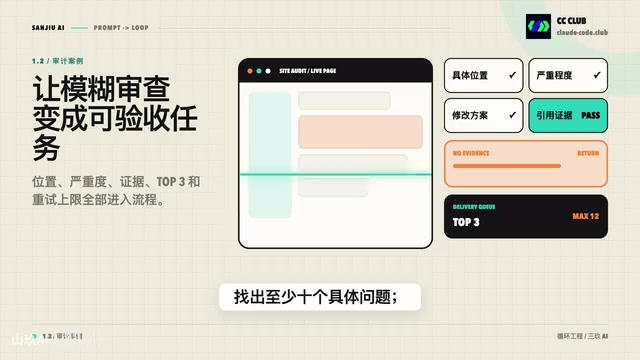
Here's an example. Say you want AI to audit a website. If you just say "take a look and tell me what's wrong," it might give you a dozen suggestions: some are useful, some are vague, and a few might not even match the actual page. Quality control is still in your hands—you have to follow up with "where exactly?" "which three items have the most impact on conversion?" "is there anything we can ship today?"
The Four Core Components of Loop Engineering: Goal, Acceptance Criteria, Checks, Budget
With the loop approach, you spell everything out from the start: read the website's pages and code, identify at least ten specific issues with severity ratings and exact locations; provide actionable fix recommendations ranked by revenue impact, selecting the top three; every suggestion must cite content that already exists on the site; after completion, run a self-check—if any empty placeholders, factual errors, or missing evidence are found, go back and fix them; attempt a maximum of twelve rounds, stop when publication-ready standards are met, and deliver a report.
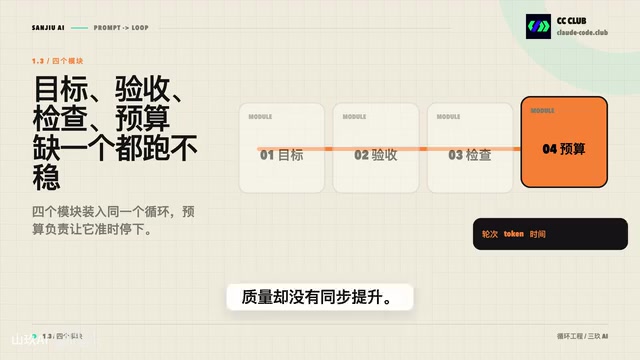
This set of rules contains four parts. Just remember four words: Goal, Acceptance Criteria, Checks, Budget.
Goal: Define the Deliverable
What's the final deliverable? A website audit report, ten video topic ideas, or a cleaned data table? The clearer the deliverable, the easier it is for AI to determine whether the task is truly complete.
Acceptance Criteria: Turn Standards into Quantifiable Checklists
"Write it better" or "make the analysis deeper" are nearly impossible to verify. Replace them with specific conditions: how many items total, what fields each item must have, whether sources need to be cited, what sorting rules to follow, and what content must not appear. These conditions become the "ruler" in AI's hands.
This practice of operationalizing acceptance criteria borrows from the concept of "Assertions" in software testing. In unit tests, developers write explicit assertion statements: a function's return value must equal a certain value, an array's length must be greater than zero, a string must contain specific keywords. If an assertion fails, the test doesn't pass. Acceptance criteria in Loop Engineering play the same role—they transform the vague question of "is it good enough?" into boolean judgments that can be checked item by item: Is a source cited? Does the quantity meet the target? Does it contain content that's forbidden? This mindset shifts AI's self-checking from "generate another version that looks different" to "compare item by item against predetermined conditions."
Checks: Verify, Don't Just Regenerate
After a round is complete, how does AI verify the results? It might re-read the original materials to find gaps, run tests to see if code passes, or cross-reference data sources to confirm conclusions are supported. Simply having the model regenerate often just produces "another version of the answer." Adding a checker gives each round a real chance to move closer to the acceptance criteria.
Budget: Set Boundaries to Prevent Runaway Loops
How many attempts maximum, how many Tokens to consume at most, how long to run at most. Tokens here are the basic units large language models use to process text—they're not simply equivalent to a single character or word. In English, a common word typically corresponds to 1-2 Tokens, while in Chinese, due to different encoding methods, a single character might consume 1.5-2 Tokens. Every model invocation calculates the total input and output Tokens, and API pricing is based on this. When Loop Engineering has AI repeatedly executing, checking, and correcting, each round generates new Token consumption. Setting budget boundaries isn't just about preventing logical runaway—it's a hard constraint directly tied to usage costs.
A loop without boundaries might keep retrying, burning through your quota without a proportional improvement in quality. So when the limit is reached, stop—and clearly state what was completed and where things are stuck.
The Difference Between Inner Loops and Outer Loops
Once you understand the four components, you need to distinguish between two types of loops: one manages "the quality of this task," and the other manages "how often this task runs."
This nested relationship between inner and outer loops has broad analogies in computer science. An operating system's scheduler is a classic two-level loop structure: the outer loop uses time-slice round-robin scheduling across different processes, while the inner loop is the instruction execution cycle within each process. In DevOps, the outer loop corresponds to release cycles (deploying once per week), while the inner loop corresponds to the build-test-fix workflow within each deployment. The key to understanding this nested relationship is: the outer loop determines "when to start," the inner loop determines "how to do it well"—their responsibilities are distinct but tightly coordinated.
Inner Loop: Managing Single-Task Quality
The inner loop addresses "how to make this task pass muster." Using the website audit example again: when AI reads pages and finds some content failed to load, it adjusts its approach and retries; after generating recommendations, it checks each one against the criteria—any suggestion without evidence gets deleted or rewritten. All of this happens within a single task execution.
Outer Loop: Managing Task Execution Frequency
The outer loop addresses "how often should this task run again." For example, you track five YouTube channels daily—AI records new videos' titles, topics, thumbnails, and view performance, then updates findings to a fixed document, executing once per day. During each execution, it still internally reads, analyzes, checks, and corrects—the outer loop has an inner loop nested inside it. If you only have an outer loop (scheduled execution) without an inner loop (quality checks), you'll produce a large volume of low-quality results. If you only have an inner loop without an outer loop, you'll need to manually trigger it every time, making true automation impossible.
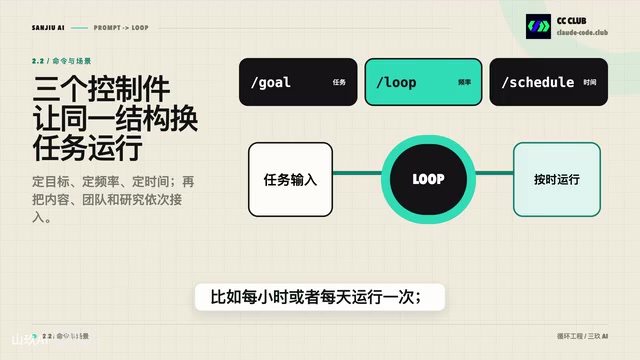
In AI coding tools that support relevant commands, Go, Loop, and Schedule correspond to three things: Go defines the task goal and completion criteria, Loop defines the execution frequency (such as hourly or daily), and Schedule specifies the exact time (such as 6 AM every day). Commands may change across tool versions, but the sequence is stable: first define the task, then define acceptance criteria, then decide when to run it.
Typical Scenarios Where Loop Engineering Can Be Applied
Once the structure is in place, many types of work can fit into it:
- Content Creation & Competitive Analysis: Regularly collect new videos from benchmark accounts, record opening hooks, content formats, and comment feedback, and analyze which structures repeatedly appear.
- Team Project Management: Regularly compile updates from project channels, summarize progress, responsible parties, blockers, and pending decisions—verify message sources before generating output.
- Market Research & Intelligence Monitoring: Periodically scan designated information sources, preserve original links, and sort by impact level. What you see each day is a curated incremental update—no need to manually sift through all the news.
Loops can also help AI "learn your working style." For instance, to train writing skills, have it periodically analyze new content from a specific account, extract article structure, sentence length, opening techniques, and argumentation patterns, then update verified patterns to a skills file. But note: learning style doesn't mean copying content. Only extract reusable structural features—new content should still come from your own perspectives, experiences, and materials.
Even AI Automation Needs Boundaries: Human Confirmation Checkpoints
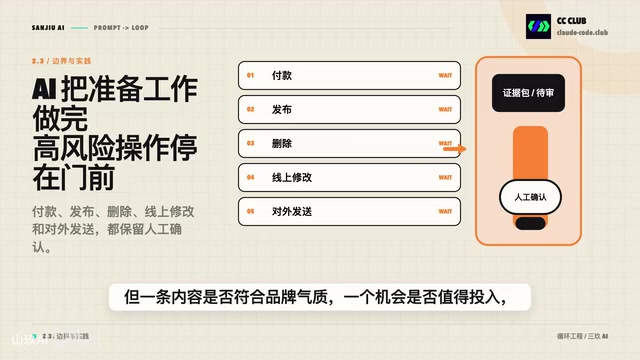
No matter how powerful the automated execution, you should retain human checkpoints. Payments, publishing, file deletion, modifications to production systems, outbound messages—these actions should keep a human confirmation step. AI can prepare the evidence, risks, and change details, then pause at the final step before execution, waiting for your decision.
This principle is known in AI safety and human-computer interaction as "Human-in-the-Loop," originating from military and aviation domains—automated systems can handle most operations, but critical decision points must be confirmed by humans. The U.S. Department of Defense's 2012 directive on autonomous weapons systems explicitly requires that lethal decisions retain a human judgment step. This principle has been widely adopted in AI product design: takeover mechanisms in autonomous driving, assistive (rather than autonomous) diagnosis in medical AI, and trade approval workflows in financial AI. Retaining human confirmation nodes for critical operations in Loop Engineering is the concrete application of this principle in AI workflow automation.
Creative judgment, business direction, and value trade-offs also need regular human calibration. AI can check formatting, facts, and rules, but whether a piece of content fits the brand's tone, or whether an opportunity is worth pursuing—those calls are still yours to make.
How to Start Your First Loop Engineering Practice
If you want to try it out, pick one task from the past week—ideally something that's frequent, low-risk, has fixed inputs and outputs, and is easy to recover from if done wrong.
Then write down four lines:
- What result do I want? (Goal)
- What counts as passing? (Acceptance Criteria)
- How will it be checked? (Check Mechanism)
- How many runs maximum? (Budget Boundary)
Start with one inner loop. Once results are stable, add scheduled execution to turn it into an outer loop. Don't rush to build a 24/7 AI system that handles everything; get one small task running reliably first, then gradually expand tool permissions and scope. Every time you add a capability, add corresponding checks and stop conditions.
Prompts are still useful, of course—they're just more like "the entry point that kicks off a workflow" now. What's truly worth practicing is defining goals, designing acceptance criteria, configuring tools, controlling permissions, and letting the system safely try again after failure. You don't have to stay glued to the chat window. Write the feedback into the task, let AI push forward within boundaries, and have it hand questions back to you when judgment calls are needed.
From Prompt Engineering to Loop Engineering—that's where the shift is.
Key Takeaways
Related articles

DeepCell: One-Click AI Generation of Documents, Spreadsheets, and Slides
DeepCell tops Product Hunt with one-click generation of documents, spreadsheets, and slides, using the .deepcell format for linked updates, designed for System 2 tasks like modeling and sales reviews.

Doneas: 15-Minute Daily Accountability Calls That Keep Indie Developers From Procrastinating
Doneas is a daily accountability tool for indie developers: plan tasks on Monday, join a 15-minute call with five builders each day, and log deliveries on a public progress page. This article analyzes its core mechanics, effectiveness, and potential issues around retention and matching.

Fastlane 2.0: Fully Automated AI Ad Campaigns, From Creative to Optimization
Fastlane 2.0 is an AI ad automation tool: enter your website and it learns your brand, generates video and image ads, and runs and optimizes them on Meta, TikTok, Instagram, and YouTube.