Loop Engineering Explained: From Agent Loops to a New AI Development Paradigm

Loop Engineering systematizes the design of Agent think-act loops as a new AI development methodology.
Loop Engineering is a newly coined AI development concept that formalizes existing practices around Agent Loops. It focuses on engineering the iterative think-act cycles that power intelligent agents—covering loop structure design, memory management, stopping criteria, and the evolution from simple While loops to Graph-based architectures like LangGraph. While not a disruptive innovation, it provides developers with a structured framework for building more efficient and controllable AI agent systems.
What is Loop Engineering?
Loop Engineering is an AI development concept that has only recently gained traction—going from introduction to widespread discussion in barely a week. While the term is new, the underlying ideas are not. Many engineers working with large language models have likely been practicing loop-related development in their daily work without abstracting it into an explicit methodology.
To understand Loop Engineering, you can't look at the term in isolation. It needs to be examined within the context of AI Agent development over the past few years. From early Prompt Engineering, to the Harness Engineering buzz at the beginning of the year, to today's Loop Engineering, this evolutionary trajectory reflects developers' ongoing exploration of a core question: "How can we better harness the capabilities of large language models?"
The relationship between these three is worth understanding deeply: Prompt Engineering was the hottest AI development paradigm from 2022–2023, with the core idea of guiding LLM outputs through carefully designed input prompts, including techniques like Few-shot (few-shot examples) and Chain-of-Thought. Harness Engineering, promoted by companies like Anthropic in early 2025, emphasizes how to "harness" LLM capabilities through systematic constraints, guardrails, and orchestration mechanisms for reliable operation in production environments. Loop Engineering takes this a step further, focusing on the engineering design of loop structures themselves—no longer optimizing single interactions, but rather the overall efficiency and controllability of multi-turn iterative processes.
So, will Loop Engineering have the same massive impact as ChatGPT or Harness Engineering? The answer is probably no. It's more of a systematic naming and theoretical distillation of existing development practices rather than a disruptive innovation. But that doesn't make it unimportant—understanding it helps developers more clearly recognize where they stand in the current technical landscape.
Starting with Agent Loops: Understanding the Core of Agentic Cycles
To explain Loop Engineering clearly, we must first address a more fundamental concept: Agent Loop.
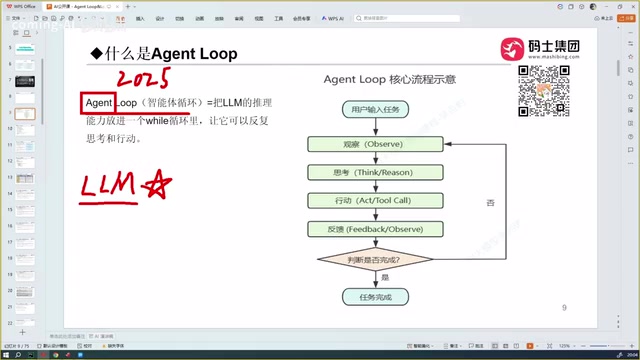
The Essential Difference Between Agents and LLMs
Many people tend to conflate Agents with LLMs, but there's a key difference. LLMs can also "call tools," but this process requires human intervention—after the LLM reasons about which tool to call, a human needs to manually execute it and feed the results back.
The core capability of an Agent lies in its autonomy: it can independently determine whether it needs to call a tool, which tool to call, and after receiving the tool's results, continue reasoning about whether it needs to call another tool for more information, or whether it can already provide the user with a final answer. This self-driven decision loop is the essence of an Agent.
From a technical implementation perspective, an Agent's autonomy relies on the LLM's Function Calling capability. In June 2023, OpenAI pioneered structured function calling interfaces in GPT models, enabling the model to output tool invocation instructions in JSON format rather than natural language descriptions. Subsequently, Anthropic's Claude, Google's Gemini, and other models also added this capability. In Agent architectures, this ability is encapsulated as the Tool Use protocol—the model not only identifies when a tool needs to be called but also correctly fills in parameters, while the system handles automatic execution and injects results into the conversation context without manual intermediation. This end-to-end automation is the key technical pillar that distinguishes Agents from ordinary chatbots.
Additionally, Agents possess contextual memory capabilities. While LLMs can also manage memory, this again requires manual human execution, whereas Agents internalize memory management into their own operational flow. Modern Agent frameworks typically implement multi-layer memory architectures: Working Memory stores the immediate context of the current task, such as the current conversation history and tool call results; Long-term Memory persistently stores cross-session knowledge and user preferences via vector databases; Episodic Memory records patterns from past successfully completed tasks for reference in future similar tasks. State management involves how to maintain and update this information during each iteration of the loop while keeping the context window within the model's Token limit. Common strategies include summary compression, relevance filtering, and sliding window truncation.
The Think-Act Cycle of an Agent Loop
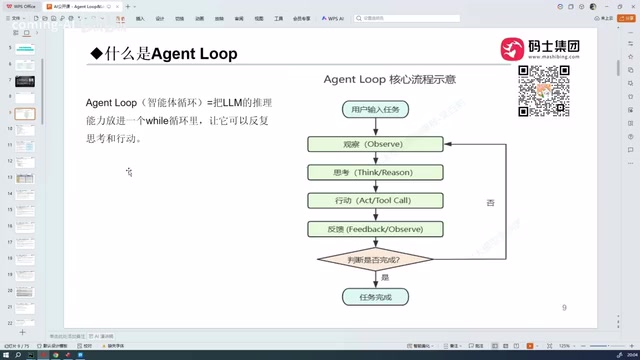
The essence of an Agent Loop is a continuously iterating "think-act-think-act" cycle. It can be summarized in one sentence: an Agent repeatedly calls an LLM within a loop structure.
The specific operational flow is roughly as follows:
- After user input, the LLM observes the input and thinks
- It determines whether to answer directly or call a tool
- If a tool call is needed, it executes the call and returns the result
- It judges again: continue calling tools, or provide a final response
- If the stopping criteria are met, the conversation ends; otherwise, the loop continues
This "whether to terminate" judgment is crucial—it determines when a conversation is truly complete. Designing Stopping Criteria is one of the most challenging engineering problems in Agent Loops. Poor design leads to two typical failures: first, "infinite loops" where the Agent repeatedly calls tools but cannot converge to a final answer, consuming massive amounts of Tokens and compute resources; second, "premature termination" where the Agent provides a response with insufficient information, resulting in low-quality answers. Common stopping strategies in the industry include: maximum iteration count limits (hard safety net), model self-judgment (relying on the model to output special termination markers), confidence thresholds (stopping when the model's certainty about the answer reaches a threshold), and semantic judgment based on user intent matching. In practice, multiple strategies often need to be combined.
Throughout the entire process, the thinking cycle continues until the Agent determines the user has received the desired result.
From While Loops to Graphs: The Technical Evolution of Agent Frameworks
Using LangChain, a mature agent development framework in the industry, as an example, we can clearly see the evolution of Agent Loop implementations.
Early Approach: Naive While Loop Implementation
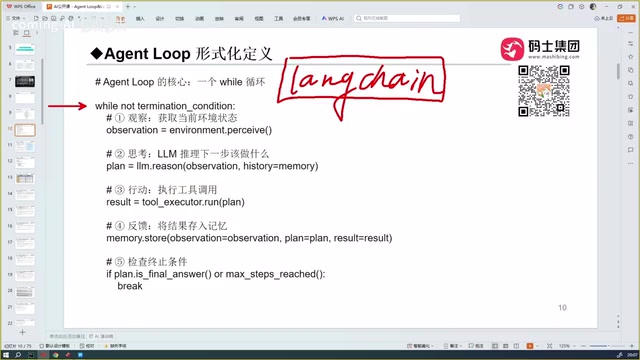
In its early versions, LangChain implemented Agent Loops in a very straightforward way—simply a While loop. The code logic was roughly:
- Get the user's question and current environment state
- Think about the next step: call a tool, or reply directly to the user
- Maintain memory (context) during execution
- Check stopping criteria: if the user is deemed satisfied, terminate the current loop
- If stopping criteria aren't met, continue looping from step two, repeatedly calling tools
This While loop-based implementation is simple and intuitive—the most primitive form of Agent development. Although it's now considered "past tense," it clearly reveals the core mechanism of agentic loops.
Current Trend: Shifting to Graph Structures
You may not have noticed, but current versions of LangChain no longer use simple While loops to implement Agent Loops—instead, they've shifted to Graph flow structures. This transition from linear loops to graph structures reflects the increasing demands for complexity and controllability in agent systems—graph structures can more flexibly express flow relationships and branching logic between nodes.
This shift has deep technical motivations. While loops are inherently linear—each iteration has only two branches: "continue" or "terminate," making it difficult to express complex multi-path decisions. Real-world Agent systems often need: parallel invocation of multiple tools followed by result merging, dynamic strategy switching based on intermediate results, collaboration and communication between multiple sub-Agents, and breakpoint mechanisms that support Human-in-the-Loop intervention. Graph structures naturally support these patterns—each node represents a processing step, edges represent state transition conditions, and state flows between nodes. LangChain launched the dedicated LangGraph sub-framework for this purpose, allowing developers to define nodes and edges declaratively while the framework automatically handles state persistence, breakpoint recovery, and concurrency control. This is also why frameworks like Microsoft's AutoGen and CrewAI have adopted similar graph orchestration concepts—graph structures have become the de facto standard architecture for complex Agent systems.
The Positioning and Practical Value of Loop Engineering
Once you understand Agent Loops, Loop Engineering's positioning becomes clear. It's essentially a methodology centered around "how to design, optimize, and engineer agentic loops."
For engineers already working on LLM development, the problems Loop Engineering addresses may have already been encountered in practice—how to design more efficient think-act cycles, how to manage memory and state within loops, how to optimize stopping criteria judgments, and how to integrate into existing systems to achieve a complete closed loop from open to close.
Specifically, the core engineering problems Loop Engineering focuses on include: loop granularity design (how large a task unit each iteration should complete), error recovery mechanisms (how to gracefully fall back or retry when a tool call fails), observability (how to monitor and trace the execution state of each step in the loop for debugging and optimization), and cost control (each loop iteration means one or more LLM API calls—how to balance quality and cost). None of these problems are entirely new, but systematically organizing them into an engineering discipline helps form reusable best practices and design patterns.
How Should Developers Approach Loop Engineering?
Loop Engineering is unlikely to deliver ChatGPT-level industry impact, but it provides AI developers with a valuable thinking framework. Developers shouldn't blindly chase new trends, but rather calmly assess: can this concept help them better organize their existing Agent development work?
For beginners, understanding the basic principles of Agent Loops is the first step to getting started. For experienced developers, Loop Engineering as a concept can help them re-examine and systematize their existing development practices. The value of a technical concept often lies not in how novel it is, but in whether it helps us understand problems more clearly and solve them more efficiently.
Key Takeaways
Related articles

Alguard: Building a Dual-Layer Trust Defense for AI Agent Shopping
Alguard, an Amazon Developer Hackathon project, designs a dual-layer trust architecture for Alexa+ agent shopping. Through physical isolation between an MCP server and a human approval channel, it replaces prompt defenses with structural constraints to block unauthorized purchases caused by prompt injection.

Food Poisoning: Causes, Symptoms, Treatment, and Prevention Explained
Food poisoning is caused by bacteria, viruses, parasites, or toxins contaminating food, with common symptoms including vomiting, diarrhea, and dehydration. This article explains the causes, symptoms, treatment, and prevention of food poisoning to help you safeguard food safety.

Meta Uses LLMs to Make Facebook Feed Customizable
Meta launches LLM-powered algorithm personalization for Facebook and Reels, letting users manage interests via menu and customize feed with a text box.