LoopAhead: Speeding Up Recurrent Language Model Decoding by 7.82x
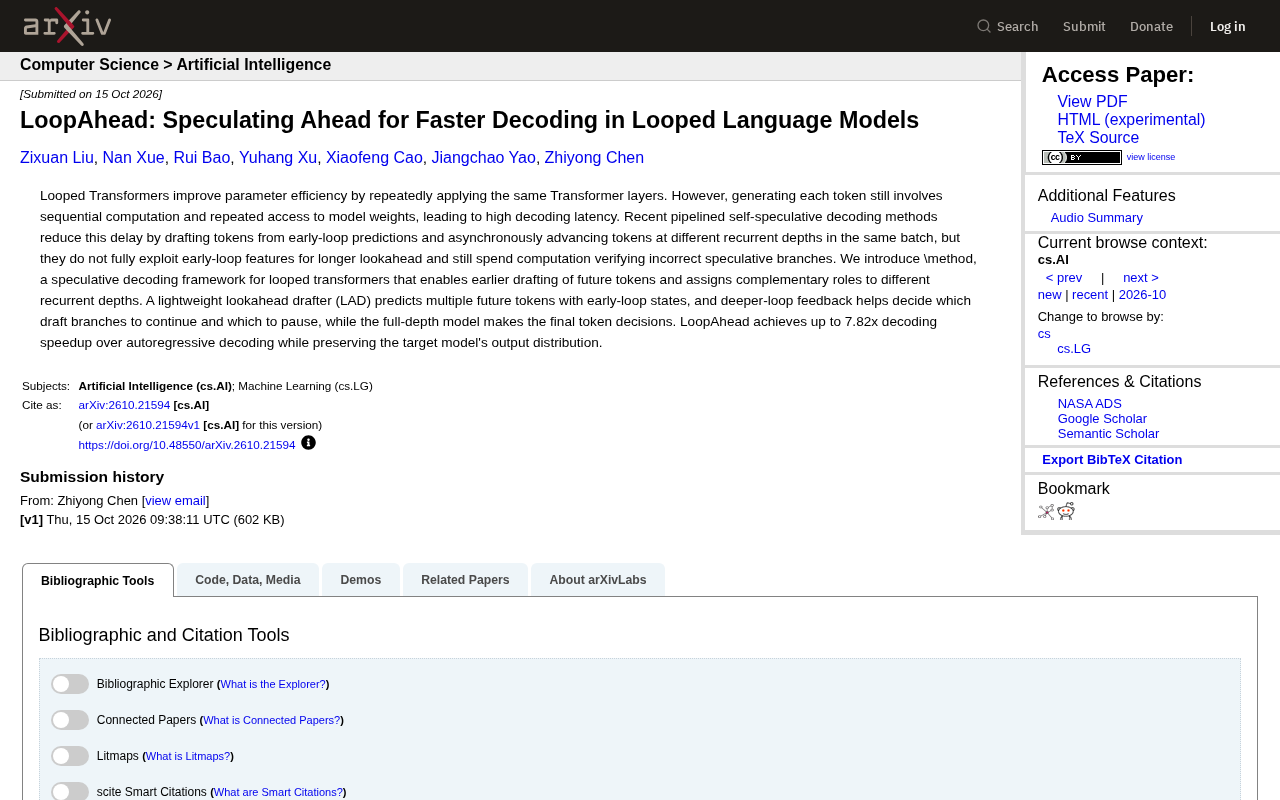
LoopAhead uses early recurrent states for lookahead drafts and deep feedback pruning to accelerate recurrent Transformer decoding by up to 7.82x without changing the output distribution.
Recurrent Transformers improve parameter efficiency via weight sharing, but serial decoding and repeated memory access make inference latency a deployment bottleneck. LoopAhead proposes a speculative decoding framework for recurrent architectures: a lightweight lookahead drafter (LAD) uses early recurrent states to predict multiple future tokens at once, lengthening the lookahead window; deep recurrent feedback decides which draft branches to keep, reducing wasted verification of wrong guesses; and final tokens are still adjudicated by the full-depth model, ensuring the output distribution is unchanged. The three complementary roles yield up to 7.82x decoding speedup over autoregressive decoding. The article stresses that this figure is an upper bound under specific settings, with actual gains varying by task, batch size, and hardware, and that drafter training cost and scheduling overhead must also be considered for deployment.
Recurrent Transformers improve parameter efficiency by repeatedly invoking the same set of layers, but generating each token still requires serial computation and repeated reads of model weights, resulting in persistently high decoding latency. LoopAhead proposes a speculative decoding framework for recurrent Transformers: a lightweight lookahead drafter predicts multiple future tokens at once, allowing different recurrent depths to take on complementary roles, and boosting decoding speed up to 7.82x that of autoregressive decoding without altering the target model's output distribution.
The Advantages and Costs of Recurrent Models
The core idea of a recurrent Transformer is weight sharing: the same set of Transformer layers is applied repeatedly to form a looped structure. Parameter count no longer grows linearly with depth, yet stronger expressive capacity can be obtained at inference by running more recurrent steps. This design is highly cost-effective in terms of parameter efficiency and suits edge or resource-constrained scenarios.
The problem lies in decoding. Autoregressive generation is inherently serial — every token produced goes through a full forward computation. Recurrent models must further repeatedly access the same weights on top of this, adding computation and memory access overhead, which makes decoding latency the primary bottleneck in real deployments. Existing pipelined self-speculative decoding attempts to alleviate this: early recurrent predictions serve as draft tokens, and different recurrent depths advance asynchronously within the same batch. But such methods do not fully exploit early recurrent features, offer limited lookahead length, and still spend substantial computation verifying incorrect speculative branches.
Speculative Decoding is a general class of lossless acceleration techniques for autoregressive generation. Its basic flow has two steps: a cheap "draft model" quickly generates several candidate tokens, then the target model verifies this batch in parallel within a single forward pass. The verification rule guarantees that the final sampled results are distributionally equivalent to direct autoregressive sampling from the target model — accepted tokens are retained as usual, and all tokens after the first rejected position are discarded and resampled by the target model. Hence speculative decoding is "lossless": it does not change the output distribution, only how computation is organized. Its speedup depends on the product of two factors: the draft acceptance rate and the average length of accepted tokens. The more accurate the draft and the longer the lookahead, the more tokens the target model can "confirm" in a single forward pass, and the more pronounced the reduction in serial steps. LoopAhead essentially belongs to this paradigm, with the difference that its drafts do not come from an independent small model, but from the recurrent Transformer's own early recurrent states.
Each Recurrent Depth Plays Its Part
LoopAhead's key design is to assign complementary responsibilities to different recurrent depths rather than having them duplicate effort.
Lightweight Lookahead Drafter (LAD)
LAD is a lightweight module dedicated to predicting multiple future tokens from early recurrent states. It plays the "exploration" role: to propose candidate token sequences as early and as far ahead as possible, buying a longer time window for subsequent decisions. Because it relies only on early recurrent features, LAD's own computational cost is very low.
Deep Feedback Decides Which Branches to Keep
The multiple candidate branches produced by the drafter are not treated equally. Feedback signals from deeper recurrence determine which draft branches are worth pursuing and which should be paused. This directly reduces wasted verification on incorrect speculative branches — precisely the main source of waste in prior pipelined self-speculative methods.
Tree-based Speculative Decoding is a common approach to improving draft utilization: rather than keeping only a single linear draft chain, generate multiple branches simultaneously to form a candidate token tree. The target model verifies all paths in the tree in parallel in a single forward pass and selects the branch with the longest accepted length as output. The benefit is that even if one path is rejected midway, other branches may still succeed, increasing the effective number of accepted tokens per forward pass. The cost is that verification computation grows with tree width; if many branches are ultimately rejected, compute is wasted on invalid paths. LoopAhead's deep feedback mechanism is designed precisely to mitigate this waste: pruning ahead of time using signals from deeper recurrence so that the verification budget is concentrated on branches more likely to be correct, rather than verifying all candidates indiscriminately.
Full-Depth Model Makes the Final Decision
Final tokens are still determined by the full-depth model. Drafts and intermediate feedback are only acceleration means and do not change the output distribution. This is also the basic guarantee of speculative decoding methods: acceleration must not come at the expense of generation quality.
What 7.82x Acceleration Means
LoopAhead's reported peak 7.82x decoding speedup is achieved while keeping the target model's output distribution unchanged. This point matters more than the speed number itself — a consistent output distribution means downstream applications need not retune parameters and will not suffer uncontrolled quality drift due to acceleration.
In terms of method composition, LoopAhead does three things at once: lengthen the draft window, concentrate verification computation on more likely correct branches, and divide work among different recurrent depths according to capability. The combined effect of the three is more pronounced than optimizing any one alone.
Speedup in decoding scenarios is typically defined as the ratio of autoregressive baseline decoding time to the decoding time of the accelerated method, i.e., the relative shortening of wall-clock time, rather than pure FLOPs savings. It is affected by both compute latency and memory access latency — for architectures like recurrent Transformers that repeatedly read the same weights, memory bandwidth often becomes the bottleneck before raw compute, so reducing serial steps may yield greater benefits than reducing total computation. Moreover, speedup depends heavily on batch size: the smaller the batch, the more single-step computation is bound by memory bandwidth, and the easier it is for speculative decoding's parallel verification advantage to show; the larger the batch, the more computation shifts toward being compute-bound, diluting the benefit. This also explains why the paper's reported 7.82x is a peak under specific settings, not a universal constant.
Implications for Deploying Recurrent Architectures
Recurrent Transformers have long faced the awkward situation of "saving parameters in training but not time in inference." The advantage in parameter efficiency holds in training and storage, but at inference it is offset by serial decoding. LoopAhead's value lies in filling this gap at the decoding strategy level without changing the recurrent model's structure.
For teams hoping to deploy large models on limited hardware, this route offers a possibility: use recurrent structures to control parameter scale and speculative decoding to control inference latency. The two optimization directions are no longer in tension.
It is worth noting that the actual gains of such methods vary with task type, batch size, and hardware conditions; 7.82x is an upper bound under specific settings and is not reproducible in all scenarios. The drafter's training cost and the scheduling overhead of deep feedback are also factors to consider when evaluating deployment feasibility.
FAQ
Does LoopAhead change the model's output results? No. It keeps the target model's output distribution unchanged; drafts and branch decisions are only acceleration means.
Is it only applicable to recurrent Transformers? By design, LoopAhead targets the recurrent depth characteristics of recurrent Transformers, using early recurrent states for lookahead drafting, which differs from speculative decoding ideas for standard Transformers.
Does the 7.82x speedup hold in all scenarios? No. This is the highest value reported in the paper; the actual speedup depends on the task, batch size, and hardware configuration.
One-line Summary
LoopAhead uses early recurrent states for lookahead drafts and deep feedback for pruning, accelerating recurrent Transformer decoding by up to 7.82x without changing the output distribution.
Paragraph Summary
Recurrent Transformers improve parameter efficiency through weight sharing, but serial decoding and repeated memory access make inference latency a deployment bottleneck. LoopAhead proposes a speculative decoding framework for recurrent architectures: a lightweight lookahead drafter (LAD) uses early recurrent states to predict multiple future tokens at once, lengthening the lookahead window; deep recurrent feedback determines which draft branches to keep, reducing wasted verification on incorrect speculative branches; and final tokens are still decided by the full-depth model, ensuring the output distribution is unchanged. The three roles are complementary, enabling decoding speeds up to 7.82x that of autoregressive decoding. The article also emphasizes that this number is an upper bound under specific settings; actual gains vary with task, batch size, and hardware conditions, and drafter training cost and scheduling overhead must also be factored into deployment evaluation.
Related articles

Amphibious Transforming Drone: Beyond 100x Power Savings, What Are the Real Needs?
Is the amphibious transforming drone just a gimmick? Starting from the 100x power difference of the M4 Morphobot, explore real application scenarios and thesis topic ideas, analyzing boundary conditions where pure drones and pure ground robots both fail.

Warhound Raises $200 Million: Genetically Engineered "War Dogs" Paired with Anduril Gear
Warhound raises $200M, backed by Ben Lamm and Palmer Luckey, to genetically engineer dogs for military and law enforcement use and equip them with Anduril gear. This article analyzes its technology direction, funding logic, and ethical controversy.

Claude API Comes to Google Cloud: IAM Integration and SDK Access Guide
Anthropic hosts the full Claude API on Google Cloud with IAM-controlled permissions and unified billing. This guide covers the Vertex AI and Anthropic-hosted entry points, IAM role configuration, and SDK access.