LoopCache: Self-Speculative Decoding Acceleration for Long-Context Looped Transformers

LoopCache accelerates long-context looped transformer inference with confidence-based dynamic drafts and cyclic KV caching.
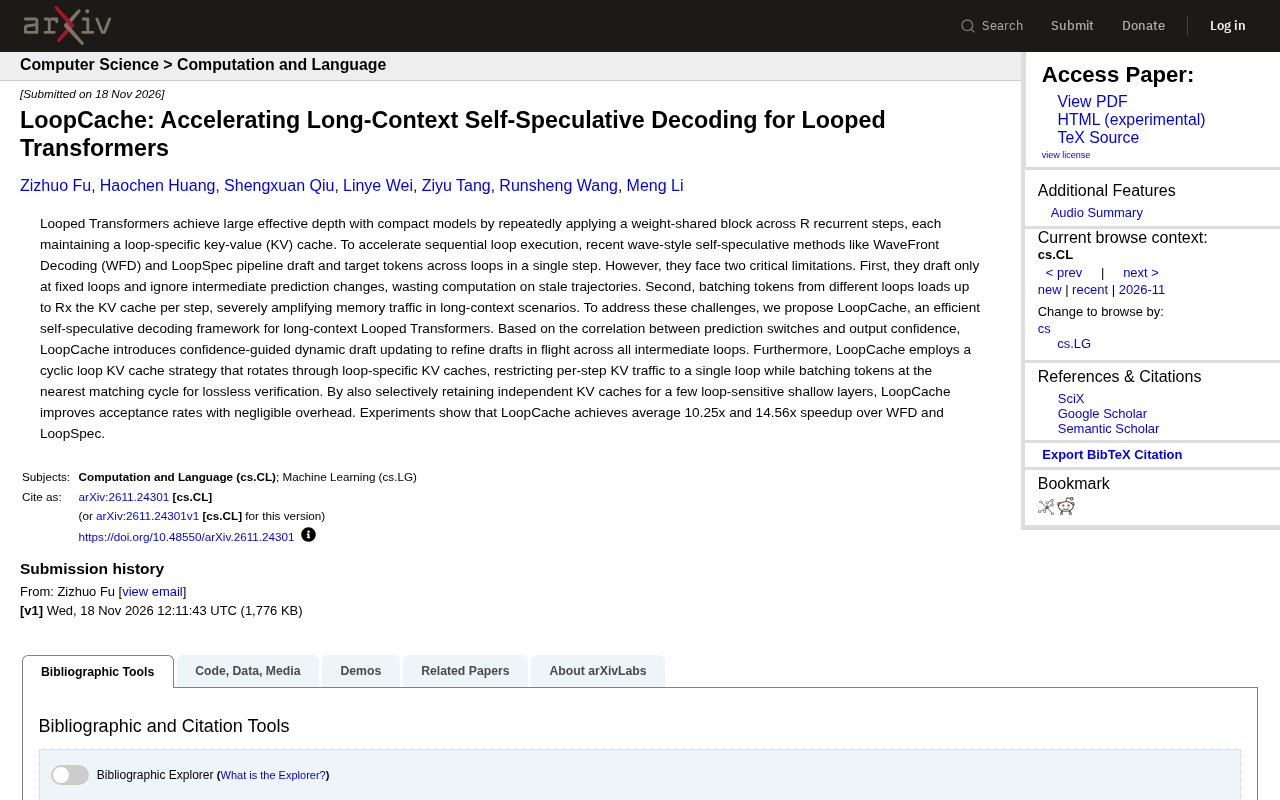
LoopCache is a self-speculative decoding framework for long-context looped transformers, addressing two bottlenecks of WFD and LoopSpec: drafts generated only at fixed loop points waste computation, and cross-loop token batching loads up to R times the KV cache per step, amplifying memory traffic. LoopCache uses confidence-guided dynamic draft updates to refine drafts across intermediate loops, and a cyclic KV cache strategy that loads only a single loop's cache per step while retaining independent caches for loop-sensitive shallow layers. Experiments show average speedups of 10.25x and 14.56x over WFD and LoopSpec.
Looped transformers achieve large effective depth by repeatedly applying weight-shared blocks, with each loop step maintaining its own KV cache. To accelerate sequential loop execution, recent self-speculative methods such as WaveFront Decoding (WFD) and LoopSpec attempt to pipeline draft and target tokens across loops within a single step, but they suffer from two major bottlenecks: drafts are generated only at fixed loop points, ignoring intermediate prediction changes and wasting computation; and when batching tokens across loops, each step loads up to Rx the KV cache, severely amplifying memory traffic in long-context scenarios. To address this, researchers propose LoopCache, an efficient self-speculative decoding framework for long-context looped transformers.
Inference Bottlenecks of Looped Transformers and Existing Solutions
The core idea of looped transformers is to achieve large effective depth with a compact model: a single weight-shared block is applied repeatedly for R loop steps, with each step maintaining its own key-value (KV) cache. This design offers advantages in parameter efficiency, but executing R loops sequentially means inference latency grows linearly with the number of loops.
Recent self-speculative decoding methods attempt to break this limitation. WaveFront Decoding (WFD) and LoopSpec adopt a "wavefront"-style pipeline that drafts and targets tokens across loops within a single step, thereby parallelizing part of the computation. These methods do not require an additional draft model, hence the term self-speculative.
However, the paper points out two key flaws. First, drafts are generated only at fixed loop points, ignoring prediction changes in intermediate loops. This means the model may waste computation on stale trajectories—when intermediate predictions have already changed, previously generated drafts are no longer valid. Second, batching tokens from different loops together requires loading up to R times the KV cache per step. In long-context scenarios, where the KV cache is itself the memory bottleneck, this amplification severely exacerbates memory traffic and offsets the gains from parallelization.
KV cache is a core data structure in autoregressive inference: to avoid recomputing the key (Key) and value (Value) projections of historical tokens for every generated token, the model caches these intermediate results and reuses them directly in subsequent steps. For standard transformers, KV cache size is proportional to sequence length, number of layers, and hidden dimension, and often dominates GPU memory in long-context settings. In looped transformers, because the weight-shared block is applied R times, each loop step has different intermediate representations, so an independent KV cache must be maintained for each loop, making the total cache roughly R times that of a standard model. This is the root cause of amplified memory traffic when batching tokens across loops—batching means accessing caches from multiple loops simultaneously, with per-step loading reaching up to R times that of a single loop.
Self-speculative decoding is a variant of speculative decoding. Standard speculative decoding requires an independent small draft model to quickly generate several candidate tokens, which are then verified in parallel by the large model in exchange for speedup; self-speculative decoding lets different parts of the same model (e.g., shallow layers, intermediate layers, or early loop steps) serve as the draft source, eliminating the memory and deployment costs of an extra model. In looped transformers, predictions from intermediate loop steps naturally serve as drafts for subsequent loops—this is the basis of WFD and LoopSpec. The benefit depends on draft acceptance rate: the more accurate the draft, the more tokens pass target verification, and the more pronounced the end-to-end speedup.
LoopCache's Two Core Mechanisms
To address the above issues, LoopCache introduces two key techniques: confidence-guided dynamic draft updates and a cyclic KV cache strategy.
Confidence-Guided Dynamic Draft Updates
LoopCache observes a correlation between prediction switching and output confidence. Based on this observation, it no longer generates drafts only at fixed loop points, but instead uses confidence signals to dynamically refine drafts across all intermediate loops. Specifically, when the model's confidence in a prediction changes, the draft is updated accordingly, avoiding wasted computation on stale trajectories. This "in-flight" refinement improves draft quality and reduces invalid verification.
Cyclic KV Cache Strategy
To control memory traffic, LoopCache accesses each loop's dedicated KV cache in a cyclic rotation manner. Each step loads only a single loop's KV cache rather than all R loops' caches simultaneously, limiting per-step KV traffic to the single-loop level. For tokens that need batching, it batches on the most recently matched loop cycle to ensure lossless verification.
In addition, LoopCache selectively retains independent KV caches for a few loop-sensitive shallow layers. These layers' caches do not participate in rotation, trading minimal extra overhead for improved acceptance rate. The paper describes this design as "improving acceptance rate at negligible overhead."
Cyclic rotation is a cache scheduling approach that trades space for time: since each decoding step primarily needs the current loop's KV cache, the system can load, use, and release caches in loop order rather than keeping all loops' caches resident in high-speed memory simultaneously. This reduces per-step cache access to the single-loop level, at the cost that a cache may have been evicted when needed. The key to LoopCache is pairing this with a "most recently matched loop cycle" batching strategy, so that batched tokens share the same loop's cache view, achieving rotation without sacrificing verification correctness. For a few shallow layers that are particularly sensitive to loop changes, independent caches are kept resident to avoid acceptance-rate loss from frequent swapping.
Experimental Results and Significance
Experimental results show that LoopCache achieves average speedups of 10.25x and 14.56x over WFD and LoopSpec, respectively. This improvement comes from two aspects: dynamic draft updates increase draft acceptance rate and reduce invalid verification; the cyclic KV cache strategy greatly reduces memory traffic in long contexts, allowing parallelization to truly translate into end-to-end speedup.
For the looped transformer architecture line that pursues parameter efficiency, LoopCache's significance lies in resolving a key contradiction in inference acceleration: while parallelizing cross-loop computation can improve compute utilization, without controlling KV cache memory traffic, gains in long-context scenarios are swallowed by memory bandwidth. By limiting per-step KV traffic to the single-loop level while maintaining draft quality through confidence guidance, LoopCache finds a balance between the two.
From a broader perspective, self-speculative decoding is becoming a practical acceleration approach that requires no external draft model. LoopCache is customized for the special structure of looped transformers, and such architecture-level optimizations often unlock more potential from specific models than general-purpose acceleration methods. For scenarios requiring deployment of compact models in long contexts, this approach is worth watching.
One-line Summary
LoopCache accelerates long-context looped transformer inference with confidence-based dynamic drafts and cyclic KV caching.
Paragraph Summary
LoopCache is a self-speculative decoding framework for long-context looped transformers, addressing two major bottlenecks of existing WaveFront Decoding and LoopSpec: drafts are generated only at fixed loop points, ignoring intermediate prediction changes and wasting computation; and cross-loop token batching loads up to R times the KV cache per step, amplifying memory traffic in long contexts. LoopCache introduces confidence-guided dynamic draft updates that exploit the correlation between prediction switching and output confidence to refine drafts in real time across all intermediate loops; it also adopts a cyclic KV cache strategy that loads only a single loop's cache per step in rotation, while retaining independent caches for a few loop-sensitive shallow layers to improve acceptance rate. Experiments show average speedups of 10.25x and 14.56x over WFD and LoopSpec, respectively, balancing parallelization gains against memory bandwidth.
Related articles

Daybreak Red Deployment Guide: A Reference Architecture for Supervised Security Investigation
A breakdown of the Daybreak Red reference architecture: security control design, deployment configuration process, and runtime monitoring for supervised security investigation.

Gemini 4 Neon Tops the Models Engineering Index
Gemini 4 Neon tops the Models Engineering Index, sparking Hacker News debate over ranking credibility and evaluation methods. Here's what it means for developers.

Apple's Self-Developed AI Agent: An Agent That Can Operate Your Mac Is Coming
Apple is reportedly developing an AI agent that can operate a Mac, targeting Meta Muse, Claude, OpenAI Dots, and others. This article analyzes Apple's system-level advantages, the competitive landscape, and likely rollout paths in the agent race.