LoopGrid + OpenAI Agents SDK: Adding Human Approval and Verifiable Records to AI Operations

LoopGrid integrates with the OpenAI Agents SDK to ensure sensitive AI operations are approved before execution using signed records.
LoopGrid plugs into the OpenAI Agents SDK's native tracing and run hooks to provide verifiable approval and auditing for sensitive AI agent operations like refunds. No core logic changes are needed—just register the Tracing Processor and use LoopGrid Core to evaluate policy. When human approval is required, the Agents SDK pauses the run with zero tool calls; after the app verifies the reviewer and records approval, the tool executes exactly once. The final signed record contains seven chronologically ordered events, with approval preceding the tool request, proving the tool ran only after human approval. This suits strongly regulated scenarios such as financial refunds and medical data access.
When an AI agent attempts to perform a sensitive action (such as issuing a refund), how do you prove who approved the operation and when, and ensure the tool only runs after approval? The integration of LoopGrid with the OpenAI Agents SDK offers a verifiable solution.
The Core Problem: Approval and Audit of AI Operations
The OpenAI Agents SDK allows agents to call tools, but in sensitive scenarios involving money, permissions, and the like, human approval must be introduced. However, simply pausing the agent run is not enough—you need a tamper-proof record proving that approval occurred before tool execution, and that the execution result matches what was approved.
LoopGrid plugs into the Agents SDK's native tracing and run hooks as a plugin, creating a signed record for every decision that covers the full chain from policy evaluation to the final result.

OpenAI Agents SDK's run hooks are a set of lifecycle callback interfaces that let developers inject custom logic at key points in the agent run (such as before and after tool calls, and at the end of a run). Unlike the tracing system, run hooks sit closer to the execution boundary and can precisely capture the moments when "a tool is about to be called" and "the tool call completes." LoopGrid uses this mechanism to pass the decision scope, making the causal relationship between tool request events and execution events recordable. The tracing processor, meanwhile, is the plugin interface for the SDK's tracing system, responsible for exporting spans generated during agent runs (such as model calls, tool calls, and handoffs) to an external backend. Together, the two provide both a macro-level run trajectory and a micro-level approval boundary.
Integration Steps: From Tracing to Signed Decisions
- Install the LoopGrid Tracing Processor: register it with the Agents SDK's tracing system to automatically capture key events during agent runs.
- Use LoopGrid Core to evaluate policy: for example, a refund policy, to determine whether the current operation requires human approval.
- Start a signed decision: record the agent's identity, the scope of authority, and the specific proposed action (such as the refund amount).
- Pass run hooks for the decision scope: these hooks record the actual tool call boundary, ensuring tool execution is accurately tracked.
According to the video demo, the integration requires no changes to the agent's core logic—you only need to add the LoopGrid components at initialization.
Live Demo: The Approval Flow for a $750 Refund
The video uses a $750 refund as an example. The policy requires human approval, so the Agents SDK interrupts the run. At this point, the tool has not executed, and LoopGrid has no tool request record.
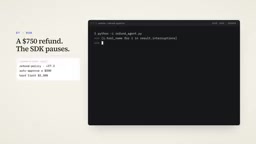
If you try to resume the run without approval, the agent stays paused and the tool call count is zero. This verifies that approval is mandatory—without approval, sensitive operations cannot be bypassed.
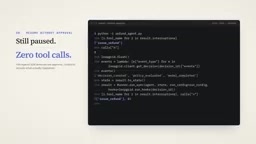
Next, the application layer authenticates the reviewer, records the approval in LoopGrid, and then approves the run state. After resuming, the refund tool executes exactly once.
Signed Record: A Closed Loop of Seven Events
The resulting signed record contains seven events: decision, policy, model output, human approval, tool request, execution, and observed result. These events are ordered chronologically, and the approval event precedes the tool request, proving the tool ran only after human approval.

The record is signed, verifiable, and passes with zero failures. This means any third party can audit the operation and confirm that it complied with policy and was properly authorized.
Signed record typically refers to a data structure that computes a hash chain over a set of structured events in chronological order and digitally signs the final digest with an asymmetric key. Its core properties include: integrity (any tampering with an event breaks the hash chain), non-repudiation (the signer cannot deny having generated the record), and verifiability (a third party can verify the signature and event order using only the public key). In AI approval scenarios, a signed record turns "who approved what" into cryptographic evidence rather than relying on the trustworthiness of a logging system. Zero-failure verification means all events in the record pass signature and ordering checks, with nothing missing or out of place.
Division of Roles and Applicable Scenarios
The OpenAI Agents SDK runs the agent, your application handles authorization, and LoopGrid records the evidence. This separation keeps responsibilities clear while providing a verifiable audit trail.
This pattern suits scenarios requiring strong compliance, such as financial refunds, medical data access, and permission changes. For developers, the integration cost is low, and it leverages the SDK's existing tracing mechanisms.
For more information, visit loopgrid.io.
One-line Summary
LoopGrid integrates with the OpenAI Agents SDK, using signed records to ensure sensitive AI operations are approved before they execute.
Paragraph Summary
LoopGrid plugs into the OpenAI Agents SDK's native tracing and run hooks to provide a verifiable approval and audit solution for sensitive AI agent operations (such as refunds). Integration requires no changes to the agent's core logic—just register the Tracing Processor and use LoopGrid Core to evaluate policy. When policy requires human approval, the Agents SDK interrupts the run and the tool call count is zero; after the application layer verifies the reviewer's identity and records the approval, the tool executes exactly once. The result is a signed record of seven events—decision, policy, model output, human approval, tool request, execution, and observed result—with the approval event preceding the tool request, proving the tool ran only after human approval. This solution suits strongly regulated scenarios such as financial refunds and medical data access.
Related articles

Running a Local LLM on a Laptop CPU: Ollama + Qwen3 Gives a Desktop Pet a Brain
An ordinary laptop without a GPU can run a local LLM: a Bilibili creator uses Ollama plus open-source Qwen3 8B on pure CPU to give an original desktop pet a local brain, with DeepSeekHarness handling plugin development and three rounds of debugging — 0 yuan, works offline, privacy stays on-device.

AgentScope 2.0 in Practice: A Guide to Enterprise-Level AI Agent Development in Java
AgentScope 2.0 is Alibaba's Java enterprise-grade distributed agent framework. This article explains why it suits server-side AI applications, contrasts client-side AI apps in permissions, state management, and concurrency, and outlines a practical learning path from environment setup to project integration.

GPT-6 Astra Directly Edits Weights to Fix Models? Full Analysis of the MIT Paper and Leaks
MIT paper shows GPT-6 Astra repairs small models by directly editing weights, raising math scores from 7.9% to 48.1%; OpenAI internal charts hint an unreleased model leads on BenchCAD 2.0; Fable 5.5 pure-code movies and the Claude WiFi radar incident analyzed.