Lossy Text Autoencoders: Where Compression Meets Semantic Representation

A lossy text autoencoder matches lossless compression at 2.24 bpb while retaining usable semantic representations.
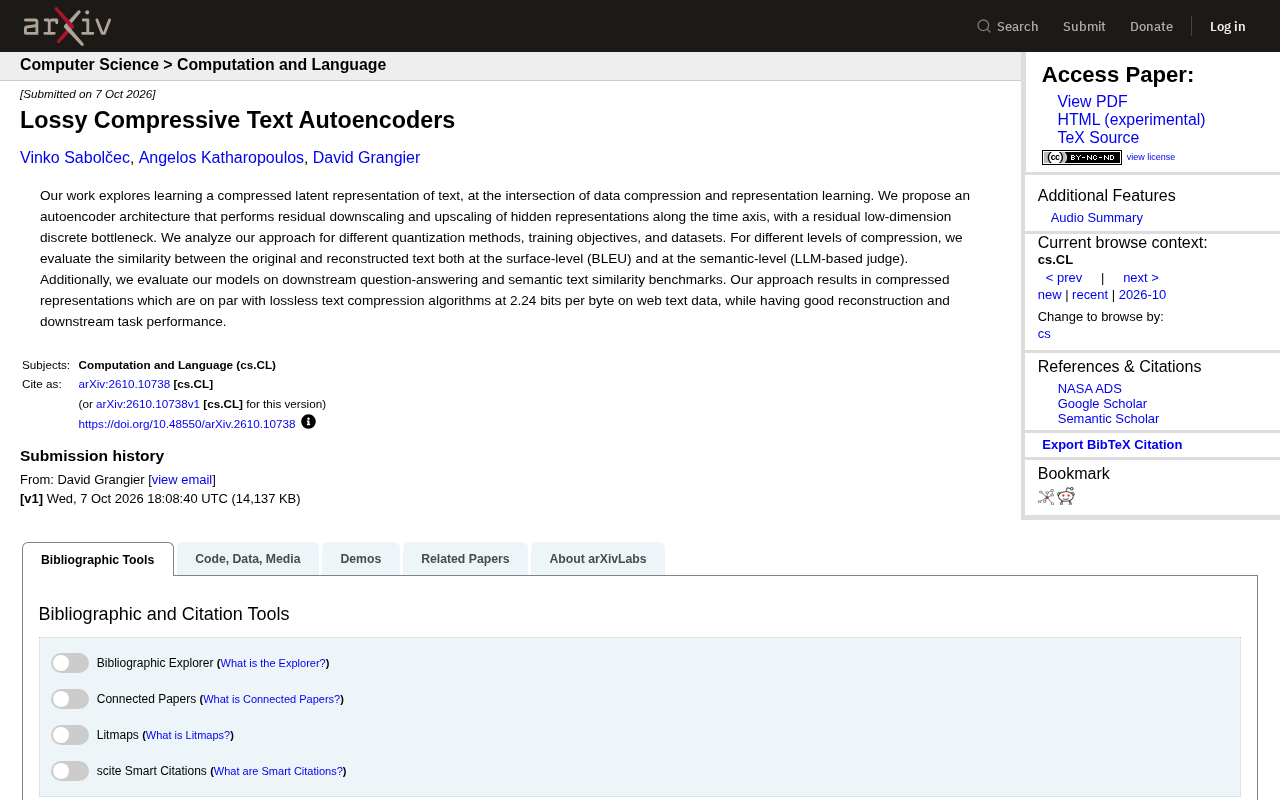
This arXiv preprint (arXiv:2610.10738v1) unifies data compression and representation learning into a single framework via a Lossy Compressive Text Autoencoder. The architecture performs residual downscaling and upscaling along the sequence time axis, forcing information through a residual low-dimension discrete bottleneck (inspired by VQ-VAE) to achieve lossy compression. Evaluation combines surface-level BLEU and LLM-based semantic fidelity judgments, with further validation on question answering and semantic similarity benchmarks. The key result: on web text, the method achieves 2.24 bits per byte — matching lossless algorithms — while delivering a semantically rich latent space that lossless compressors alone cannot provide.
When Data Compression Meets Representation Learning
Text compression has long been viewed as a pure information-theory problem — how to represent the same content with fewer bits. Representation learning, on the other hand, asks a different question: how to map text into a meaningful latent space that's useful for downstream tasks. A new paper from arXiv (arXiv:2610.10738v1) attempts to bridge these two seemingly parallel technical paths, proposing a Lossy Compressive Text Autoencoder.
The core idea is to learn compressed latent representations of text — allowing the model to save storage space like a compression algorithm while retaining enough semantic information to support real-world applications. This positioning sets it apart from both traditional lossless compressors and autoencoders that purely optimize for reconstruction accuracy.
Architecture: Residual Scaling Along the Time Axis
The proposed autoencoder architecture features several noteworthy design choices. The model performs residual-style downscaling and upscaling of hidden representations along the time axis. In other words, rather than compressing individual tokens, it incorporates the sequence length dimension into the compression process — condensing and restoring information along the temporal dimension.
The key component in the architecture is a residual low-dimension discrete bottleneck. A discrete bottleneck means information must pass through a finite, discrete codebook, which naturally introduces quantization and information loss — the source of the "lossy" in the name. The residual structure, meanwhile, helps preserve gradient flow and reconstruction capacity across successive compression layers.
This design has well-established precedents in discrete representation learning for vision (e.g., the VQ-VAE family). Applying similar ideas to temporal compression of text sequences is a meaningful engineering extension.
VQ-VAE (Vector Quantized Variational Autoencoder) is an important reference point for understanding the architecture in this paper. Introduced by DeepMind in 2017, its core innovation was replacing a continuous latent space with a finite discrete codebook: continuous vectors output by the encoder are "snapped" to the nearest discrete vector in the codebook, and the decoder reconstructs the original input from these discrete vectors. This forced discretization naturally creates an information bottleneck — only what the codebook can express passes through; the rest is discarded — which is precisely the mechanism behind "lossy" compression. The companion technique of Residual Quantization applies another round of quantization to the residual error after the first pass, stacking layers to achieve finer representational precision at modest codebook cost. The "residual low-dimension discrete bottleneck" in this paper follows the same logic, applied along the temporal axis of a sequence rather than the feature dimension of a single frame. Understanding this background helps calibrate the novelty of the contribution: the mechanism itself is not entirely new; the real contribution lies in adapting it to text sequence compression and coupling it with a semantic fidelity evaluation framework.
Multi-Dimensional Evaluation: From Surface to Semantics
The study presents a fairly systematic analysis covering different quantization methods, training objectives, and datasets. Evaluation operates on two levels:
Surface Similarity vs. Semantic Similarity
- Surface-level evaluation uses BLEU, measuring word-level overlap between reconstructed and original text;
- Semantic-level evaluation introduces an LLM-based judge to assess whether reconstructed text preserves the original meaning.
This dual-track evaluation is crucial. Lossy compression tolerates literal differences, but if semantics are destroyed, the compression loses its value. Using an LLM as a semantic judge is precisely meant to capture meaning fidelity that BLEU cannot measure.
Downstream Task Validation
Beyond reconstruction quality, the study also evaluates the model on downstream benchmarks in question answering and semantic text similarity. This is the ultimate test of whether a compressed representation is actually usable — a truly valuable compressed representation should be able to directly serve real NLP tasks, not merely be decompressible back to the original text.
Core Result: Matching Lossless Compression Bit Rates
The paper's most striking finding is that on web text data, the method achieves compressed representations at 2.24 bits per byte (bpb) — on par with lossless text compression algorithms — while maintaining strong reconstruction quality and downstream task performance.
The significance of this number is that it demonstrates the lossy compression approach does not sacrifice compression efficiency in exchange for semantic capability. Conventional wisdom holds that lossless compression is the "gold standard" for information density, yet this method reaches comparable compression ratios while additionally providing a semantically rich latent space that's friendly to downstream tasks — something lossless compression algorithms simply cannot offer on their own.
"Bits per byte" (bpb) is the standard efficiency metric in information compression, measuring the average number of encoded bits needed to store or transmit one byte of raw data. The theoretical lower bound is determined by Shannon entropy: for perfectly random data, bpb approaches 8 (incompressible); for structured natural language, mature lossless compression algorithms (such as zstd and Brotli) typically compress English web text to around 2–3 bpb. Large language models can themselves be interpreted as compressors — the stronger a model's next-token prediction ability, the lower the compression rate it can theoretically achieve, which is the basis of the "language models as compression" perspective (as in the Hutter Prize competition). The reported 2.24 bpb in this paper falls squarely within the competitive range of lossless compression, meaning that the lossy approach — despite discarding some fine-grained detail — does not sacrifice overall encoding efficiency. This is not intuitively obvious: one would typically expect lossy compression to trade lower bpb for greater information loss, but the results here suggest both can be achieved simultaneously.
Value and Limitations of This Work
In terms of research positioning, this paper's contribution lies in placing compression efficiency and representation quality within the same unified framework and delivering quantifiable results. It hints at an intriguing possibility: future large models handling long texts might first compress text into a compact discrete latent space, then perform reasoning in that space, thereby reducing both computational and storage overhead.
That said, caution is warranted. The paper's abstract primarily reports results on web text; generalization to other domains still requires broader validation. Furthermore, how lossy compression balances semantic fidelity at higher compression ratios, and the reliability of LLM-based judge evaluations themselves, are questions worth digging into further. As a newly posted preprint, these conclusions remain to be reproduced and scrutinized by the community.
For researchers interested in efficient NLP, long-context modeling, and discrete representation learning, this is a technical direction worth tracking.
Related articles

Automatically Convert CSV to Parquet with Hugging Face Buckets and Webhooks
Learn how to use Hugging Face Buckets, Webhooks, and Jobs to build a cloud data pipeline that automatically converts new CSV files into Parquet—no local downloads or uploads of large files required.

Software Factory in Practice: Building an Evaluable Self-Evolving Development Pipeline with Codex and Claude Code
Deconstructing a Codex and Claude Code software factory: control/data plane separation, foreman prompts for consistency, automatic triggers, and data-driven evaluation.

WorkBuddy Full Guide: How an AI Coworker Takes Over Workplace Automation
What is WorkBuddy? This article analyzes the core capabilities of this full-scenario AI agent: autonomous execution with deliverable results, local file processing, multi-agent parallelism, and workplace automation workflows, helping you judge its essential difference from ordinary AI chat tools.