LoudFlow: Teaching Text-to-Speech to 'Understand' Sentences Before Speaking

LoudFlow argues that TTS should understand sentence semantics before generating speech, to eliminate the mechanical feel.
LoudFlow is a new product on Product Hunt that aims to overturn traditional TTS's phoneme-by-phoneme synthesis by having the model first understand the semantic structure of the whole sentence and use that to determine pauses, stress, and intonation. It offers system-level select-and-read in any app via two hotkeys, supports any voice including the user's own, and is free on Mac and Windows. The article notes that its semantic depth, voice cloning compliance, and free-model sustainability remain to be verified, and highlights its potential for commute listening, proofreading, language learning, and readers with dyslexia.
Most text-to-speech tools work by "reading letters"—converting text phoneme by phoneme, then stitching those phonemes into sound. The result: every word is pronounced correctly, but the whole sentence sounds like a machine reciting from a script. LoudFlow, newly launched on Product Hunt, takes the opposite approach: understand the sentence first, then generate speech.
From 'Reading Word by Word' to 'Understanding Before Speaking'
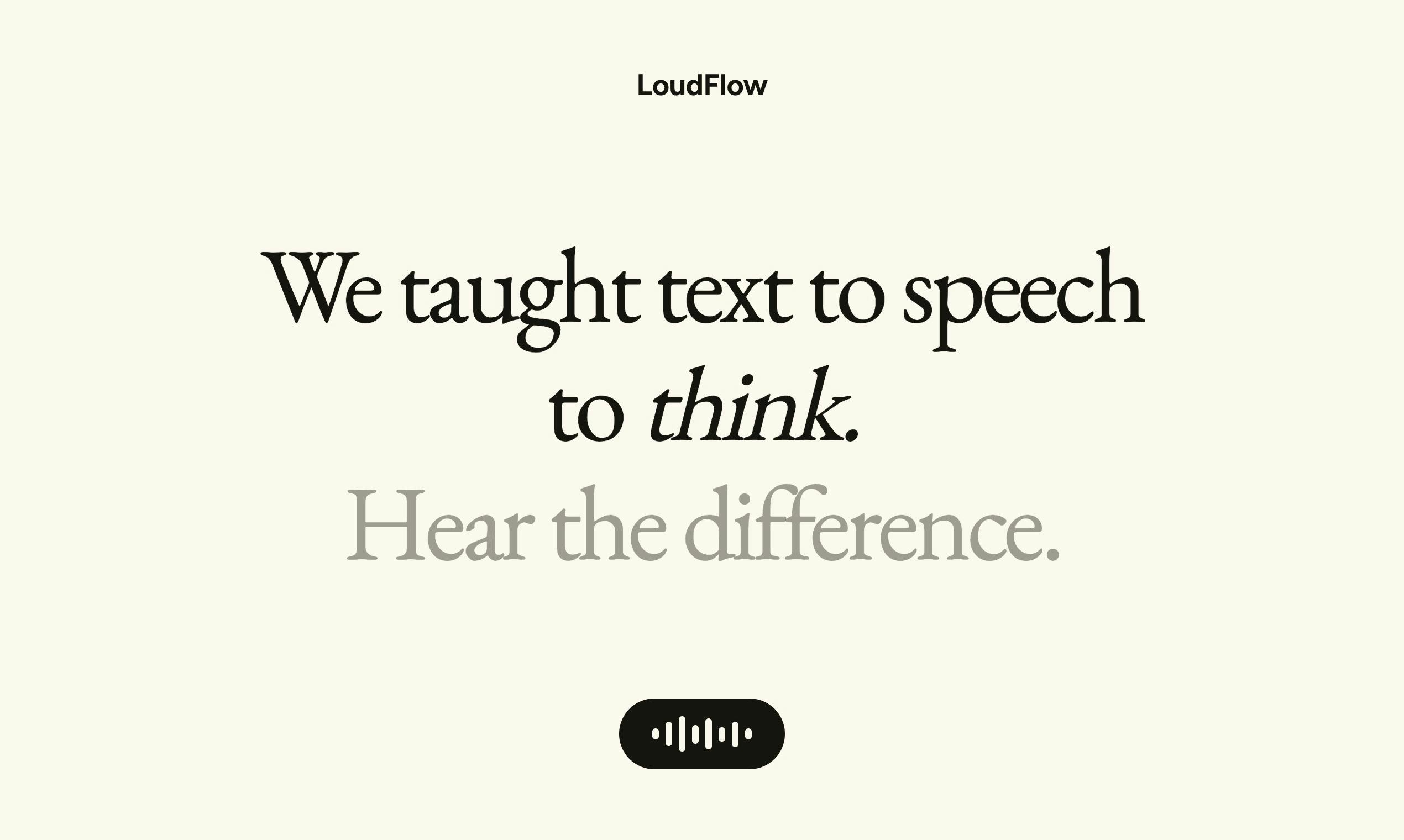
LoudFlow's official tagline is "We taught text to speech to think." That slightly bold claim points directly at the core weakness of traditional TTS: prosody disconnected from semantics.
When humans speak, where we pause, which word gets stressed, and how our intonation rises and falls are all determined by what the sentence means. The same string of text—whether it expresses a question or a statement, whether it emphasizes the first half or the second—requires completely different vocal treatment. Traditional TTS often relies on fixed rules or shallow prediction to handle pauses and intonation, and it tends to fall apart with long sentences, complex subordinate clauses, or colloquial expressions.
LoudFlow claims to let the model first understand the semantic structure of the entire sentence, then decide how to read it. The official description is blunt: most voices just read letters, but LoudFlow understands the sentence first, so it sounds like a person rather than a machine. This brings it closer to a "language model that can read aloud" than a "converter that can produce sound."
TTS (Text-to-Speech) is the technology that automatically converts written text into audible speech. A traditional TTS pipeline typically includes several stages: text normalization, tokenization, phoneme conversion, acoustic modeling, and vocoder synthesis—phonemes being the smallest units of speech. Early systems mostly used concatenative synthesis (selecting and stitching segments from a recording library), before the mainstream shifted to parametric and neural synthesis (end-to-end models like Tacotron and FastSpeech). While these models have continuously improved audio quality, most still take "character/phoneme sequences" as their input unit, with prosody (pauses, stress, intonation) often predicted by separate modules or rules—easily disconnected from the sentence's actual semantics. This is precisely the technical root of what the article calls the "machine recitation" feeling.
Prosody refers to those features of speech beyond phoneme content, mainly including pitch (intonation rise and fall), duration (speaking rate and elongation), stress, and pauses. Prosody is the key distinction between "reading characters" and "speaking": with the same sentence, different pause placement or stress on different words can convey completely opposite meanings. Prosody planning in TTS is usually treated as a separate subtask that needs to predict based on syntactic structure and semantic focus. If the model performs semantic parsing of the whole sentence before generating speech, and then lets semantics guide prosody decisions, this could theoretically significantly improve naturalness and intelligibility—which is exactly the foundation of LoudFlow's technical approach.
Interaction Design: Two Keys to Summon, Works in Any App
LoudFlow's product form is quite lightweight. Users select text in any application, press two shortcut keys, and playback begins—no need to copy and paste into a dedicated reading app.
This "system-level select-and-read" positioning means it targets everyday reading scenarios rather than voiceover studios: reading long articles, emails, documents, and foreign-language materials. The official emphasis is on supporting any voice—even the user's own.
In terms of platform coverage, LoudFlow offers both Mac and Windows versions, and it's free. For a new product that just launched on Product Hunt with 58 votes and a #17 ranking, a free strategy is clearly a means of quickly gathering user feedback.
Three Questions Worth Watching
First, how deep is the semantic understanding, really? "Understand before reading" is easy to say, but implementation requires the model to complete semantic parsing and prosody planning in an extremely short time. Whether it can handle real-world text with mixed Chinese and English, dense technical terminology, and non-standard punctuation—there's still a lack of public head-to-head comparisons.
Second, the boundaries of voice cloning. "Even use your own voice" is a strong selling point, but it also means compliance and ethical issues will follow. The source material doesn't mention what mechanisms LoudFlow has for voice authorization and abuse prevention—questions it must answer as it scales to a larger user base.
Third, how long can the free model last? Speech synthesis is a compute-intensive task, and offering high-quality TTS plus voice cloning for free is not an easy cost structure. For users, now is a good window to try it out; for the product, it needs to validate a paid conversion path as soon as possible.
Voice Cloning refers to using a small number of speech samples from a target speaker to have a TTS model imitate their timbre and pronunciation style. Current mainstream approaches include speaker embedding and zero-shot/few-shot cloning models, the latter capable of reproducing a voice from just seconds to minutes of audio. This technology dramatically lowers the barrier to custom voices, but it also brings abuse risks such as impersonating others' voices and forging audio. Common industry safeguards include requiring explicit speaker authorization, adding voiceprint watermarks and synthesis detection, and restricting use in sensitive scenarios. For products offering "use your own voice" features, establishing traceable authorization and abuse reporting mechanisms is an unavoidable compliance step.
Who Should Try It First
If you frequently need to turn on-screen text into audio input—listening to documents during your commute, proofreading manuscripts, learning foreign-language pronunciation, or simply not wanting long articles to monopolize your eyes—LoudFlow's two-key select-and-read is worth installing and trying. It turns "reading aloud" from an action within a standalone app into a convenient operating-system-level operation.
For developers and product managers, what's more worth watching about LoudFlow is its technical approach: moving semantic understanding upstream into the speech generation stage. If this direction can be reliably delivered on large-scale real-world text, the "machine feel" that has plagued TTS for years may be redefined.
LoudFlow was built by Lauro Maffei and is currently live on Product Hunt, categorized under Productivity, Artificial Intelligence, and Inclusivity—that last category also hints at another layer of value: for people with reading difficulties and those who spend long hours staring at screens, the quality of semantics-aware reading directly determines how comfortable information access feels.
One-line Summary
LoudFlow advocates having TTS understand sentence semantics before generating speech, to eliminate the mechanical feel.
Paragraph Summary
LoudFlow is a new product launched on Product Hunt whose core proposition is to overturn traditional TTS's "phoneme-by-phoneme" synthesis by having the model first understand the semantic structure of the whole sentence, then use that to determine pauses, stress, and intonation—escaping the mechanical feel of "machine recitation." The product form is system-level select-and-read: select text in any app and press two shortcut keys to listen, supporting any voice including the user's own, with free Mac and Windows versions. The article argues that its depth of semantic understanding, the compliance boundaries of voice cloning, and the sustainability of the free model remain unverified, and notes its potential value for commute listening, manuscript proofreading, foreign-language learning, and people with reading difficulties.
Related articles

ChatGPT Plus Subscription Pitfall Guide: Go/Plus/Pro Tier Comparison and Quick Activation
A complete ChatGPT Plus subscription guide based on a Bilibili tutorial: from registering an account, comparing Go/Plus/Pro tiers, to the practical steps for quickly completing your subscription.

GPT-6.2 Sol/Astra Released! A Step-by-Step ChatGPT Plus Subscription Guide and Tier Comparison
GPT-6.2 Sol/Astra is out—here's a ChatGPT Plus subscription guide: register an account, compare Go/Plus/Pro tiers, and subscribe in a minute.

Comparing Three Channels for Subscribing to GPT Plus in China: Is Website Top-Up the Easiest?
How to subscribe to GPT Plus in China? This article compares website top-up, credit card, and mobile top-up channels—process, cost, and risk—with steps and tips to help you choose wisely.