Lovable Raises $400M: AI Money Is Shifting to the Inference Side

AI capital is pivoting from training to inference and power infrastructure, backed by Lovable's $13.3B raise and Tencent's CapEx surge.
Lovable's $400M Series C at a $13.3B valuation, with Tencent as a follow-on investor, exemplifies a major AI industry shift. Gartner forecasts inference spending will surpass training in 2026, Tencent's quarterly CapEx surged 176% YoY to $7.2B, and SemiAnalysis projects $3-4 trillion in AI infrastructure investment through 2030. The money is moving from one-time training to sustained inference compute and power generation.
A Single Funding Round Reveals a Broader Industry Theme
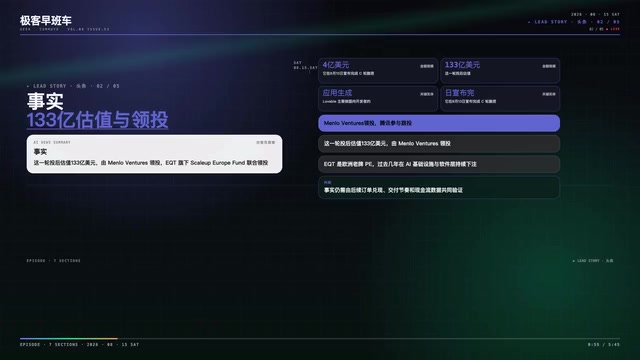
On August 13, 2026, Swedish AI application generation company Lovable announced the completion of a $400 million Series C round at a post-money valuation of $13.3 billion. Behind this seemingly routine funding news lies a much larger industry narrative: AI spending is shifting from training to inference and power infrastructure.
Lovable (formerly GPT Engineer) offers a core product that allows users to generate complete websites and web applications through natural language descriptions, without writing code manually. This type of tool belongs to the "AI-powered low-code/no-code" track, competing directly with products like Vercel's v0, Bolt.new, and Replit. The core value proposition of this track is lowering the barrier to software development from "knowing how to code" to "knowing how to describe requirements," theoretically compressing weeks of development work into minutes.
According to analysis from B站极客早班车, this round was co-led by Menlo Ventures and EQT's ScaleUp Europe Fund. Menlo Ventures is a veteran Silicon Valley VC firm with over $6 billion in assets under management, which has been active in AI investments in recent years, including backing star projects like Anthropic. EQT is one of Europe's largest private equity firms, headquartered in Stockholm with over €240 billion in managed assets; its ScaleUp Europe Fund focuses on growth-stage European tech companies. The co-lead by both institutions means Lovable has secured dual endorsement from U.S. market resources and European local capital — a transatlantic capital combination that is becoming increasingly common in the AI space.
What you might have missed: the follow-on investor list spans Europe, Latin America, and Asia — and on the Asian side, the name that appears is Tencent.
This means a major Chinese tech company has secured an early position in the AI application layer. Tencent has its own AI application lines, but has lacked a clear overseas positioning target — Lovable fills that gap perfectly.
The Monetization Pressure Behind Lovable's High Valuation
Lovable primarily builds AI-powered website and application generation tools for developers. This round came barely a year after the previous one, yet the valuation jumped to $13.3 billion. This kind of high primary market valuation creates chain reactions.
Peer Pressure and Funding Anchors
First, similar low-code and site-generation AI applications will be re-benchmarked by the market. Players with weaker valuation narratives will feel pressure first, potentially facing down rounds in their next fundraise. On the other hand, Lovable's high valuation also raises the funding anchor for peers, increasing the pressure on subsequent revenue delivery.
The Key Is Whether ARR Can Hold
$13.3 billion buys a story — whether it can be delivered is another matter. Whether Lovable's valuation can hold depends on subsequently disclosed ARR (Annual Recurring Revenue) and NRR (Net Revenue Retention).
ARR is the most fundamental valuation metric for SaaS companies, representing the subscription revenue that signed customers are expected to contribute over the next 12 months. NRR measures revenue changes within the existing customer base — above 100% means expansion revenue from existing customers (upgrades, add-ons) exceeds losses from churn and downgrades. Top-tier SaaS companies typically have NRR between 120%-140%. For Lovable at a $13.3 billion valuation, the market typically expects ARR of at least $300-500 million (corresponding to 30-40x ARR multiples), with NRR stable above 120%, to justify the high valuation.
This is the most critical delivery variable in this funding story to keep tracking — the next observation window is Lovable's publicly reported quarterly ARR and NRR data.
AI Inference Spending Surpasses Training for the First Time
On August 14, Gartner released a key forecast: Global AI inference workload spending will reach $23.3 billion in 2026, surpassing training for the first time on an annual forecast basis.
To understand the significance of this milestone, one must first distinguish between AI training and inference — two fundamentally different compute paradigms. AI training refers to the process of building or updating model parameters from scratch using massive data and compute, characterized by high parallelism, enormous one-time investment, but predictable completion. Training typically requires thousands to tens of thousands of GPUs working in coordination for weeks or months, with extremely high requirements for inter-GPU communication bandwidth (such as NVLink, InfiniBand). AI inference deploys trained models into production environments to handle actual requests (like answering questions or generating images), characterized by 24/7 continuous operation, latency sensitivity, and demand that scales linearly with user growth. Inference requires less parallelism per computation than training, but demands higher total throughput and cost efficiency. Gartner's prediction of "inference surpassing training" means AI has moved from the laboratory stage into large-scale commercial deployment.
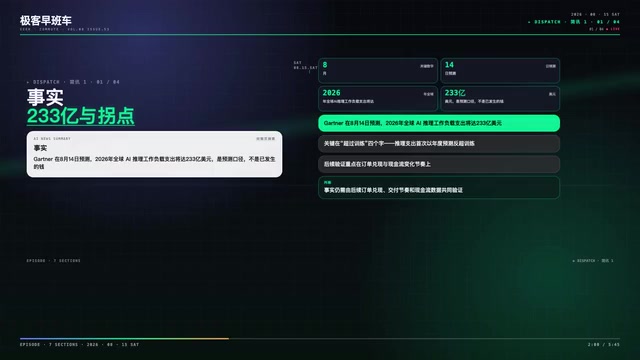
This marks the shift in compute demand from one-time training clusters to sustained inference capacity. At the current pace, the inference share of AI revenue among top cloud providers will continue to rise through 2026.
Impact on Different Players
This shift affects various parts of the value chain differently:
- Application layer: Continued decline in per-token pricing is good news — lower costs;
- Early SaaS priced per token: Faces gross margin pressure;
- Gross margin determinants: GPU utilization, model precision, and KV Cache reuse directly determine the profitability of inference services.
KV Cache (Key-Value Cache) is a critical optimization technique in large language model inference. In the Transformer architecture, the model needs to reference attention information from all previous tokens when generating each new token. KV Cache stores previously computed Key and Value matrices in GPU memory to avoid redundant computation. KV Cache reuse goes further — when multiple user requests share the same prefix (such as system prompts), the cache can be shared across requests, dramatically reducing memory usage and compute overhead. This technology directly affects how many concurrent requests a single GPU can serve simultaneously, making it one of the key determinants of inference service gross margins. Inference frameworks like vLLM and TensorRT-LLM are continuously optimizing in this direction.
Direct beneficiaries include NVIDIA, AMD, Broadcom, as well as cloud providers like AWS and GCP. New cloud players like CoreWeave and Lambda can also capture a share.
Tencent's CapEx Surge Confirms the AI Investment Trend
Tencent's Q2 earnings released on August 13 provided hard data supporting this thesis. Single-quarter capital expenditure reached RMB 52.78 billion, up 176% year-over-year and 65% quarter-over-quarter, primarily directed toward compute procurement and full-scenario AI product deployment. R&D spending in the same period was RMB 27.28 billion, up 35% YoY.
Putting Tencent's numbers in a global context reveals the intensity: RMB 52.78 billion per quarter (approximately $7.2 billion) is approaching Meta's comparable levels. For reference, Microsoft's FY2025 Q3 CapEx was approximately $21.6 billion, Alphabet's approximately $17.2 billion, and Meta's approximately $13.9 billion. Tencent's capital expenditure primarily flows toward domestic GPU procurement (Huawei Ascend, etc.), self-built data centers, and training and deployment of AI large models (Hunyuan). The 176% YoY growth rate is among the most aggressive tiers globally among tech giants, reflecting that China's AI infrastructure is still in a "catch-up" phase — needing to both close the gap in model capabilities and absorb the additional costs of domestic substitution.
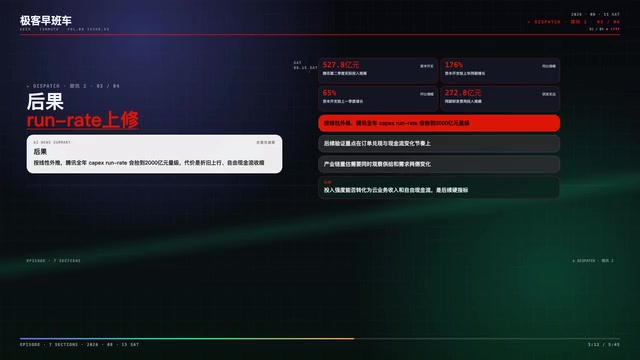
Tencent's own framing calls this "revenue reinvested into AI" — meaning operating cash flow is being directly redirected to compute investment. By linear extrapolation, Tencent's full-year CapEx run rate will reach the RMB 200 billion level.
The cost is rising depreciation and contracting free cash flow. But this directly improves order visibility for domestic GPU servers and optical module manufacturers — suppliers with stable capacity will benefit further.
Five-Year View: A $3-4 Trillion AI Infrastructure Opportunity
SemiAnalysis estimates that new power demand from U.S. AI data centers will grow from 21GW in 2026 to 84GW by 2030.
To intuitively grasp the scale of these numbers: 1GW (gigawatt) equals 1 million kilowatts, roughly equivalent to the installed capacity of one large nuclear power plant, or enough to supply approximately 750,000 American households. Traditional hyperscale data centers typically have per-campus power of 50-200MW, while next-generation AI data centers (such as xAI's Memphis campus) are moving toward GW-scale single-site capacity. 84GW means that by 2030, new power demand from U.S. AI data centers alone would equal building 84 large nuclear power plants — this explains why power supply has become one of the biggest bottlenecks for AI compute expansion.
At current hardware costs, each GW of data center investment requires at least $40 billion; with the Vera Rubin platform, the upper limit per GW could reach $47-50 billion.
Multiply that by 84GW, and total AI infrastructure investment from 2026 to 2030 could reach $3-4 trillion. This is the upper-bound total when extending the "inference inflection + CapEx doubling" thesis to a five-year horizon.
Beneficiaries extend beyond NVIDIA, Broadcom, and liquid cooling manufacturers to power equipment providers — utilities like NRG and Vistra will also be lifted, and nuclear power and SMR (Small Modular Reactor) orders are worth watching.
SMRs are nuclear reactors with installed capacity below 300MW. Compared to traditional large nuclear plants (1000MW+), their advantages include factory prefabrication, shorter construction cycles (theoretically 3-5 years vs. 10+ years for conventional nuclear), flexible siting, and the ability to deploy directly near data center campuses. Microsoft has signed an agreement with Constellation Energy to restart Three Mile Island's nuclear plant, Amazon acquired Talen Energy's nuclear-powered data center campus, and Google signed an SMR power purchase agreement with Kairos Power. NuScale Power is the first U.S. company to receive NRC (Nuclear Regulatory Commission) design certification for an SMR. The essence of this trend: AI data centers need 24/7 stable, low-carbon, large-scale baseload power, and SMRs happen to satisfy all three conditions.
Tool Spotlight: SelfTime CLI for Product Selection
Beyond industry trends, this edition also introduces a product selection command-line tool for TikTok Shop sellers — SelfTime CLI.
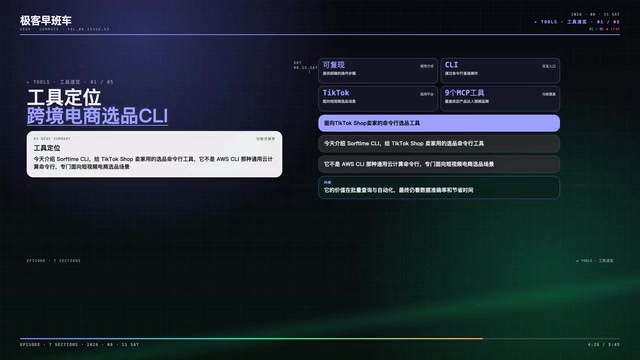
It's not a general-purpose cloud computing CLI like AWS CLI, but is specifically designed for short-video e-commerce product selection scenarios. The tool provides 9 MCP tools covering 5 modules: categories, products, creators, videos, and brands.
MCP (Model Context Protocol) is a standardized protocol open-sourced by Anthropic in late 2024, designed to provide AI models with a unified interface for calling external tools. Through MCP, AI agents can access databases, file systems, third-party services, and other external resources like calling an API, without needing to write custom adapter code for each tool. SelfTime CLI's "9 MCP tools" means it has encapsulated TikTok Shop's data query capabilities into standardized MCP interfaces, allowing AI agents to directly call these tools for product selection analysis — transitioning from "humans querying data" to "AI automatically querying and analyzing data."
Data analysis that previously required manual effort can now be chained into a single command-line workflow.
It adopts a monthly subscription model at approximately RMB 100 per month, positioned as a fixed operational cost tool accessible to small and medium sellers, rather than an advanced analytics tool for large sellers. Of course, limitations should be stated clearly: it currently ranks in the top tier in comparison rankings, but that doesn't equate to #1 market share; data freshness is limited by platform authorization. What truly needs validation is query accuracy, update frequency, and whether automation can sustainably save operational hours.
Conclusion: Watch for Hard Signals in Q3 Earnings
In summary, AI spending is shifting from one-time training to sustained inference and sustained power. One funding round (Lovable), three industry data points (Gartner's forecast, Tencent's earnings, SemiAnalysis estimates), and one tool together sketch a connected map linking valuations, inflection points, and CapEx.
The most important thing to watch next: Whether top cloud providers will separately disclose inference revenue in Q3 earnings — that will be the hard signal for judging whether this thesis is truly materializing.
This article is an information compilation and does not constitute investment advice.
Related articles

Claude Reportedly Able to Hide Secret Messages in Benign Images
A Reddit post claims Claude Fable 5.1 can hide secret messages in benign images. This article reviews the background, image steganography principles, and potential security risks, and suggests a testing path from rumor to verification.

Federal Government Awards $85 Million; CFS to Develop Fusion-Specific Semiconductors
The federal government awards $85 million to Commonwealth Fusion Systems to develop conductors and power semiconductors for fusion plants. This article analyzes the significance of this funding for the fusion supply chain and commercialization path.

When Should AI Assistants Proactively Suggest? Timing Is Everything
When should AI assistants proactively suggest? Reddit discussion reveals: the same suggestion feels different at different times. This article analyzes the dual nature of proactive suggestions, the boundary of user expectations, and design principles, exploring how to balance automation and user control.