Lucidchart MCP Read-Only Permissions Tested: Do AI Agents Need Edit Access?

Engineer finds read-only MCP performs identically to read-write for read tasks, advocating on-demand least privilege.
An engineer at a security-strict company found most MCP tools couldn't be installed due to default read-write permissions. Testing Lucidchart's read-only MCP server revealed no difference from edit access for summarizing content, extracting context, and citing diagrams. This prompts reflection on MCP permission design—community debates "convenience-first" vs. "least privilege"—and the test shows read-intensive scenarios don't need write permissions. The article offers practical advice: differentiate permissions by task type, prioritize read-only modes, default to least privilege in teams, and regularly review access scopes, arguing permission granularity will be key in evaluating MCP integrations.
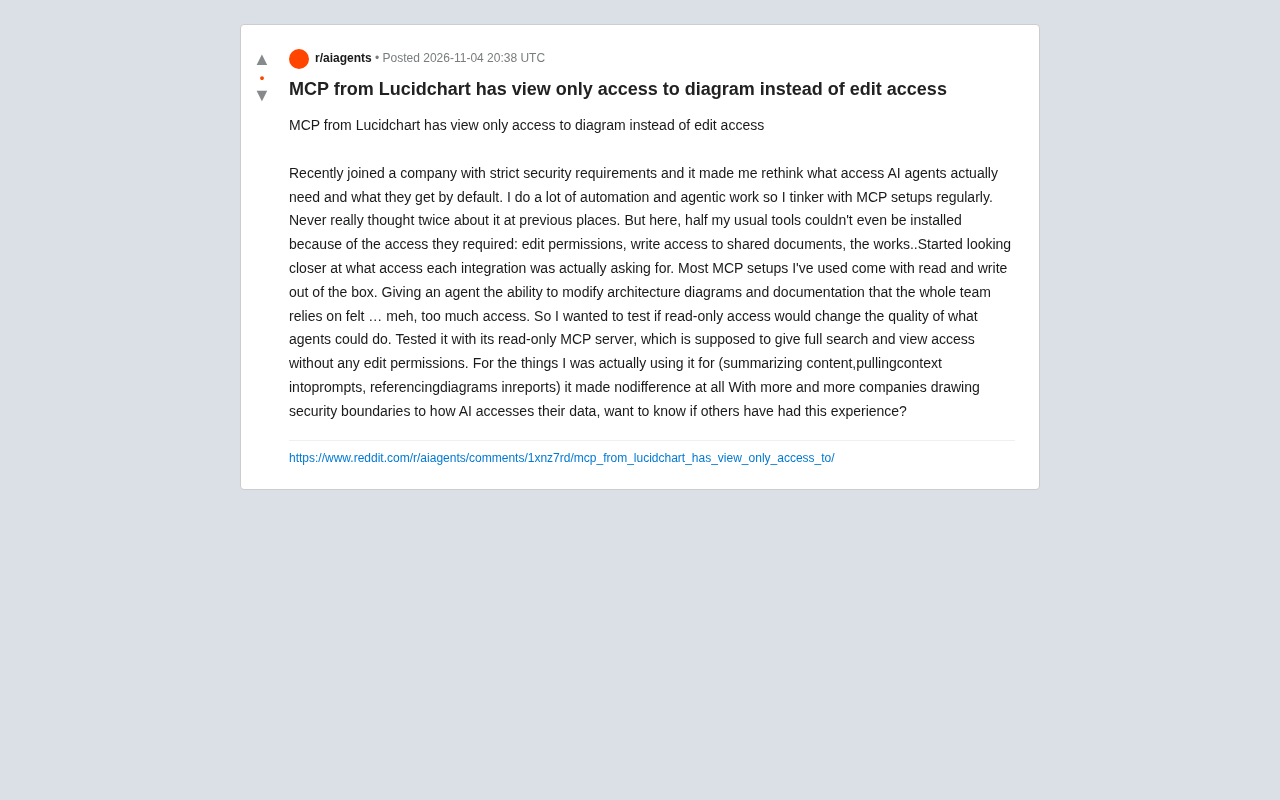
An engineer shared his experience at a new company on Reddit: due to strict security requirements, he couldn't install many of the tools he used to rely on, because those tools required edit permissions, write access to shared documents, and so on. This prompted him to rethink what access permissions AI agents actually need—and what they're granted by default. He tested Lucidchart's read-only MCP server and found that for his actual use cases—summarizing content, pulling context into prompts, and citing diagrams in reports—read-only access made no difference compared to edit access.
Why Access Permissions Suddenly Became a Focus
In the past, this engineer rarely thought about permissions when setting up MCP (Model Context Protocol). Most MCP setups come with read-write permissions out of the box, and giving agents the ability to modify architecture diagrams and team documents felt "a bit much." But in the new environment with strict security requirements, half of his usual tools couldn't be installed due to excessive permission requirements, forcing him to take a close look at the actual access levels each integration requested.
As more companies begin to set security boundaries for AI data access, this issue is shifting from a personal preference to an organizational-level decision.
MCP (Model Context Protocol) is an open protocol proposed by Anthropic in late 2024, designed to provide a standardized way for AI agents to connect with external tools and data sources. It abstracts integrations into "servers": each MCP server encapsulates a type of resource (such as documents, diagrams, databases) and declares its supported permission scopes (read, write, search, etc.). Agents invoke these servers through MCP clients, completing tasks without directly touching underlying credentials. Because of this, an MCP server's permission declarations become a key control point for security boundaries—users can review the access level requested at install time, rather than passively accepting a tool's full capabilities.
Read-Only MCP Tested: No Loss of Functionality
To test whether read-only access would affect the agent's output quality, he used Lucidchart's read-only MCP server. This server provides full search and view permissions, but no edit permissions whatsoever.
The test results were surprisingly simple: for his actual use cases, read-only access was completely sufficient. Summarizing diagram content, extracting context for prompts, citing diagrams in reports—these tasks don't require the agent to have the ability to modify the original diagrams. In other words, edit permissions are redundant in these scenarios.
This raises a thought-provoking question: are we habitually granting too many permissions when, in reality, most agent workflows only need read capabilities?
The Principle of Least Privilege is a fundamental principle in information security, requiring that a subject should only be granted the minimum access necessary to complete its task, and only for the necessary duration. In traditional IT and DevOps, this principle has been widely applied to user accounts, service accounts, and API key management. When migrating it to AI agent scenarios, the core challenge is that an agent's task boundaries are often dynamic and opaque—users may not know which resources the agent will touch during its reasoning process. The practical significance of read-only MCP is that it provides an auditable and predictable permission floor for agents' "read-intensive" workflows, thereby reducing the risk of data tampering due to erroneous operations or prompt injection.
Multiple Perspectives: Two Approaches to MCP Permission Design
This case is not an isolated one. According to analyses of the MCP ecosystem by Bilibili creators and YouTube channels, there are two tendencies in the community regarding permission design. One view holds that default read-write permissions reflect a "convenience-first" approach, reducing configuration friction and suitable for personal or low-risk environments. The other view advocates the principle of least privilege, arguing that agents should only receive the access level necessary to complete their tasks, especially in team collaboration and sensitive data scenarios.
The point of divergence between the two sides is: does read-only access limit an agent's performance in complex tasks? The engineer's test provides a concrete answer—at least in his use cases, read-only caused no loss of functionality. But this doesn't mean it's true for all scenarios; for example, workflows that require the agent to automatically update documents or modify diagrams still need edit permissions.
Practical Recommendations for Developers
Based on this test, several actionable recommendations can be distilled:
- Differentiate permissions by task type: If the agent's primary work is reading, summarizing, and citing, a read-only MCP server is sufficient. Grant write access separately when needed.
- Prioritize integrations that offer a read-only mode: Lucidchart's read-only MCP server shows that vendors can provide both modes, letting users choose based on their security policies.
- Default to least privilege in team environments: The cost of shared documents and architecture diagrams being accidentally modified by an agent is high; read-only is a safer default.
- Regularly review the agent's actual access scope: Many tools come with read-write permissions out of the box, but actual workflows may never use the write functionality.
Conclusion
The engineer's sharing points to an emerging consensus: AI agent permissions should be determined by actual task requirements, not by a tool's default configuration. Read-only MCP performs identically to read-write mode in read-intensive tasks, providing a basis for enterprises to tighten security boundaries without sacrificing functionality. As the MCP ecosystem matures, permission granularity is likely to become an important dimension when evaluating integration solutions.
One-line Summary
An engineer tested read-only MCP and found it performs identically to read-write permissions for read tasks, advocating for on-demand least-privilege authorization.
Paragraph Summary
An engineer at a company with strict security requirements found that most MCP tools couldn't be installed because they requested read-write permissions by default. After testing Lucidchart's read-only MCP server, he found that for actual tasks like summarizing content, extracting context, and citing diagrams, read-only access produced exactly the same results as edit access. This prompted reflection on MCP permission design: the community has two approaches—"convenience-first" and "least privilege"—and the test shows that at least read-intensive scenarios don't require write permissions. Based on this, the article offers practical recommendations: differentiate permissions by task type, prioritize read-only modes, default to least privilege in team environments, and regularly review access scopes. It argues that permission granularity will become an important dimension for evaluating MCP integration solutions.
Related articles

DSH + Ollama Local LLM Deployment in Practice: Free Chat with Da Fei Yu
Bilibili creator tests DSH + Ollama local LLM deployment end to end: Ollama install, Xunlei-accelerated downloads, ModelScope GGUF model import, DSH custom API address setup, and a comparison of Qwen 3.5 4B, 8B, Gemma, and other models on 8GB VRAM, with advice on choosing local deployment vs. API calls.

Tested: A $899 Mac Mini vs. a $200/Month AI Subscription
Real-world test of whether an M4 Mac mini can replace a $200 AI subscription: 16GB can't fit large models, and both speed and quality fall short—but privacy, no caps, and near-zero running costs make it an ideal host for an always-on agent. Includes buying advice per configuration and money-saving strategies.

RSTGameTranslation: Real-Time OCR Localization + Offline Translation with Local LLMs
RSTGameTranslation is an open-source real-time Windows game translation tool: OCR for English, Japanese, and Korean with Chinese overlays in place, plus Ollama or LM Studio local LLM offline translation and Whisper speech transcription for games, manga, and visual novels.