MachineMail: Real Email Inboxes for AI Agents, With Built-in Trust Verification

MachineMail gives AI agents independent email inboxes and trust reports, with MCP/API integration.
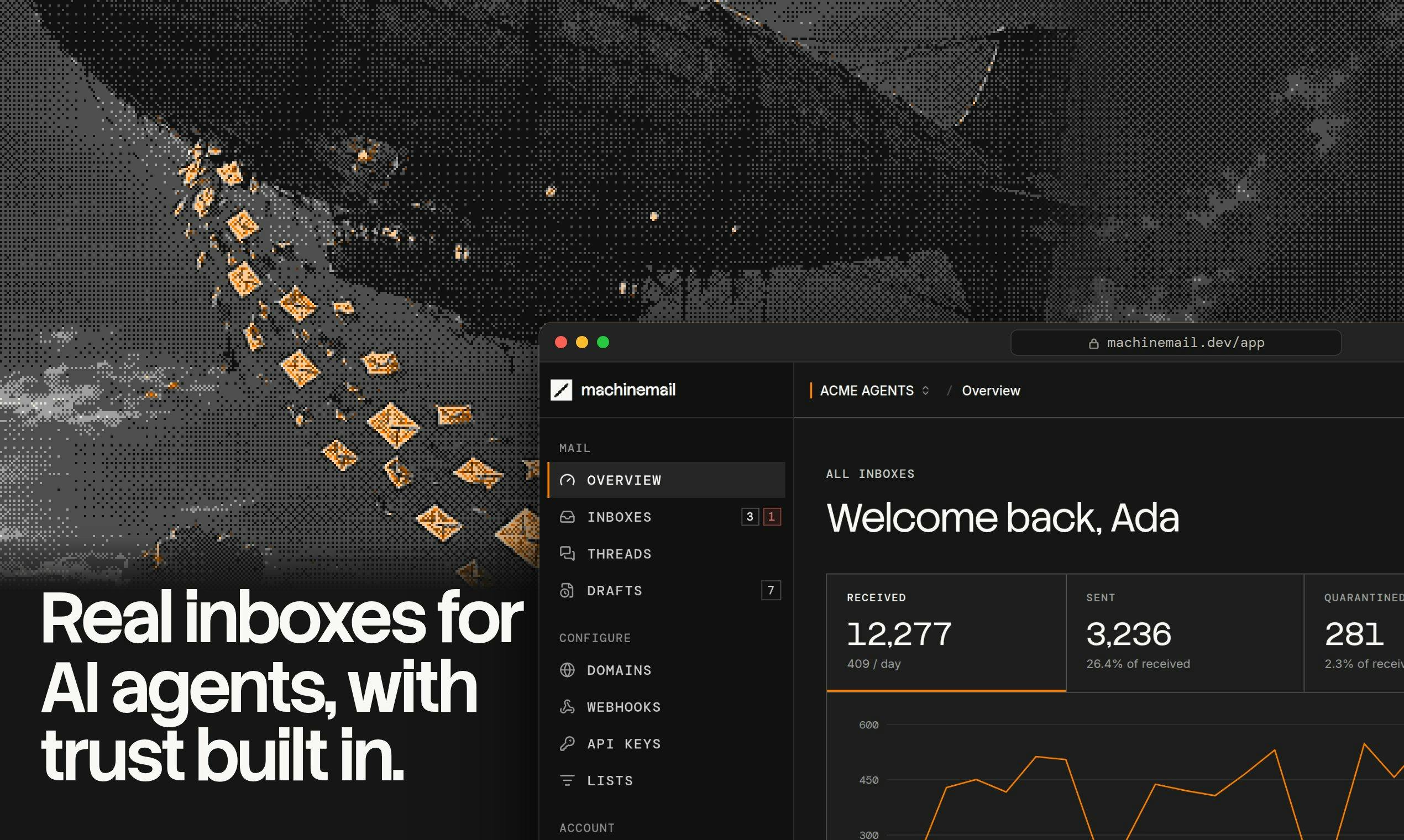
MachineMail is an email service for AI agents that gives them real addresses to send and receive mail, with custom domain support. Its key differentiator is a trust report attached to every inbound message, helping agents assess sender credibility. It supports MCP and API integration, with MCP prioritized for agent-workflow developers. Free tier: 3,000 messages/month; paid from $9/month. Details on trust report evaluation and outbound controls are not yet public.
AI agents need more than text generation to truly integrate into workflows—they need to be able to send and receive emails and handle external communications. But letting AI operate email inboxes directly brings security and trust concerns: how do you confirm whether a sender is a human or another AI? How do you prevent malicious emails from inducing an agent to perform dangerous actions? MachineMail attempts to answer these questions with an "email service with trust reports."
Product Positioning: Giving Agents a "Legitimate" Email Identity
MachineMail's core idea is straightforward: give AI agents real email addresses so they can receive and send emails. Developers connect agents via MCP or API and can use their own domains.
This solves a real pain point. Currently, most agents handle email by attaching to a human email account, resulting in blurred permission boundaries and difficulty distinguishing communication counterparts. MachineMail provides email as infrastructure for agents, essentially assigning each agent an independent communication identity.
In terms of pricing, the free tier allows 3,000 messages per month, and paid plans start at $9 per month. For automation scenarios that require sending and receiving large volumes of email, this threshold is not high.
Trust Reports: Every Inbound Message Goes Through Security Screening
MachineMail's most differentiated design is that "every inbound message comes with a trust report."
When an agent receives an email, it doesn't just get the body text—it also receives an assessment of the sender's credibility. This is quite critical in agent automation scenarios—when an agent makes autonomous decisions based on email content (such as replying, forwarding, or invoking tools), whether the email source is trustworthy directly determines the risk level.
From the product description, the trust report is an additional information layer for inbound messages, rather than simple spam filtering. It's more like providing a basis for judgment in the agent's decision-making chain: who sent this email and how trustworthy it is, so the agent can adjust its behavioral strategy accordingly.
However, the official documentation does not disclose the specific evaluation dimensions and technical implementation of trust reports, which is something to watch for going forward.
In the email security space, sender identity verification typically relies on three technologies: SPF, DKIM, and DMARC. SPF verifies whether the sending IP is in the domain's authorized list; DKIM uses digital signatures to ensure email content hasn't been tampered with; DMARC builds on the results of the first two to tell receivers how to handle emails that fail verification. These mechanisms effectively prevent sender forgery, but they only verify domain-level authenticity and cannot determine whether email content has malicious intent (such as phishing links or social engineering manipulation). For AI agents, simply knowing that "the sending domain is legitimate" is not enough, because attackers may use legitimate domains to send carefully crafted manipulative content. Therefore, MachineMail's trust reports likely need to combine multiple signals such as domain reputation, content analysis, and behavioral patterns to provide agents with a more comprehensive risk assessment.
MCP Integration: Aligning With the Agent Tool Ecosystem
MachineMail supports both MCP and API integration methods, with MCP being mentioned first—a noteworthy detail.
MCP is becoming a common protocol for connecting AI tools with external services, and agent frameworks increasingly support it. MachineMail placing MCP before API indicates that its target users are developers building agent workflows, rather than traditional email integration scenarios.
The option to use your own domain makes emails sent by agents appear to come from a legitimate business domain rather than a temporary address. For business scenarios that require communicating with external customers and partners, this reduces the likelihood of being flagged as spam.
MCP (Model Context Protocol) is an open protocol proposed by Anthropic in late 2024, aimed at standardizing how AI models interact with external tools and data sources. It uses a client-server architecture: AI applications (such as agent frameworks) act as clients, while external services (such as email, databases, and APIs) act as servers, exposing tool capabilities through a unified JSON-RPC interface. Compared to the traditional approach of writing separate integration code for each service, MCP allows developers to implement the protocol once and have it callable by any MCP-supporting agent framework. Currently, tools like Claude Desktop, Cursor, and Zed natively support MCP, and a large number of open-source MCP servers have emerged in the community. MachineMail's prioritization of MCP means it can be directly embedded into these mainstream agent workflows, reducing integration costs for developers and aligning with the broader trend of standardization in the agent tool ecosystem.
Several Issues Worth Watching
The product currently has 80 upvotes on Product Hunt, ranking 8th, with modest discussion and only 3 comments. As an early-stage product, several questions remain to be clarified:
- What is the basis for trust reports? Is it based on sender domain reputation, email content analysis, or other signals?
- How are the frequency and content of emails sent by agents audited? The product description does not mention outbound-side controls.
- The free tier of 3,000 messages per month is sufficient for individual developers, but billing for multi-agent scenarios needs further understanding.
Summary
MachineMail taps into an emerging need: agents need independent communication identities, and communication identities need a trust layer. Packaging email and trust reports as infrastructure is a clear approach. However, the actual effectiveness of trust reports, outbound-side security controls, and the stability of an early-stage product all need to be tested in practice. For developers building email-based agent applications, this is a direction worth watching.
One-line Summary
MachineMail provides AI agents with independent email inboxes and trust reports, supporting MCP/API integration.
Paragraph Summary
MachineMail is an email service for AI agents that gives agents real email addresses to send and receive emails, with support for custom domains. Its core differentiation is attaching a trust report to every inbound message, helping agents assess sender credibility and evaluate risk during autonomous decision-making. The product supports both MCP and API integration, with MCP mentioned first, indicating it targets developers building agent workflows. On pricing, the free tier allows 3,000 messages per month, with paid plans starting at $9 per month. The product is currently in its early stages; the specific evaluation dimensions of trust reports and outbound-side controls have not been disclosed, and actual effectiveness remains to be tested in practice.
Related articles
 Tech Frontiers
Gemini Omni 1.2 Flash: AI Video Moves Toward Draft-Style Editing
Google's Gemini Omni 1.2 Flash update enables conversational, draft-style editing of the same video—swap scenes while keeping products, adjust lighting while keeping characters. Clips up to 15s, 720p costs 30% less than the previous Flash—ideal for e-commerce ads, previs, and short-asset production.

Codex Tutorial: One-Command Install and Run Your First Task
Codex tutorial: one-command install and run your first task. Covers the four Codex forms, sandbox and approval guardrails, AGENTS.md and MCP configs, cloud network policy, and the iron rule of human review—everything you need to get started with this autonomous coding agent.
 Tech Frontiers
Localix: An Open-Source Agentic Development Environment with Multi-Model and Local AI Integration
Localix is an MIT open-source Agentic Development Environment (ADE) supporting seamless Claude Code plugin loading, multi-model cloud and local execution, Mini Apps extensions, and agent context management—an open AI collaboration workbench for developers.