MacSentinel: A Native Mac Tool That Diagnoses Performance Issues and Cleans Safely
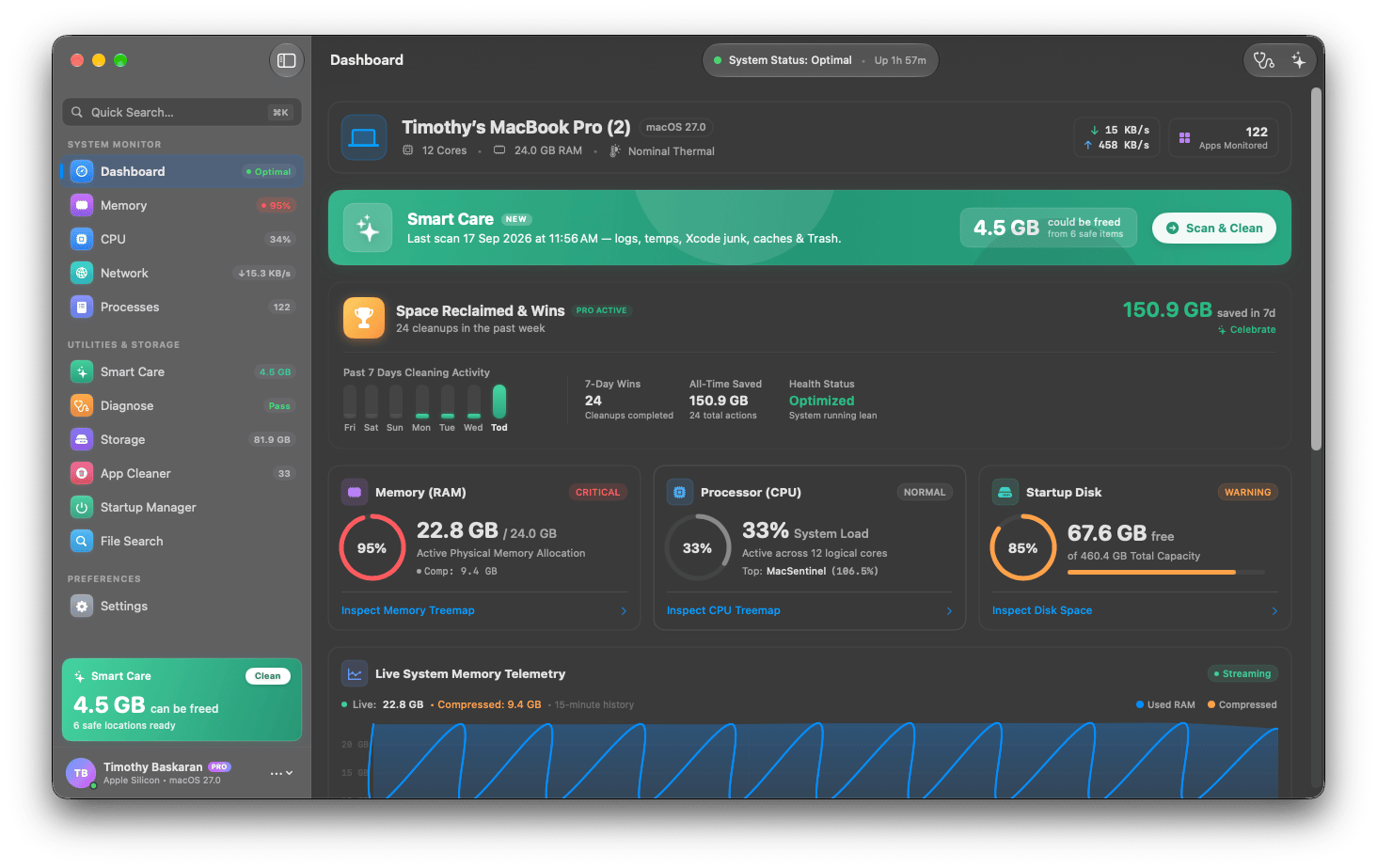
MacSentinel diagnoses Mac slowdowns and cleans safely with 500+ app rules and a one-time purchase.
MacSentinel is a native Mac cleanup tool on Product Hunt built around a "diagnose first, act second" philosophy — analyzing slowdown causes locally rather than just displaying metrics. Its flagship Smart Care feature includes 500+ app rules across 50 categories, covering Xcode derived data, render caches, and AI tool files. It uses a Trash-first mechanism for recoverable cleanup and offers a one-time purchase instead of a subscription.
Long-time Mac users inevitably run into sluggishness and low storage warnings. Most cleanup tools on the market stop at displaying system metrics or deleting generic caches — rarely explaining what's actually causing the slowdown. MacSentinel, a native app that recently appeared on Product Hunt, takes a different approach: diagnose first, then clean safely.
Integrating Monitoring, Diagnostics, and Cleanup into One Native Workflow
MacSentinel positions itself as a tool that combines Mac performance monitoring, issue diagnostics, storage analysis, and cleanup into a single native workflow. Most similar tools either just list system metrics like CPU and memory usage, or offer a one-click cache deletion with no explanation of the underlying cause.
MacSentinel emphasizes "explain before acting": it analyzes possible reasons why your Mac is slowing down locally, rather than dumping raw data on users to figure out themselves. For everyday users unfamiliar with system internals, knowing why things are slow is often more valuable than seeing how slow they are. This diagnostic-first product philosophy is what sets it apart from traditional cleanup software.
Smart Care: 500+ App Rules Across 50 Categories
The standout feature is Smart Care, which includes over 500 built-in app rules covering 50 categories — spanning development, creative work, productivity, and AI tools.
This means MacSentinel doesn't apply one-size-fits-all logic to every file. Instead, it uses differentiated cleanup strategies tailored to specific applications. For example, Xcode derived data and build caches common among developers, render temp files used by creative professionals, and local data generated by emerging AI tools can all be identified with greater precision. For power users like developers and creatives who burn through disk space quickly, targeted rules are generally more effective at reclaiming meaningful storage — and far less likely to accidentally delete critical files.
Take Xcode as an example: its DerivedData directory can easily balloon to tens of gigabytes under heavy use, containing compiled intermediates, index caches, and playground logs. Manually locating these paths isn't intuitive for most developers. On the AI tools side, locally-run large language models or image generation tools often leave behind model weight caches, inference logs, and temporary tensor files in user directories. Because this tool ecosystem is relatively new, traditional cleanup software has almost no recognition rules for it. Smart Care claims to have established dedicated strategies for these scenarios — a key differentiator from generic cleanup logic.
Safety First: Trash-First Recoverable Cleanup
The biggest concern with any cleanup tool is accidental deletion. MacSentinel uses a Trash-first design, meaning cleaned files are sent to the Trash rather than permanently erased, giving users the ability to recover them before confirming.
This recoverable mechanism lowers the barrier to use and reduces anxiety — especially for users worried that cleanup software might be too aggressive. Compared to solutions that permanently delete files immediately, Trash-first strikes a more cautious balance between convenience and safety.
Technically, the Trash-first strategy replaces permanent deletion (unlink) with a file move operation. The actual disk space isn't freed until the Trash is emptied, meaning users need to manually empty the Trash to reclaim storage — a step that can't be overlooked on devices critically low on space. Some competing products offer a "preview → confirm → delete" flow, sacrificing recoverability for immediate space recovery. Both approaches involve trade-offs; MacSentinel's choice prioritizes data safety, making it better suited for users unfamiliar with system file structures who want to keep their options open.
One-Time Purchase — No Subscription
On the business model front, MacSentinel goes against the current trend: the Pro version is a one-time purchase, not a subscription.
As more and more software tools shift to monthly or annual subscriptions, a perpetual license still holds strong appeal for many users — particularly for system maintenance tools that aren't used daily but are worth keeping around long-term. This pricing strategy may also serve as a meaningful differentiator in a crowded market.
Quick Take
MacSentinel earned 76 upvotes on Product Hunt and ranked #15, listed under Mac, Storage, and Developer Tools, built by Timothy Baskaran. From what's publicly available, it aims to carve out its own space in the crowded Mac cleanup tool market through a combination of diagnostic-driven analysis, targeted rules, safe cleanup, and a one-time purchase model.
For developers, creative professionals, and users troubled by local caches from AI tools, the scenario-specific cleanup rules genuinely address real pain points. That said, the actual diagnostic accuracy, rule update frequency, and long-term maintenance after purchase still need more real-world user feedback to validate. If you're curious, it's worth evaluating as an alternative to traditional cleanup tools.
Related articles
WAN 2.1 Physics Motion LoRA Benchmark: Rankings and Methodology for 11 Models Tested
A Reddit user benchmarked 11 physics-motion LoRAs on WAN 2.1 using optical flow analysis. Only 3 worked meaningfully; 4 scored below the no-LoRA baseline. Full rankings and methodology inside.
Lucid Partners with Bolt to Target European Robotaxi Market
Lucid Motors has signed a letter of intent with European mobility platform Bolt to explore Robotaxi services in Europe, though no vehicle orders have been placed yet.
AI Assistants Enter the "Phone Call" Era: Instinct and Meta Muse Add Voice Task Execution
AI assistants Instinct and Meta Muse now make phone calls on your behalf — booking restaurants, canceling subscriptions — marking a leap from chat tools to real-world agents.