MAEM: Scaling the Interpretation of Residual Stream Directions with Reinforcement Learning
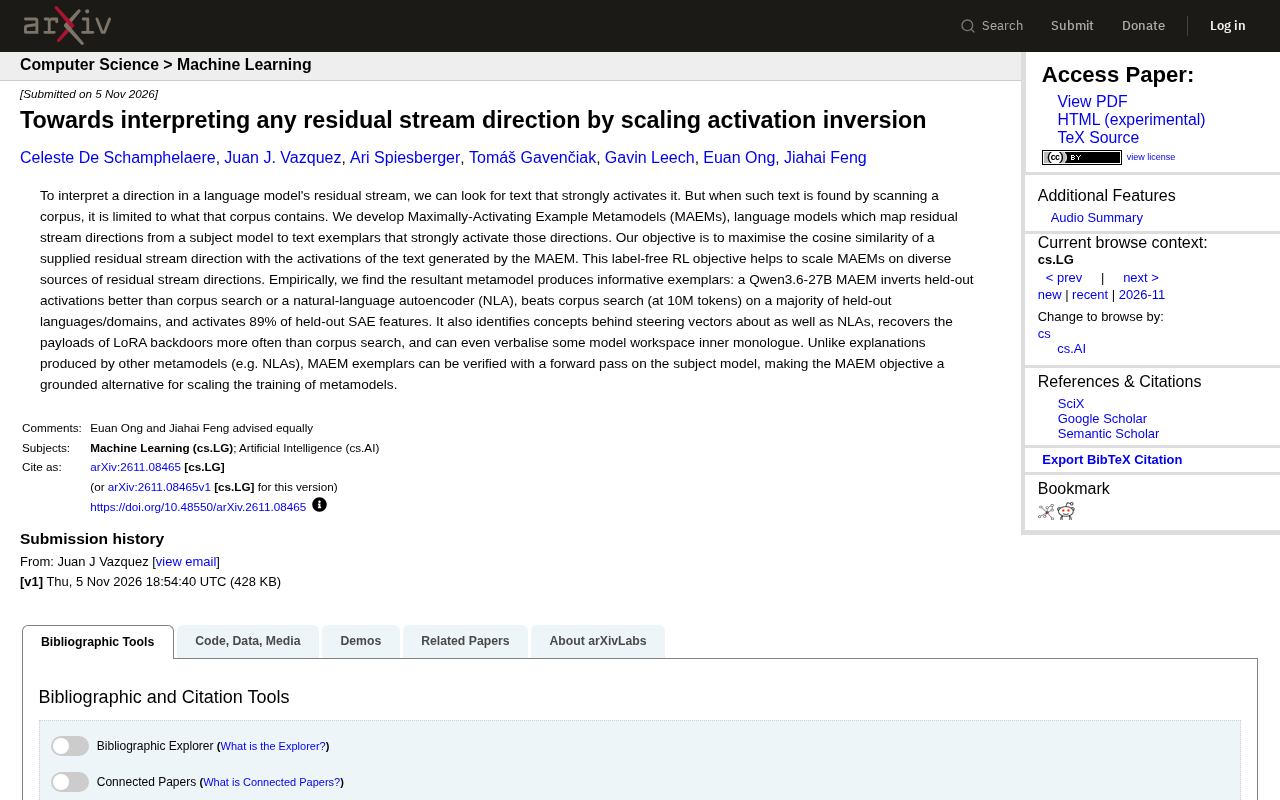
MAEM uses label-free reinforcement learning to map residual stream directions into strongly activating text, breaking through the limits of corpus search.
The article introduces MAEM (Maximally-Activating Example Metamodel), a new method for interpreting directions in the residual stream of large language models. Traditional corpus search is limited by corpus coverage, whereas MAEM is itself a language model that takes a residual stream direction and generates text that strongly activates it. Its training requires no human labels; instead, it uses the cosine similarity between the activation from the subject model's forward pass and the target direction as a reward optimized via reinforcement learning. On Qwen3.6-27B, MAEM outperforms corpus search and NLA, beats 10-million-token corpus search on most held-out languages and domains, activates 89% of held-out SAE features, and performs better on tasks such as recovering LoRA backdoor payloads. Its key advantage over NLA is verifiability: generated examples can be objectively checked in a single forward pass, providing a grounded objective for training metamodels at scale.
From "Corpus Search" to "Metamodel Generation": A Paradigm Shift in Residual Stream Interpretation
A common approach to understanding the internal representations of large language models is to find text that strongly activates a given residual stream direction. The traditional method is to scan a corpus and see which text fragments best match the activation of that direction. But this approach is limited by what the corpus itself contains—if there is no relevant text in the corpus, no suitable explanation can be found.
According to a research blog, a new method called Maximally-Activating Example Metamodels (MAEMs) attempts to break through this limitation. MAEM itself is a language model whose task is to map a residual stream direction of a subject model into text examples that strongly activate that direction.
The core objective of this work is to maximize the cosine similarity between a given residual stream direction and the activation produced by MAEM-generated text. Because this objective requires no labels, reinforcement learning can be used to optimize it, allowing MAEM to handle residual stream directions from different sources at scale.
The residual stream is the main information channel that runs through all layers in the Transformer architecture. Each layer's attention sublayer and feed-forward network sublayer "add back" their outputs into this channel, so at any position the residual stream is a high-dimensional vector that can be viewed as the model's cumulative representation of the current token at that depth. Researchers often treat a direction in the residual stream as a linear feature carrying a specific concept or function, and by intervening along that direction (e.g., with steering vectors) they can observe behavioral changes. Understanding "what a given direction represents" is precisely the core question of residual stream interpretation.
How the Label-Free Reinforcement Learning Objective Works
MAEM's training does not rely on human-annotated "correct explanations"; instead, it directly uses the forward pass results of the subject model as the reward signal. Specifically, MAEM receives a residual stream direction vector, generates a passage of text, and then feeds this text into the subject model to compute the cosine similarity between its activation and the direction vector. The higher the similarity, the better the generated text "hits" the target direction.
The key advantage of this design is verifiability. Unlike explanations produced by metamodels such as Natural Language Autoencoders (NLA), MAEM-generated examples can be checked directly with a single forward pass of the subject model—if the text indeed strongly activates the target direction, then it is a grounded explanation. This "grounded" property makes MAEM's objective function suitable for training at scale.
Cosine similarity measures how closely two vectors align in direction, with values ranging from -1 to 1, independent of vector length. In MAEM, it is used to compare whether "the activation vector produced when the subject model processes the generated text" and "the target residual stream direction vector" point in the same direction: the closer the similarity is to 1, the better the text activation matches the target direction. Cosine similarity is chosen over dot product or Euclidean distance because interpretation concerns semantic alignment of direction rather than the absolute magnitude of activation, which avoids length differences interfering with the reward signal.
Empirical Performance: Surpassing Corpus Search and NLA
The research team built MAEM on Qwen3.6-27B and evaluated it on multiple tasks. The results show several noteworthy conclusions:
- Inversion outperforms baselines: On held-out activation directions, MAEM's inversion performance is better than corpus search and Natural Language Autoencoders (NLA).
- Cross-lingual/cross-domain advantage: On most held-out languages and domains, MAEM beats corpus search using 10 million tokens.
- SAE feature coverage: MAEM activates 89% of held-out SAE features, indicating that its generated examples can reach a wide variety of semantic features captured by sparse autoencoders.
- Concept identification and safety applications: In identifying the concepts behind steering vectors, MAEM performs roughly on par with NLA; on the task of recovering LoRA backdoor payloads, MAEM succeeds more often than corpus search.
- Inner monologue verbalization: MAEM can even verbalize some of the "inner monologue" of the model's workspace.
Together, these results indicate that MAEM can not only find activation text already present in the corpus but also generate new, explanatorily powerful examples.
Sparse Autoencoders (SAEs) are an unsupervised tool commonly used to decompose model activations. They train a wide-bottleneck autoencoder with a sparsity constraint to reconstruct dense residual stream activations into a set of sparse latent features, each often corresponding to an interpretable semantic concept (e.g., "legal terminology," "negative tone"). The so-called "held-out SAE features" refer to a set of features not directly targeted during MAEM training and used for evaluation afterward. That MAEM can activate 89% of held-out features means its generated text does not merely hit a few directions but can cover the broad semantic space characterized by the SAE, which provides indirect evidence that "generated examples are explanatorily powerful."
Comparison with NLA: Verifiability as the Watershed
NLA (Natural Language Autoencoder) is another type of metamodel that maps activations into natural language explanations. MAEM and NLA perform similarly on concept identification tasks, but the fundamental difference between the two lies in how they are verified.
The explanations generated by NLA are themselves natural language descriptions, and it is hard to directly judge whether they are faithful to the model's internal state. In contrast, MAEM generates concrete text examples whose activation similarity can be computed via the subject model's forward pass, yielding an objective verification score. This verifiability makes MAEM better suited as a grounded objective for training metamodels at scale.
In other words, MAEM is not "guessing" what the model is doing; it is "finding" text that can reproduce the activation of that direction. This closed loop from generation to verification offers a more reliable path for residual stream interpretation.
Steering vectors are direction vectors obtained by taking the difference of mean residual stream activations under different input conditions or by training a linear probe for a concept. At inference time, multiplying it by a coefficient and adding it to the residual stream can steer model outputs toward a specific concept (e.g., more positive, more formal). Explaining the concept behind a steering vector essentially means answering "what does this direction represent semantically." By generating text that can reproduce the activation of that direction, MAEM provides a testable semantic anchor for steering vectors, which is also the basis for its safety applications (such as identifying injected backdoor directions).
Significance and Limitations
The value of MAEM lies in turning the interpretation of residual stream directions from a "retrieval problem" into a "generation problem" and using reinforcement learning to bypass the annotation bottleneck. It frees interpretation from the limits of corpus coverage and can in principle handle arbitrary directions—including those for which no corresponding text exists in the existing corpus.
However, the method is currently still primarily experimented on Qwen3.6-27B, and its generalization ability across models with different architectures remains to be further verified. In addition, although MAEM-generated examples can strongly activate the target direction, whether "strong activation" equates to "faithful explanation" remains an open question worth continued discussion. The research team positions MAEM as a grounded alternative for training metamodels at scale, and this direction is worth watching.
One-line Summary
MAEM uses label-free reinforcement learning to map residual stream directions into strongly activating text, breaking through the limits of corpus search.
Paragraph Summary
The article introduces a new method called MAEM (Maximally-Activating Example Metamodel) for interpreting directions in the residual stream of large language models. Traditional corpus search is limited by corpus coverage, whereas MAEM itself is a language model that receives a residual stream direction and generates text that strongly activates that direction. Its training does not rely on human annotation; instead, it uses the cosine similarity between the activation obtained from the subject model's forward pass and the target direction as a reward, optimized with reinforcement learning. Experiments on Qwen3.6-27B show that MAEM's inversion performance is better than corpus search and NLA, beating 10-million-token corpus search on most held-out languages and domains, activating 89% of held-out SAE features, and performing better on tasks such as recovering LoRA backdoor payloads. Compared with NLA, MAEM's key advantage is verifiability: generated examples can be objectively checked with a single forward pass, providing a grounded objective for training metamodels at scale.
Related articles
 Tech Frontiers
Stylome Bot Slammed as Useless Junk: Why Do AI Detection Tools Keep Failing?
Reddit users test the Stylome AI detection bot: Gemini-rewritten text judged human-written, consistently low confidence. An analysis of AI text detection's technical dilemmas, privacy concerns, and credibility crisis in community governance.
 Tech Frontiers
When AI Becomes a Productivity Divide: Clarity or "AI Psychosis"?
A civil engineer's deep use of agentic AI boosted efficiency but bred contempt for peers who refuse to learn. Is this clarity or AI psychosis? An analysis of the cognitive and psychological challenges behind the AI productivity divide.
 Tech Frontiers
Opus 5.5 Benchmark Scores Climb, Community Says Its "Weights Are Blessed"
Reddit community discusses Opus 5.5's rising scores on the Benchmaxxing Bench, with users describing its performance as "weights are blessed." This article interprets the community reaction and cautions against conflating benchmark scores with real capability.