Magnitude: A Privacy-First Code Assistant That Keeps Everything Local

Magnitude keeps AI code assistance fully local with bundled inference engine and complete Agent capabilities.
Magnitude is a privacy-first AI code assistant that runs model inference and Agent execution entirely on the user's local machine. It features hardware-aware auto-configuration that detects your GPU, RAM, and CPU to recommend and set up appropriate models automatically. Beyond simple Q&A, it offers full Agent capabilities including file modification, command execution, and extensible skills — all without sending data to the cloud. While local models can't match cloud-based frontier models in raw capability, Magnitude serves developers who prioritize keeping sensitive code off external servers.
Sensitive Code Stays Off the Cloud: Magnitude's Core Value Proposition
In today's crowded field of AI coding assistants, the vast majority come with one prerequisite: your code needs to be sent to the cloud for remote model processing. For developers working on sensitive projects involving trade secrets or compliance constraints, this alone is a dealbreaker.
Magnitude aims to solve exactly this pain point. It's a private code assistant that keeps both model inference and Agent execution entirely on your local machine. What truly hits the mark isn't just another chat interface — it's that the team bundles a local inference engine with the product, so you don't need to set up an inference environment from scratch. A local inference engine refers to a framework that runs large language models on the user's own device. Common solutions in the industry include llama.cpp, Ollama, vLLM, and others. These engines use model quantization techniques (for example, compressing 32-bit floating-point parameters down to 4-bit integers) to drastically reduce VRAM requirements, enabling models that would normally require server clusters to run on consumer-grade hardware. Magnitude integrates this type of engine out of the box, sparing users the hassle of manually selecting quantization schemes, configuring CUDA or Apple Metal acceleration, and other tedious steps.
According to a Bilibili creator's overview, Magnitude's positioning is crystal clear: it's designed for people who handle sensitive code and prioritize local processing. Its differentiation isn't about being "more powerful" — it's about "keeping data on your machine as much as possible."
Hardware-Aware Auto-Configuration Lowers the Local Deployment Barrier
Deploying models locally has always been a high-barrier endeavor — choosing models, configuring environments, downloading weights — each step can discourage average users. Magnitude has put considerable engineering effort into addressing this.
According to official documentation, it first analyzes your hardware configuration, then recommends suitable models and automatically handles the download and setup process. Specifically, hardware-aware configuration involves detecting GPU model and VRAM size, system memory capacity, CPU architecture, and other key information, then matching appropriate model sizes and quantization levels accordingly. For example, a machine with an 8GB VRAM GPU might be suited to run a 7B-parameter 4-bit quantized model, while a machine with 24GB VRAM could attempt a quantized version of a 70B-parameter model. This automatic matching mechanism prevents users from selecting the wrong model and encountering out-of-memory (OOM) crashes or severely insufficient performance. In other words, "less hassle" is itself a major selling point. For developers who don't want to dive deep into local inference details, this plug-and-play experience is remarkably friendly.
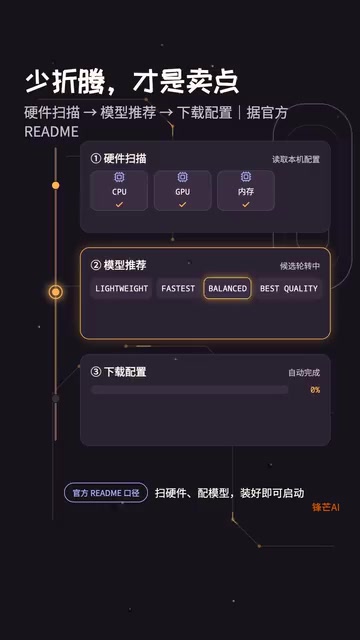
This hardware-aware design philosophy deserves recognition. After all, local model performance is highly dependent on machine specs — understanding what you're working with before recommending a solution is far more practical than having users guess blindly.
More Than Answering Questions: Full Local Agent Capabilities
The biggest difference between Magnitude and ordinary chat-based assistants is that it's a true Agent, not just a Q&A box. It's worth explaining the AI Agent concept here: an Agent is an intelligent entity with autonomous planning, tool invocation, and multi-step execution capabilities, fundamentally different from single-turn Q&A chatbots. Agents typically employ ReAct (Reasoning + Acting) or similar loop architectures — first reasoning about what to do next, then calling external tools to execute actions, then observing execution results and deciding subsequent moves. This enables Agents to autonomously complete compound task chains like reading/writing files, running terminal commands, and calling APIs, rather than merely generating a text response.
According to official documentation, it can:
- View and modify files
- Execute commands and run scripts
- Process images
- Extend to documents, spreadsheets, and browser scenarios through skills
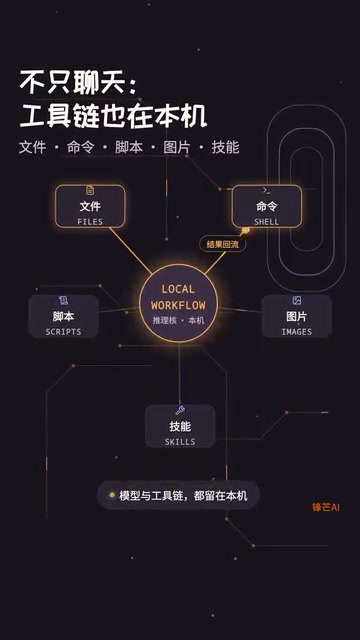
The most critical point is that the entire workflow stays on your machine. From inference to tool invocation, there's no need to rely on the cloud at every step. This addresses a long-overlooked pain point: a local Agent shouldn't achieve local inference only to send data back to the cloud during tool invocation. Magnitude's design keeps this entire chain local.
Capability Boundaries: Local Inference Doesn't Mean More Powerful
That said, a dose of reality is necessary here. Local inference does not equate to stronger model capabilities.
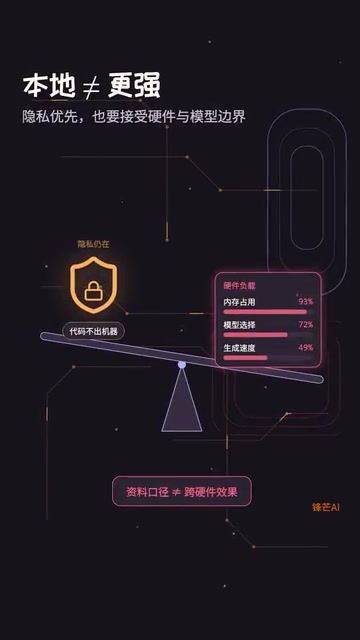
Model selection, memory usage, and generation speed are all directly constrained by your machine's performance. Available information only confirms the team's product positioning — it doesn't guarantee consistent real-world performance across different hardware setups. The benefits of privacy-first often come with compromises on capability boundaries — something users need to accept upfront. Currently, top-tier models available via the cloud (such as GPT-4, Claude 3.5 Sonnet) typically have hundreds of billions of parameters, while locally runnable models are limited by hardware to versions with only billions to tens of billions of parameters. The gap between the two in complex reasoning, long-context understanding, and similar tasks objectively exists.
If you're chasing the absolute best model capabilities, Magnitude may not be your first choice. But if your core requirement is "keeping data on your machine as much as possible," it's an excellent fit. This is a trade-off that requires clear-headed evaluation.
GitHub Popularity Is Only Supporting Evidence
Looking at community traction, as of the time of data collection, Magnitude shows 925 stars and 88 forks on GitHub.
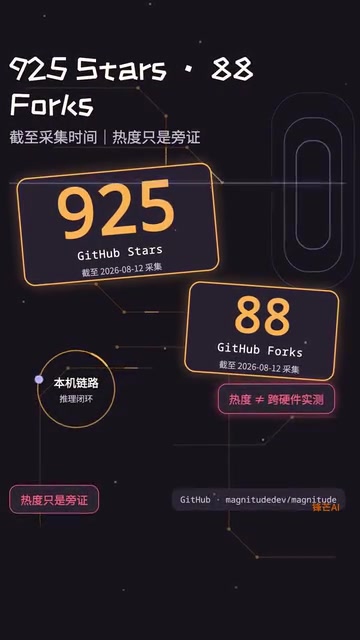
These numbers aren't extraordinary, but they've captured a genuine need: a local Agent shouldn't depend on the cloud at every step from inference to tool invocation. It's worth noting that GitHub star counts can only serve as supporting evidence — they don't directly equate to product maturity or actual effectiveness.
Is Magnitude Worth Your Attention?
Overall, Magnitude is best suited for the following types of developers:
- Those handling sensitive code involving privacy or compliance constraints
- Those who prioritize local processing and want data to stay on their machine
- Those willing to accept the capability boundaries of local models
Conversely, if you're only pursuing the highest model capabilities and don't care where your data goes, its appeal to you will be limited.
For privacy-first developers, Magnitude offers a relatively complete local-first pathway worth adding to your watchlist. Interested readers can search for Magnitude or Dev-Magnitude to learn more. Of course, don't follow the hype blindly — your final judgment should be based on real-world experience on your own machine.
Related articles

Chain of Thought Isn't Just for AI: How Humans Can Use CoT to Improve Thinking Quality
Chain of Thought isn't just a prompt trick for large models. Starting from a Hacker News discussion, this article analyzes why CoT works for human thinking too, breaks down actionable ways to transfer it, and highlights the key differences between human CoT and machine CoT.
Cloudflare Teams Up with OpenAI: Closi…
Cloudflare Teams Up with OpenAI: Closing the Loop from Vulnerability Discovery to Defense with AI
Cloudflare uses OpenAI Daybreak to investigate security vulnerabilities and generate reviewable remediation plans, while developers use Codex to boost coding efficiency and quality.

Orca Multi-Agent Orchestration in Practice: A Guide to Parallel Collaboration with Claude and Codex
Orca is Stable AI's free open-source agent workbench supporting 34 agents like Claude Code and Codex in parallel. Learn its Git worktree isolation, multi-model orchestration, and mobile management.