Magnitude: One Service to Handle Local LLM Inference and Agent Integration
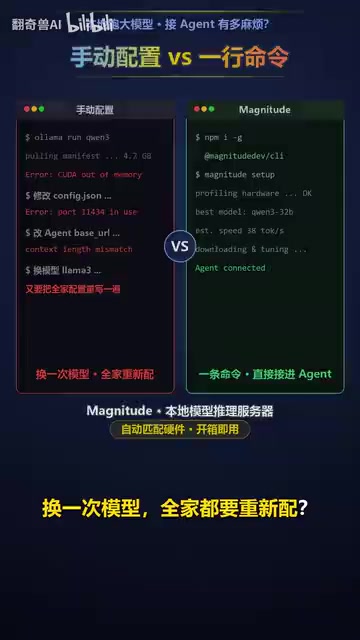
Magnitude is an open-source server that makes local LLM inference seamlessly work with mainstream AI Agents.
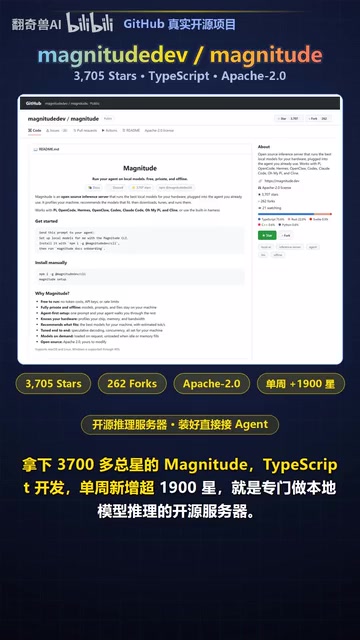
Magnitude is an open-source local LLM inference server built with TypeScript that bridges the gap between running models locally and connecting them to AI Agents like OpenAI Codex and Claude Code. It automatically detects hardware and optimizes model configurations, supports multi-model switching without reconfiguration, and provides OpenAI-compatible API endpoints for seamless Agent integration. With over 3,700 GitHub stars and rapid community growth, it fills a critical gap in the local AI deployment toolchain.
Where Do Local LLM Setups Get Stuck?
Developers who want to run large language models locally often face a common pain point: there's a massive configuration gap between deploying an inference service and connecting it to AI Agents. Every time you switch models, you have to reconfigure the environment; every time you connect a new Agent, you have to wrestle with API compatibility all over again. This repetitive labor eats up time that should be spent on actual development.
The "inference service" here refers to the runtime environment that loads a trained model into memory or VRAM, accepts inputs, and generates outputs. An "Agent" is an AI application capable of autonomously calling tools and executing multi-step tasks—think coding assistants, automated workflows, and the like. The gap between the two lies in the fact that inference services typically expose low-level APIs, while Agents expect standardized interfaces conforming to specific protocol formats (such as the OpenAI Chat Completions API format). Different inference frameworks (e.g., llama.cpp, vLLM, TGI) have varying API formats, parameter naming conventions, and response structures, meaning every time you swap out the underlying inference solution, you need to re-adapt the Agents on top.
Magnitude is an open-source project built to solve exactly this problem. It's a server focused on local model inference, with one core goal: let developers configure once and seamlessly connect local models to all major Agents, without ever worrying about the underlying deployment details.
What Is Magnitude?
Positioning: A Unified Access Layer for Local Inference
At its core, Magnitude is a local model inference server built with TypeScript. It acts as an adaptation layer between local models and various AI Agents, abstracting away differences across models and hardware configurations while providing a unified interface to the layers above.
This positioning differentiates it from tools like Ollama or LM Studio, which focus more on model management and execution. Ollama is an open-source tool dedicated to running and managing local LLMs, offering a Docker-like experience—you can pull and run various open-source models with simple command-line instructions, with llama.cpp bundled as the inference backend. LM Studio provides a graphical interface that lets users browse, download, and run GGUF-format models, making it more suitable for non-technical users. The core value of both lies in "getting models to run"—simplifying model downloading, format conversion, and inference engine configuration. However, their adaptation to the Agent ecosystem is relatively limited. They typically only provide basic OpenAI-compatible API endpoints, and their support for advanced Agent features like tool calling (Function Calling), streaming output formats, and multimodal inputs may be incomplete or inconsistent.
Magnitude focuses specifically on the "integration" aspect—it doesn't just get models running, it makes them directly usable by Agents, ensuring that local model output formats, capability declarations, and interaction protocols seamlessly align with what mainstream Agents expect.
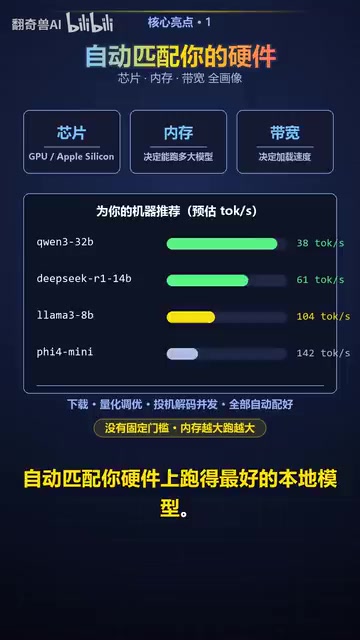
Core Feature: Automatic Hardware-Optimal Configuration
One of Magnitude's key capabilities is automatically detecting the current hardware environment and matching the best local model configuration for that hardware. This is especially useful for users with limited VRAM or those running CPU inference—no need to manually tweak quantization parameters, context length, or batch size, as the service automatically provides recommended configurations.
Several key concepts here are worth expanding on. Quantization is the technique of converting model weights from high-precision floating-point numbers (e.g., FP16, BF16) to lower-precision formats (e.g., INT8, INT4, or even Q2_K, Q4_K_M in GGUF format). The goal is to reduce the VRAM and memory footprint so that large-parameter models can run on consumer-grade hardware. However, the more aggressive the quantization, the greater the loss in output quality. Context Length determines the maximum number of tokens a model can process in a single pass, directly impacting VRAM usage—for example, a 7B parameter model's VRAM requirements can differ by several GB between 4K and 32K context lengths. Batch Size affects concurrent inference capacity and throughput. The optimal combination of these three parameters is highly dependent on specific hardware configurations (GPU model, VRAM capacity, RAM size, CPU core count, etc.), and manual tuning requires considerable experience and repeated experimentation.
The logic behind this is straightforward: local inference experience is heavily dependent on how well hardware and model parameters are matched. A model with too many parameters on a low-VRAM device will result in extremely slow inference or even crashes. By automating this matching process, Magnitude dramatically lowers the barrier to entry for average developers.
Installation and Usage: Truly Out-of-the-Box
Quick Start Flow
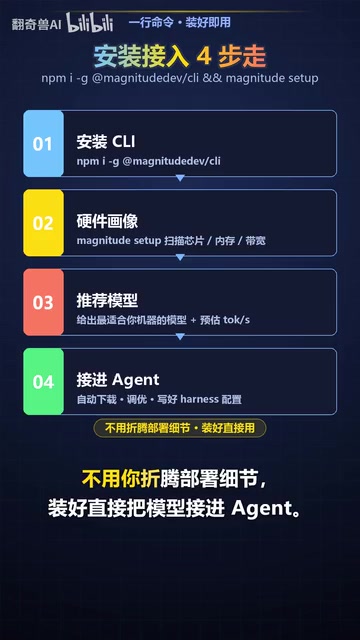
Magnitude's design philosophy is "install and go." After installation, developers don't need to write complex configuration files—the service automatically discovers locally available models and launches inference endpoints. The entire process is dramatically simplified compared to the traditional approach:
- Traditional approach: Install inference framework → Configure model path → Start service → Manually configure Agent API endpoint → Debug compatibility issues
- Magnitude approach: Install → Start → Agents connect directly
Switch Models Without Reconfiguring
In real-world development scenarios, developers frequently need to compare different models' performance or select different models for different tasks. Magnitude supports managing multiple local models under a single service instance, and when switching models, zero changes are needed on the Agent side. For researchers and developers who need to frequently experiment with different models, the efficiency gains are significant.
Agent Compatibility: Full Coverage of Mainstream Coding Tools
Out-of-the-Box Agent Ecosystem Support
Magnitude currently supports multiple mainstream AI coding Agents, including OpenAI Codex, Anthropic Claude Code, and various clients compatible with the OpenAI API format. This means developers using these tools only need to point their API endpoint to the local Magnitude service to replace cloud models with local ones—the workflow itself requires no changes whatsoever.
The key here is that OpenAI's Chat Completions API has become the de facto standard interface format in AI application development. This API defines interaction specifications including message lists (with system, user, assistant, and other roles), tool calling (Function Calling / Tool Use), streaming output (Server-Sent Events), structured output (JSON Mode / Structured Outputs), and more. Virtually all mainstream Agent frameworks—including LangChain, LlamaIndex, AutoGen, CrewAI, and others—natively support this format. When Magnitude claims OpenAI API compatibility, it means developers can switch the API base URL on the Agent side from OpenAI's cloud address to their local Magnitude service address without modifying any business code.
Why Agent Compatibility Matters So Much
The current AI coding tool ecosystem is quite mature. Developers typically accumulate extensive prompts, configurations, and usage habits around a fixed set of Agent workflows. If switching to local models means rebuilding that entire workflow, the migration cost will deter most people.
By providing a standards-compliant interface, Magnitude makes the "go local" migration nearly transparent. This is the core reason it offers more practical value compared to other local inference solutions.
Project Status and Community Traction
What the Growth Numbers Tell Us
As of now, Magnitude has accumulated over 3,700 stars on GitHub, with more than 1,900 new stars in a single week—meaning the star count nearly doubled in just one week. This kind of growth rate is uncommon in the open-source tools space and typically indicates that a project has precisely hit a real pain point within the developer community.
From the community's response, it's clear that the need for connecting local inference to Agents has long been in a "missing tools" state. In the local/private AI deployment space, tool options show a polarization: on one end are full MLOps platforms like BentoML, Ray Serve, and Triton Inference Server, which provide enterprise-grade capabilities such as model version management, A/B testing, auto-scaling, monitoring, and alerting—but their deployment and configuration complexity is extremely high, making them overkill for individual developers and small teams. On the other end are minimalist solutions like llama.cpp's server mode and llamafile, which can quickly spin up inference services but offer limited functionality in Agent protocol adaptation, multi-model management, and automatic hardware optimization. Magnitude fills the gap between these two extremes precisely—it offers more than lightweight solutions with its Agent compatibility layer and intelligent configuration capabilities, yet it's far lighter than MLOps platforms, with deployment complexity approaching zero. This "just right" feature density explains why it has attracted so much attention in such a short time.
The TypeScript Tech Stack Choice
Using TypeScript for development is a noteworthy technical decision by Magnitude. In the AI/ML space, Python dominates with its ecosystem advantages through libraries like PyTorch and Transformers, making the choice of TypeScript over Python for an inference server seem quite bold. However, at the AI application layer—particularly in Agent development and AI-driven web applications—the JavaScript/TypeScript ecosystem is growing rapidly. Vercel's AI SDK, LangChain.js, and numerous AI application templates built on Next.js all run on Node.js.
TypeScript's type safety features make the implementation and maintenance of complex API interfaces more reliable. Furthermore, Node.js's event-driven, non-blocking I/O model is naturally suited for handling Server-Sent Events streaming responses—which is exactly the core requirement for token-by-token output scenarios in LLM inference. For frontend and full-stack developers, this choice lowers the contribution barrier and makes it easier to integrate into JavaScript-based AI application development workflows. Given the current vibrancy of the JavaScript/TypeScript ecosystem in AI application development, this choice is conducive to rapid community growth.
Conclusion
The problem Magnitude solves isn't complex, but before it came along, almost no tool did it well: making local LLM inference truly out-of-the-box for mainstream AI Agents. Configure once, switch between multiple models, automatic hardware matching—these three points together form a highly practical toolchain entry point for local AI developers.
For developers who want to run models locally while maintaining a consistent experience with cloud-based Agent workflows, Magnitude is worth adding to the toolbox. The project is fully open source, currently in a rapid iteration phase, and community activity continues to climb.
Related articles
AgentScope 2.0 Deep Dive: A Complete Guide to the Multi-Agent Development Framework
Deep dive into Alibaba's AgentScope 2.0 multi-agent framework: ReAct agent design, three-layer security defense, context management, and a complete guide from beginner to production.
vLLM vs Ollama for Local LLM Deployment: A Practical Guide from Script to Production
A practical guide comparing vLLM and Ollama for local LLM deployment, covering VRAM optimization, high-concurrency serving, and how to upgrade from demo scripts to production-ready model services.
Are Markdown Config Files Going Extinct? How the Bitter Lesson Is Reshaping AI-Assisted Programming
Will CLAUDE.md and .cursorrules be replaced by AI? Analyzing the tension between hand-crafted rules and model autonomy through Sutton's Bitter Lesson.