Making Chicken Transparent with Dorito Dust? A Fun Experiment Breakdown
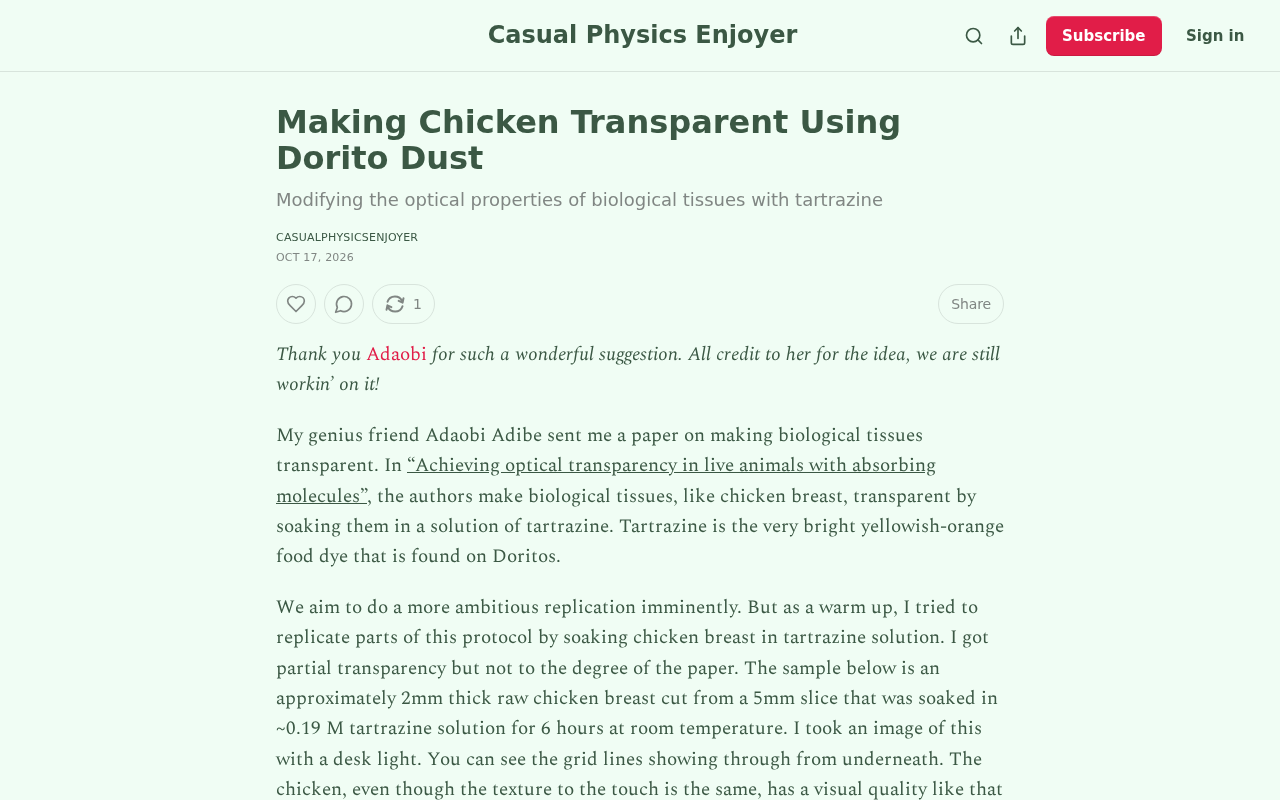
Dorito powder chicken transparency is a fun kitchen experiment, not research-grade clearing.
The article examines a Hacker News post about "making chicken transparent with Dorito powder," explaining the optics and materials science behind it. Chicken opacity results from light scattering due to uneven refractive indices; research-grade clearing requires glycerol or CLARITY. Dorito powder's salt and MSG may limitedly change surface appearance via osmosis but can't achieve true transparency. Community discussion questions the experiment's rigor, comparing it to protein denaturation from marination. Content creators can use such cross-disciplinary experiments to spark interest while distinguishing fun demos from scientific conclusions.
A post from Hacker News titled "Making Chicken Transparent Using Dorito Dust" has sparked discussion in the tech community. This seemingly absurd experiment actually involves an interesting intersection of optics, materials science, and food chemistry.
Experiment Background and Core Principles
"Making chicken transparent" isn't a common kitchen experiment, but it's not entirely scientifically absurd either. Biological tissue (such as muscle) is opaque mainly because its internal structure is uneven—light is repeatedly refracted and scattered between cell membranes, protein fibers, and water. To make tissue transparent, you typically need to homogenize the refractive index—common laboratory methods include using clearing agents like glycerol or benzyl alcohol to replace the water in tissue.
So what role does "Dorito Dust" (the seasoning powder from Doritos tortilla chips) play here? According to speculation in the HN discussion, the tortilla chip powder contains large amounts of salt and monosodium glutamate, which may alter the tissue's hydration state through osmosis, while particles in the powder may affect light scattering. However, this clearing effect is likely very limited—nowhere near research-grade transparency.
Refractive index is a physical quantity describing the speed at which light propagates through a medium, defined as the ratio of the speed of light in vacuum to the speed of light in the medium. Biological tissue consists of different components including cell membranes (lipids, refractive index ~1.46), protein fibers (refractive index ~1.50), and water (refractive index ~1.33). The significant differences in refractive index among these components cause light to scatter at microscopic interfaces, giving tissue its opaque appearance. The core strategy of tissue clearing is to replace the water in tissue with higher-refractive-index media (such as glycerol at 1.47 or benzyl alcohol at 1.54) through chemical agent immersion, electrophoresis, or perfusion, bringing the refractive indices of various components into alignment—thereby reducing scattering and increasing light transmission. This principle is widely applied in neuroscience to enable deep imaging of intact organs.
The CLARITY technique is a tissue clearing method developed in 2013 by Karl Deisseroth's team at Stanford University. Its core steps include: first, perfusing tissue with formaldehyde and acrylamide monomers to form a hydrogel network in situ that covalently crosslinks with proteins; then removing lipids (the main component of cell membranes) through electrophoresis or passive diffusion, leaving behind a transparent protein scaffold supported by the hydrogel; finally, immersing the sample in a high-refractive-index matching solution (such as FocusClear) to make the tissue optically transparent. CLARITY's advantage lies in preserving tissue structure and molecular information for subsequent fluorescent labeling and whole-organ imaging, but the process is complex and equipment-intensive—something snack powder could never replicate.
Controversies and Insights from Community Discussion
The Hacker News comment section displayed a typical tech community style: some analyzed feasibility from an optical physics perspective, some questioned the experiment's reproducibility, and others shared amusing stories of their own experiments with snacks. One consensus in the discussion was that真正的组织透明化 requires rigorous chemical processing protocols—such as the CLARITY technique (using hydrogels to embed tissue and remove lipids)—and tortilla chip powder clearly cannot achieve similar results.
Other comments noted that this experiment may simply use a high-salt or high-oil environment to make the chicken surface semi-transparent, similar to the appearance changes caused by protein denaturation when marinating fish fillets. Since the original post did not provide detailed experimental steps or result images, the community remained skeptical about the experiment's rigor.
Osmosis refers to the phenomenon where solvent molecules (usually water) diffuse through a semipermeable membrane from the side with lower solute concentration to the side with higher solute concentration. In food marination, high-salt or high-sugar environments create high osmotic pressure, causing cells to lose water, proteins to denature, and the tissue's optical properties to change—for example, marinated fish fillets or shrimp cured in lemon juice become semi-transparent. Dorito powder contains large amounts of salt and monosodium glutamate, which theoretically could increase surface osmotic pressure, causing surface cells of the chicken to dehydrate and proteins to aggregate, thereby reducing local scattering. But this effect is limited to a few millimeters in depth and is accompanied by tissue shrinkage and texture changes—it cannot achieve uniform transparency throughout.
Implications for Content Creators
This case demonstrates the tech community's strong interest in "cross-disciplinary experiments." Even if the conclusions aren't rigorous, a catchy headline and a phenomenon that seems to defy common sense can spark extensive discussion. For AI and tech content creators, this approach can be borrowed: combining complex scientific principles with everyday objects to lower the barrier to understanding—but care must be taken to distinguish "fun demonstrations" from "scientific conclusions" to avoid misleading readers.
Conclusion
"Making chicken transparent with Dorito powder" is more of an amusing kitchen science experiment than a rigorous research project. It reminds us that optical clearing is a complex physicochemical process, and snack powder's role is limited. For the tech community, the value of such posts lies in sparking curiosity and discussion—not in providing reliable knowledge conclusions.
One-line Summary
Making chicken transparent with Dorito powder is a fun kitchen experiment—far from research-grade tissue clearing.
Paragraph Summary
The article centers on a Hacker News post about "making chicken transparent with Dorito powder," analyzing the optics and materials science principles behind it. Chicken's opacity stems from light scattering caused by uneven refractive indices among internal components; research-grade clearing requires homogenizing the refractive index with agents like glycerol or employing CLARITY technology. Dorito powder contains salt and monosodium glutamate, which may limitedly alter surface appearance through osmosis but cannot achieve true transparency. Community discussion questioned the experiment's rigor, suggesting it's closer to protein denaturation from marination. The article concludes by suggesting content creators use cross-disciplinary experiments to spark interest while distinguishing fun demonstrations from scientific conclusions.
Related articles
iPhone Duo Review Controversy: Why Apple's First Foldable Is Said to 'Should Be Called an iPad'
The Vergecast debates the iPhone Duo review controversy: is a 7 fair? Why are apps struggling? Why critics say it 'should be called an iPad'? We unpack Apple's first foldable's positioning mismatch and first-gen compromises, plus AI security flaws and agentic shopping.

Meta vs. Publishers: The AI Data Battle Over Terms of Service Changes and the Future of the Internet
Meta changed its business account terms to allow AI training on linked website data, sparking backlash from publishers and creators. Industry groups demanded negotiations, forcing Meta to remove 'training' wording and delay the effective date. The dispute reveals the deeper battle over data authorization and the future of the internet in the AI era.

When Outside Xbox Meets Blood on the Clocktower: A Legion Match in Minecraft
Outside Xbox guests Ellen and Mike play Minecraft Blood on the Clocktower in a Legion game. How can three good players fight an evil majority amid information noise? This article breaks down Legion mechanics, information-role mind games, and the endgame reversal.