Making LLMs Proactively Detect User Contradictions: UC-Bench and the SynUC Synthesis Method Explained
SynUC and UC-Bench enable a 4B model to outperform Claude Opus at detecting implicit user conflicts in dialogues.
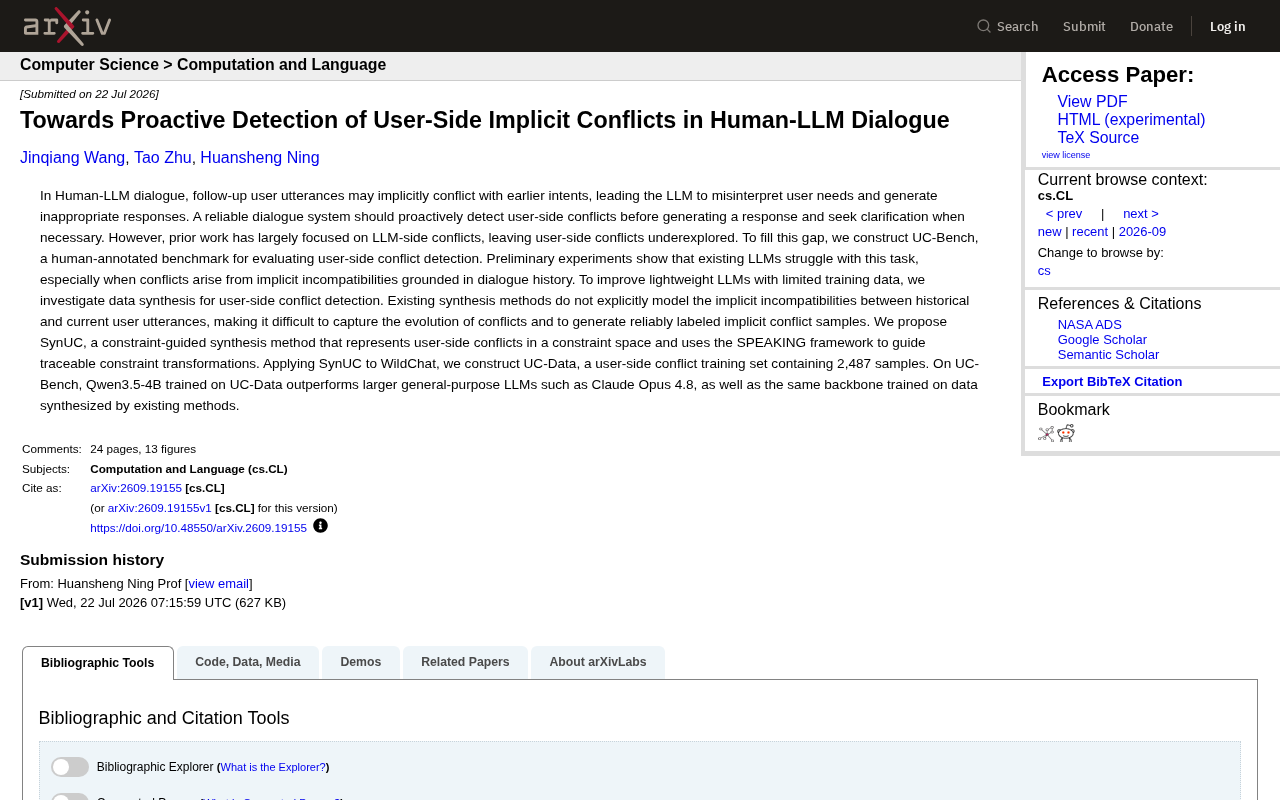
This arXiv paper addresses the long-overlooked problem of user-side implicit conflicts in multi-turn human-LLM conversations — where a user's current statement contradicts their earlier intent. The authors build UC-Bench, a human-annotated benchmark, revealing that existing LLMs struggle with this task. To overcome the data scarcity bottleneck, they propose SynUC, which abstracts user needs into a constraint space and uses the SPEAKING framework for traceable constraint transformations. The resulting 2,487-sample training set UC-Data enables a Qwen3.5-4B model to surpass Claude Opus 4.8 on UC-Bench, demonstrating the power of high-quality specialized synthetic data.
In multi-turn conversations between humans and large language models (LLMs), a commonly overlooked problem is emerging: a user's later statements may create implicit conflicts with intentions expressed earlier in the conversation. When an LLM fails to notice these contradictions, it tends to misread the user's actual needs and generate inappropriate responses. This paper published on arXiv (arXiv:2609.19155v1) focuses precisely on this issue, proposing a comprehensive detection benchmark and data synthesis methodology.
The Overlooked Problem of "User-Side Conflicts"
Prior research on dialogue conflicts has largely focused on LLM-side conflicts — where the model's own responses are inconsistent or contradict known facts. By contrast, user-side conflicts have received far less attention.
User-side conflicts refer to situations where a user's current statement in a conversation is incompatible with something they expressed earlier. For example: a user first says "I'm looking for a quiet café where I can work," then later asks for one "with a live band performance" — two fundamentally contradictory requirements. A reliable dialogue system should proactively detect such conflicts before generating a response and, when necessary, ask the user for clarification rather than producing a self-contradictory answer.
What makes these conflicts particularly difficult to handle is their "implicit" nature: the contradiction is often embedded in the conversation history, requiring the model to trace back through context to identify it, rather than being explicitly present in the current utterance.
UC-Bench: A Human-Annotated Evaluation Benchmark
To address this research gap, the authors built UC-Bench — a human-annotated benchmark specifically designed to evaluate user-side conflict detection capabilities.
The initial findings are sobering: existing LLMs generally struggle with this task, and detection performance drops noticeably when conflicts stem from implicit incompatibilities buried in conversation history. This suggests that while current leading models excel at generation, they have clear weaknesses in the fine-grained comprehension task of "proactively recognizing logical contradictions in user intent."
This finding has real-world implications. In customer service, assistant, and advisory applications, users tend to express themselves in a fragmented, iterative manner, making conflicting requirements between turns quite common. Without proactive detection capabilities, both user experience and task completion rates suffer.
SynUC: Modeling Implicit Conflicts Through Constraint Space
Poor detection performance is largely constrained by the scarcity of training data. The research team therefore turned to data synthesis, aiming to provide high-quality training samples for lightweight LLMs.
However, existing synthesis methods suffer from a core flaw: they do not explicitly model the implicit incompatibility between historical and current utterances, making it difficult to capture how conflicts evolve and impossible to reliably generate implicit conflict samples with accurate annotations.
To address this, the authors propose SynUC — a constraint-guided synthesis method built on two key ideas:
- Constraint space representation: User-side conflicts are represented in a "constraint space," where each user requirement is abstracted as a set of constraints, and conflicts are defined as incompatibilities between these constraints.
- SPEAKING framework guidance: The SPEAKING framework is used to guide traceable constraint transformations, making the process by which conflicts arise transparent and traceable, thereby generating reliably annotated samples.
The key advantage of this approach is traceability — rather than randomly manufacturing contradictions, every constraint transformation can be explained, ensuring the quality and label accuracy of the synthesized data.
The SPEAKING framework originates from Dell Hymes, a sociolinguist who proposed a model for analyzing conversational context. It describes eight components of communicative events: Setting, Participants, Ends, Act sequence, Key, Instrumentalities, Norms, and Genre. In this study, the researchers adapt it as a structured contextual annotation framework to characterize the situational dimensions of each user utterance in a dialogue. By mapping user requirements onto these dimensions, SynUC can systematically identify which dimensional constraints shift or conflict across turns, making constraint transformations documented and traceable rather than relying on random perturbations or heuristic rules. This cross-disciplinary methodological transfer is one of the key design choices that distinguishes SynUC from prior synthesis approaches.
UC-Data and Experimental Results
By applying SynUC to the real dialogue dataset WildChat, the team constructed the training set UC-Data, comprising 2,487 samples.
The most striking result came from the experimental comparison: on UC-Bench, Qwen3.5-4B trained on UC-Data outperformed larger general-purpose LLMs (such as Claude Opus 4.8), while also outperforming the same backbone model trained with existing synthesis methods.
This result carries two important signals:
First, task-specific, high-quality synthetic data can enable small models to beat large models on targeted tasks. A 4B-scale model outperforming much larger general models suggests that for specialized tasks like user-side conflict detection, data quality matters more than model scale.
Second, SynUC's constraint modeling approach genuinely works. Using the same Qwen3.5-4B backbone, training on SynUC-synthesized data outperforms training on data from conventional synthesis methods, validating the value of explicitly modeling implicit incompatibilities.
WildChat is a large-scale real human-LLM conversation dataset containing millions of multi-turn dialogues between real users and large models like ChatGPT, spanning multiple languages and topics. It is widely used in dialogue systems research for its naturalness and diversity. The advantage of using WildChat as source material is that the synthesized data's dialogue structure and language style closely align with real user behavior, avoiding the distribution shift problems common when constructing data entirely from scratch. UC-Data, derived from WildChat via SynUC, retains the naturalness of real conversations while injecting reliable conflict annotations through constraint space modeling — balancing authenticity with annotation quality. Qwen3.5-4B is a lightweight open-source model from Alibaba's Qwen series with approximately 4 billion parameters, deployable on consumer-grade hardware. Its ability to outperform larger models on this task especially highlights the leverage effect of purpose-built training data.
Significance and Outlook
This work advances dialogue system reliability research from "model self-consistency" to the more practically relevant dimension of "proactively understanding user contradictions." For building more robust conversational assistants, proactively detecting and clarifying user conflicts is a crucial component for improving trustworthiness and task success rates.
From a methodological perspective, abstracting conflicts into constraint space and generating data through traceable constraint transformations provides a reusable synthesis paradigm for other dialogue tasks that are difficult to annotate and require contextual reasoning. For teams with limited resources who cannot afford the inference costs of large models, the "small model + specialized synthetic data" approach also holds considerable appeal.
Related articles
Three Stages of AI LLM Testing: A Practical Guide from Core Concepts to API Calls
A learning path for testers covering LLM fundamentals, prompt engineering, OpenAI SDK calls, API Key vs Token differences, streaming output, RAG, and Agent systems.
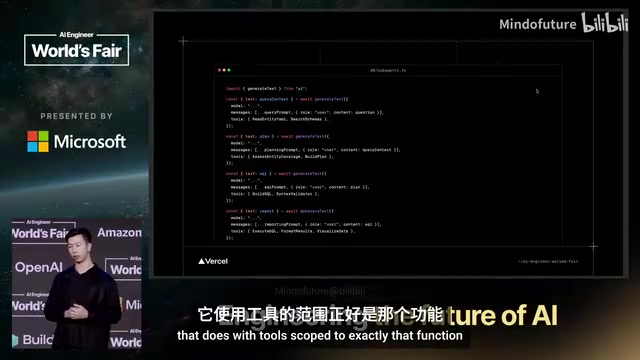
Vercel's Chief of Software Looks Back: The Evolution of Agent Building — From Multi-Agent Chains to File System Agents
Vercel's Chief of Software Andrew recaps the agent-building journey at AI Engineer: from giant prompts to multi-agent chains, monolithic memory, file system agents, and the open-source EVE framework.
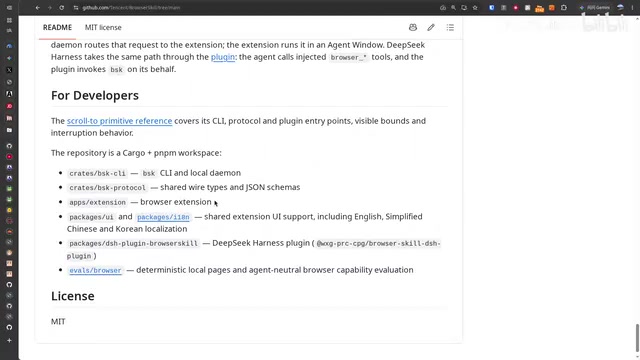
Tencent's Open-Source BSK in Action: Letting AI Take Over Your Already-Logged-In Browser
Tencent's open-source BSK (Browser Skill Kit) lets AI take over your real, logged-in Chrome via WebSocket. We break down the architecture, setup, and three key pitfalls from real-world testing.