Making Money with n8n Automation: How a Bangladeshi Freelancer Racked Up 473 Five-Star Reviews with Small Gigs
A Bangladeshi freelancer earns well on Fiverr with n8n by selling revenue-generating workflows, not just time-saving tools.
The article profiles Imran, a Bangladeshi freelancer who built 473 five-star reviews on Fiverr using n8n automation, with pricing tiers spanning 13x from $80 to $1,050. It analyzes why a foreign couple making $20K/month stalled — selling time savings is invisible to clients, while selling revenue generation drives renewals. It also covers fierce competition on n8n's forum, the tool's rapid growth, four steps from zero to landing gigs, and license boundaries.
A Bangladeshi Freelancer's n8n Business
On Fiverr, a Bangladeshi man named Imran started taking automation workflow gigs in December 2023. His service has accumulated 473 reviews with a 5.0 rating, 463 of which are five-star. Looking at his recent order history, most buyers are American clients, paying $50 to $100 per gig for small workflows like inventory syncing and automating routine tasks.
English isn't his native language, but he still lands orders from Americans. The language barrier isn't as hard as you'd think — AI can write the English descriptions now. When I checked his profile, he already had three orders in the queue.
The tool he uses is called n8n, an automation workflow platform. Clients describe what they need, and he turns repetitive tasks like spreadsheet syncing, email replies, and order logging into a workflow that runs automatically — clients just use the results. The entire delivery happens online, so you can do it from anywhere.
How He Justifies the Price Gap
Imran's pricing has three tiers with a 13x spread: the cheapest at $80 handles a workflow connecting two apps with five-day delivery; the mid-tier at $450 integrates AI into the workflow so it can automatically read emails and write replies; the top tier at $1,050 connects nine apps with 14-day delivery. He also takes hourly gigs at around $47 per hour.
The platform takes 20% of each order. After the cut, the cheapest tier nets $64 — roughly 430 RMB at a 6.7 exchange rate. The AI tier costs more than 5x the basic one — same workflow-building work, but if you can do one more thing for the client, the price jumps dramatically.

n8n is an open-source workflow automation platform — think of it as a "visual programming version of IFTTT or Zapier." It connects different apps through a chain of nodes: one node triggers an event, the next processes the data, the next calls another app's API, eventually forming an automated workflow. Compared to Zapier, n8n's advantages are that it can be self-hosted, has no hard limit on node count, and supports custom code.
In Imran's pricing, "connecting two apps" or "connecting nine apps" refers to the number of app nodes chained in a workflow. More nodes mean more complex logic branches, higher error probability, and longer debugging and delivery time — which is why prices rise exponentially. The $450 tier's "AI integration" typically means inserting a large language model node into the workflow — for example, automatically reading client emails, determining intent, generating reply drafts, and writing them back to the inbox or CRM. This tier costs over 5x the basic one because it upgrades "data moving" to "data decision-making," and the perceived value to the client is significantly higher.
Why Someone Making $20K/Month Quit
A foreigner with the username Cleano started an automation service last August with just himself and his wife. Within months they hit $20,000 per month, roughly 130,000+ RMB. He quoted clients $5,000 per month for unlimited workflows — whatever they wanted, he'd build it.
Then his revenue plateaued. Clients averaged 5 to 6 months before not renewing. His own analysis: he was selling time savings, but the time saved was invisible on the client's books. When renewal time came, the client only saw an invoice and figured they could cut that expense.
Imagine a shop owner who spends every day replying to emails, doing bookkeeping, and logging orders. He pays you to build a workflow and mentally calculates what he gets back. Whether the workflow helps him earn more money matters more than how many hours it saves.
Cleano changed his approach: he now specializes in workflows directly tied to client revenue. Telling a client "this workflow brings back 20 more customers per month" is far more likely to get renewed than "this saves you 5 hours per week." The extra customers are visible on the owner's books.
How Fierce Is the Competition on Freelance Platforms?
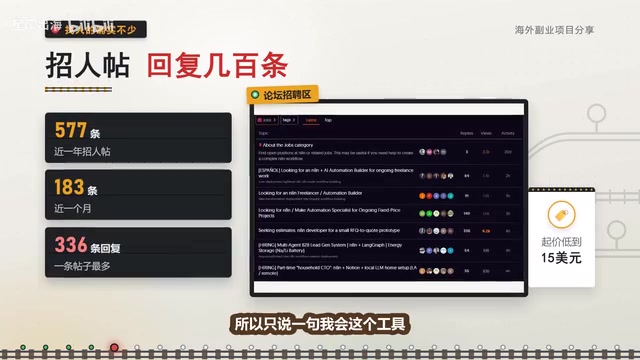
n8n's official forum has a job board section. In the past year, 577 hiring posts were made — 183 in the last month alone. That looks like a strong demand signal, but a single hiring post can get anywhere from a few dozen to 336 replies.
There are already plenty of people who can build workflows. Similar services start as low as $15, and just saying "I know this tool" won't get you picked. To stand out, you need to show clients in one glance what money you can help them make. Don't just write "I'm proficient in n8n" in your service description — writing "I'll build you a booking reminder workflow that reduces no-shows" gets far more orders than "I'm an automation expert."
The n8n official forum's "Jobs & Collaboration" section is a primary channel for many freelancers and agencies to find work, but its mechanics differ from platforms like Fiverr: the posters are the demand side, and freelancers reply under posts introducing their skills, rates, and past work — it's a "bidding + proposal" model. A hot post with 300+ replies means the poster has to pick from hundreds of nearly identical self-introductions, making the odds of being noticed extremely low.
Fiverr, by contrast, is more of a "service commoditization" marketplace where buyers filter sellers directly by keywords and reviews. Imran's 473 five-star reviews are themselves a powerful competitive moat — even if new sellers charge less, they can't easily shake that accumulated reputation in the short term. This also explains the article's conclusion: "position your service by results." In a market with extremely saturated supply, whoever can say in one sentence "I help you earn X more dollars" is the one who gets recognized from the crowd.
Why n8n Is Worth Doing Now
Every cloud tier of the tool comes with an AI assistant. Describe what you want in plain language, and it helps generate workflows and debug them. One foreigner in this field said 99% of his work is now done in the chat box. Previously, beginners dreaded reading English docs and writing logic — now AI handles most of that, and the barrier has genuinely dropped.

More people are using it. Last year alone, n8n gained 112,000 new GitHub stars — the biggest gain among all JavaScript projects. The official forum has 179,000 registered users. The company's valuation went from $2.5 billion in October 2025 to $5.2 billion in May this year. The more companies use it, the more companies need help building and fixing workflows.
Costs are low too. n8n's Community Edition can be installed free on your own server, and the cheapest cloud tier is €20 per month. The main investment is learning time. Most automation workers in China serve domestic companies — few take the same skills to foreign clients and earn USD. That's the information gap.
n8n uses a "fair-code" license model rather than a standard open-source license. Its source code is publicly available, can be self-hosted, and can be modified, but there are restrictions on commercial use: you can't resell it as a hosted service to third parties, and you can't remove the branding and distribute it as your own product. The Community Edition runs free on your own server with essentially full functionality, minus official technical support and enterprise features (SSO, permission management, audit logs, etc.).
Cloud is subscription-based, with the cheapest tier at about €20/month, including a certain number of executions with overage billed by usage. Its built-in AI assistant lets you describe requirements in natural language to generate nodes and workflows — very beginner-friendly. Pay special attention to version security: the 1.1.2 version mentioned in the article fixes a remote code execution vulnerability with broad impact. Self-hosted users must upgrade promptly. Community Edition and Cloud differ little in execution capability; the real cost difference is whether you're willing to spend time maintaining the server, handling upgrades, and backups.
Four Steps from Zero to Landing Gigs
Start by practicing with scenarios around you. For example, automatically save invoices from your inbox into a spreadsheet. Build three to five usable workflows before taking your first order. If you're self-hosting, make sure to upgrade to version 1.1.2 or above — a critical security vulnerability was exposed in January this year, and earlier versions could be remotely controlled. An estimated 100,000 instances worldwide were affected.
Pick workflows that help clients earn more money. There are four main categories: instant replies to new client inquiries — when a client leaves a phone number, the workflow auto-replies within seconds; appointment reminders — for clinics and similar settings, automatically send a reminder the day before; customer win-back — automatically send a discount to those who haven't ordered in six months; payment follow-up — send sequential reminders for overdue invoices. All four have results that can be directly calculated in dollars.
Leave good documentation when delivering. You can build the workflow on your own account or the client's — the client only sees the results. Besides the workflow itself, record a few minutes of screen explanation and write a one-page English guide explaining what each step does and what error prompts to expect. Write the English with AI, explain the screen recording as you normally would, and add English subtitles.

Discuss monthly maintenance fees after the client is comfortable using it. This includes software upgrades, fixing workflow errors, and adding small features — so one client can generate recurring revenue. For payments, the platform supports PayPal, Payoneer, and bank transfers. Just set up your accounts in advance.
License Boundaries and Two Directions
n8n officially states it's not open-source software — it uses its own custom license. Charging clients for building and maintaining workflows is fine. Charging for training and consulting is also fine. What's not allowed: opening an account for a client to build workflows themselves, or removing the branding and selling it as your own product. Just remember one line — "I'll build it for you, you use the results" is fine; "I'll give you an account to use yourself" is not.
There are currently two directions to explore. First, become an outsourced technician for small agencies — the forum has agencies looking for people to build auto-replies and booking systems for hair salons, car dealerships, and hotels. One post got 91 replies. Second, teach clients' teams to do it themselves. The owner of a $45 million/year e-commerce company said he wants his team to learn it, and the official license also permits charging for training.
Ultimately, this business isn't about selling tool proficiency — it's about selling a workflow that helps clients earn more money. The tool has a free version, AI helps with both workflows and English, so start with one or two small gigs to build up reviews, then pick a revenue-calculable workflow and charge monthly.
Related articles
uGAP: An AI Platform Unifying 100+ African Geospatial Datasets
uGAP is an African geospatial AI platform by a University of Cape Town team, unifying 120+ African datasets with a Python SDK for discovery, processing, and model training, already used in cyclone flood mapping.

Cursor Can Now Control Your Computer: AI Agents Can Drive Desktop Apps for Testing
Cursor adds desktop control: AI agents can drive desktop apps like the iOS Simulator to test their own features. We analyze the impact on dev workflows, possible technical approaches, and reliability concerns.

Vibecoding a Custom Inference Engine: High Hopes, Harsh Reality
A Reddit developer shares the real experience of vibecoding a custom inference engine: running GGUF Q4 models in the browser with WebGL2 and GLSL, only to fall into tokenizer debugging hell. This article analyzes the engineering challenges of browser-side LLM inference and why cloning llama.cpp is the more rational choice.