Manus AI Hands-On Review: Can This AI Agent Actually Do Your Work? 4 Real-World Scenarios Tested

Manus AI hands-on review: an AI Agent that evolves from assisting thinking to executing tasks autonomously
Manus AI is an AI Agent focused on end-to-end task completion. Unlike conversational AI tools like ChatGPT, it can autonomously plan, call tools, and independently deliver results. Through four hands-on test scenarios—competitor analysis, content planning, no-code website building, and automated PPT creation—it demonstrates its core capability of going from "helping you think" to "helping you do," marking a new phase of AI Agents in autonomous execution and empowering individuals to achieve "Super Individual" productivity.
The hottest concept in the AI world in 2025 is undoubtedly AI Agent. The concept originates from "autonomous agent" research in artificial intelligence, with the core idea of enabling AI systems to perceive their environment, make autonomous decisions, and execute actions. Since 2023, as large language model (LLM) capabilities have made leaps forward, AI Agents have rapidly moved from academic concept to industrial application. Leading AI companies including OpenAI, Google, and Anthropic have all made Agent capabilities a core strategic direction, with the industry widely believing that AI Agents will become the next mainstream AI application paradigm after chatbots.
But let's be honest—most AI tools on the market are essentially helping you research information and organize text. When it comes to actual execution, you still have to do it yourself. They're more like cheerleaders: they shout "you can do it!" and then walk off the field.
Manus AI is breaking this pattern. It doesn't just offer suggestions—it actually runs through an entire workflow from start to finish—understanding requirements, reasoning and analyzing, calling tools, and delivering results as a full-service package. This marks a new phase for AI Agents: evolving from "assisting thinking" to "executing on your behalf."
This article takes you through an in-depth hands-on test across four real-world scenarios to see just how capable Manus AI really is, and whether it truly deserves to be called "an AI Agent that actually gets things done."
What Is Manus AI? An AI Agent That Goes From Assisting Thinking to Executing on Your Behalf
Manus AI is an AI Agent tool focused on "end-to-end task completion." End-to-end means the system can automatically decompose a complex task into multiple sub-steps, sequentially calling different tools and APIs to complete each phase, and ultimately outputting a complete deliverable. The core technologies behind this include: Task Planning, Tool Use/Function Calling, Memory Management, and Multi-step Reasoning. Similar technical architectures can be found in open-source projects like AutoGPT and LangChain Agent, but Manus AI packages these capabilities into a product form that ordinary users can directly use.
Unlike conversational AI tools like ChatGPT and Claude, Manus AI's core design philosophy isn't about chatting with you—it's about autonomously planning, calling tools, and independently completing deliverables after receiving a task.
It has a built-in feature module called PlayBook, which provides a large collection of ready-made prompt templates covering scenarios like website creation, video content generation, YouTube creator discovery, market research, and more. PlayBook is essentially a combination of carefully designed prompt templates and workflow orchestration. In the field of Prompt Engineering, structured prompt templates can significantly improve the quality and consistency of AI output. Manus AI's PlayBook goes further—it not only contains prompts but also predefines execution steps, tool-calling sequences, and output formats, essentially codifying expert-level workflows into one-click reusable automation solutions. This design lowers the barrier to entry—even users unfamiliar with prompt techniques can get professional-grade output.
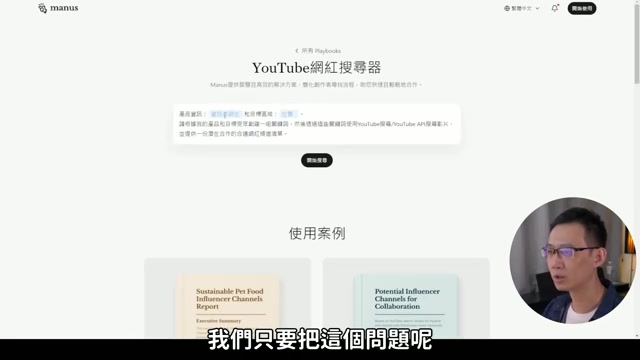
Next, let's examine Manus AI's actual performance across four real-world scenarios.
Scenario 1: Competitor Analysis for Content Creators — An Intelligent Research Assistant
Quickly Identifying Competitors with the YouTube Influencer Finder
Take the "YouTube Influencer Finder" in PlayBook as an example. Suppose you run an AI knowledge education channel—simply input "Find YouTube channels that are doing AI tutorials," select YouTube as the target platform, and click execute.
A real-time execution view appears on the right—Manus works like a human assistant, automatically opening YouTube, entering keywords, searching and filtering, and organizing content. This visual execution incorporates the concepts of RPA (Robotic Process Automation). Traditional RPA uses preset scripts to simulate human mouse and keyboard operations for repetitive tasks but lacks understanding and judgment capabilities. Manus AI combines the comprehension and reasoning capabilities of large language models with RPA's interface operation capabilities, forming "AI-driven intelligent automation." This visual execution not only allows users to monitor AI's work progress in real-time but also enhances transparency and trust—you can see what it's "thinking" and "analyzing" simultaneously.
The final output is a complete list containing channel names, subscriber counts, content themes, and other comprehensive data.
This feature isn't just useful for creators doing competitor analysis and topic planning—brands and businesses can also use it to quickly screen suitable collaboration partners.
Finding the Viral Formula with Viral Content Analysis
Another highly practical template is YouTube Viral Content Analysis. Simply paste your YouTube channel link and execute—Manus AI will automatically open the channel page and examine each video's performance data, viewing trends, and popular topics one by one.
The resulting analysis report is quite specific: which topics have standout metrics, which direction future content should optimize toward, and which areas have the most growth potential. This tedious work that would normally require creators to manually compare data in their backend one by one—Manus can handle it in minutes.
Scenario 2: Content Planning From Scratch — An AI Agent That Doesn't Need Step-by-Step Guidance
Beyond preset templates, users can also freely input requirements in the prompt box. This is where Manus truly demonstrates the real power of an AI Agent.
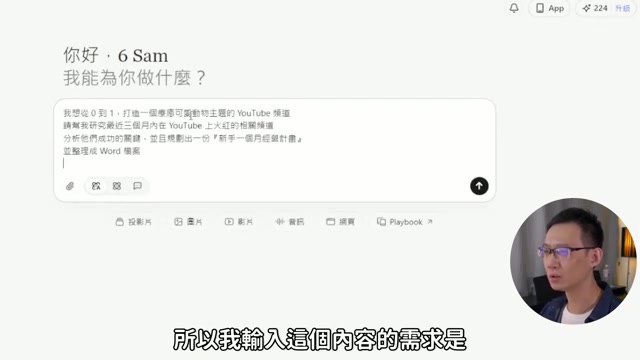
For example, input a requirement like this:
"I want to build a healing/cute animal-themed YouTube channel from scratch. Help me research the hottest related channels and topics on YouTube in the past three months, analyze their keys to success, and create a one-month operating plan for beginners, compiled into a Word document."
After clicking execute, Manus AI operates completely autonomously. Unlike traditional AI conversation tools like ChatGPT, you don't need to guide the conversation step by step, nor do you need to stay at your computer. This is the fundamental difference between an AI Agent and conversational AI: conversational AI requires users to play the role of "project manager," gradually decomposing tasks and guiding the AI through each phase; AI Agents have built-in task planning capabilities that can autonomously break down a vague high-level requirement into specific execution steps and complete them in logical order. You can go grab a cup of tea, take a break, and the document will be ready when you return.
The final Word file includes: breakdowns of successful channels, trend summaries, content recommendations, and more—with clear formatting and complete logical structure. This is what an AI Agent should look like—not chatting with you, but getting the work done for you.
Scenario 3: AI No-Code Website Building — Launch a Complete Website Without Knowing How to Code
For users who don't know code or design, building a website has always been a high-barrier task. Manus AI brings that barrier straight down to ground level.
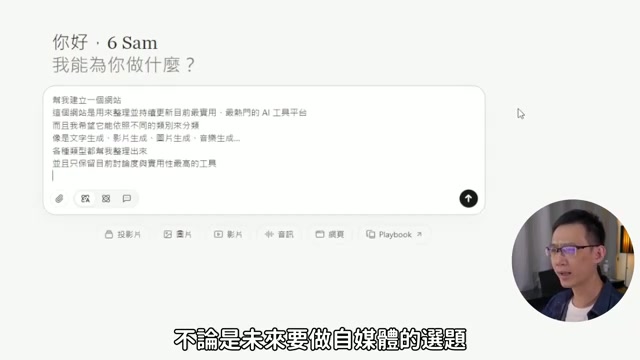
No-code website building isn't a new concept—platforms like Wix, Squarespace, and Webflow have long enabled non-technical users to create websites through drag-and-drop. But these tools still require users to plan website structure, choose templates, fill in content, and adjust layouts themselves. Manus AI's breakthrough is pushing no-code website building to a "zero-operation" stage—users only need to describe their requirements in natural language, and the AI automatically completes everything from information architecture design, frontend code generation, and content population to deployment. This involves the coordinated work of multiple technologies including code generation models (converting natural language to HTML/CSS/JavaScript), automated deployment pipelines, and content scraping and organization.
The requirement entered during testing was: Build a website that curates and continuously updates the most practical and popular AI tools, categorized by text generation, video generation, image generation, music generation, etc., keeping only the tools with the highest discussion volume and practicality.
After execution, Manus AI built a complete website from scratch. Clicking the generated link reveals:
- Clear website architecture with categories at a glance
- Fully aligned with the input requirements, with tools organized neatly by category
- Supports subsequent editing for ongoing maintenance and updates
The entire process requires not a single line of code—from development to deployment to ongoing maintenance, Manus handles it all. For individual creators, small teams, and indie developers, this is an enormous efficiency boost.
Scenario 4: AI-Automated PPT Creation — From Requirements to Finished Product With Zero Manual Operation
Creating presentations is a task almost no one can escape, and one of the most time-consuming. The traditional process: open PowerPoint → lay out pages according to an outline → find images → write bullet points → design charts—every step is time-consuming and laborious.
While AI presentation tools like Gamma and Beautiful.ai exist on the market, most still require manual adjustments. Gamma is a representative product where users input a topic and it auto-generates a presentation; Beautiful.ai focuses on smart layout, automatically adjusting element placement. There are also tools like Tome, SlidesAI, and Canva AI, each with their own focus. But the common limitation of these tools is that they primarily solve efficiency in the "layout and design" phase—content materials still need to be prepared by users themselves.
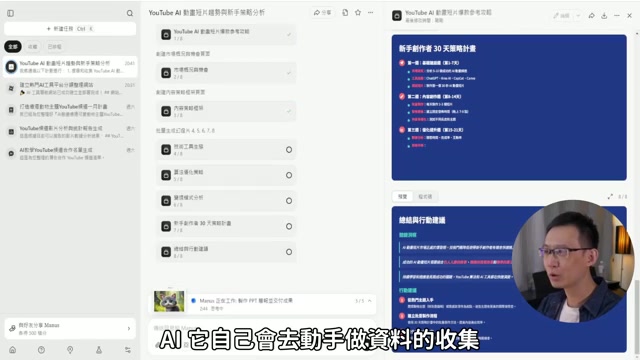
In Manus, input a complex requirement:
"Find YouTube channels that went viral with AI short video content in the past three months. Analyze content themes, video styles, posting frequency, video length, regional viewing performance, etc. Compile it into a viral content reference guide and draft a 30-day strategy plan for beginner creators. Put everything into PPT format."
After clicking execute, Manus AI autonomously completes data collection, analysis, and presentation layout. Manus AI's differentiator lies in connecting the entire chain of "data collection → data analysis → content writing → layout design," achieving full automation from raw requirements to final product. Within minutes, a complete PPT is presented:
- Contains comprehensive channel analysis charts
- Includes detailed data support
- Key information is clearly highlighted
- Supports secondary editing—text can be modified and images adjusted
From "make me a PPT" to receiving the finished product—zero manual operation in between. This is the fundamental difference between an AI Agent and traditional AI tools.
Manus AI vs. ChatGPT: Core Differences Between AI Agents and Conversational AI
Through the hands-on testing of these four scenarios, the gap between Manus AI and traditional AI tools is abundantly clear:
| Comparison Dimension | Traditional AI Tools (ChatGPT, etc.) | Manus AI Agent |
|---|---|---|
| Interaction Mode | Step-by-step conversational guidance | One-shot requirement description |
| Execution Capability | Provides suggestions and text | Autonomously completes full tasks |
| Output Format | Plain text responses | Documents/Websites/PPTs/Videos |
| User Involvement | Must be present throughout | Can leave and wait for results |
| Tool Calling | Single capability | Automatically judges and calls multiple tools |
It's worth noting that this comparison reflects differences in product positioning rather than a simple better-or-worse judgment. Conversational AI like ChatGPT still has irreplaceable advantages in open-ended exploration, creative brainstorming, and real-time Q&A scenarios. Manus AI is better suited for task execution scenarios with clear objectives and well-defined processes. The relationship between the two is more like the complementary roles of "advisor" and "executor" rather than a replacement.
Manus AI's core value lies in automatically determining which tools to use and what strategies to adopt to achieve the user's ultimate goal. It's not an executor that requires precise instructions from you—it's an intelligent assistant that can understand intent, plan autonomously, and deliver independently.
Conclusion: Manus AI Lets One Person Do the Work of an Entire Team
Manus AI represents not just an upgrade of a single tool, but a fundamental shift in how AI is applied. When AI Agents evolve from "helping you think" to "helping you do," the ceiling of individual productivity is dramatically raised.
The "Super Individual" concept has been frequently mentioned in entrepreneurship and workplace contexts in recent years, referring to how a single person can accomplish work that previously required an entire team, powered by technology tools. The maturation of AI Agents is accelerating the realization of this trend. According to a McKinsey 2024 research report, generative AI has the potential to automate 60%-70% of knowledge workers' time. When AI Agents can independently complete market research, content creation, website development, data analysis, and other tasks, the competitiveness of solo entrepreneurs and small teams will see exponential improvement.
Whether you're a content creator, social media operator, or ordinary professional, you can leverage AI Agent tools like Manus AI to focus your energy on creativity and decision-making—the areas that truly require human intelligence. This also means that future workplace core competitiveness will shift from "execution ability" to "judgment, creativity, and strategic thinking."
In 2025, the AI Agent space has only just begun, but Manus AI has already shown us the early form of the "Super Individual" era—one person plus an AI Agent can complete the workload of an entire team. This isn't a future vision—it's a reality that's happening right now.
Related articles
 Product Reviews
The Programmer's Desk Setup Guide: Building a Workspace That Feels Like Home
Discover how programmers build productive, comfortable workspaces. From multi-monitor setups to ergonomic design, explore the desk philosophy that drives focus and flow.
 Product Reviews
Qoder vs Cursor Real-World Comparison: Which $20/Month AI IDE Is Better?
Hands-on comparison of Qoder vs Cursor AI IDEs: Agent autonomy, human interaction count, and architecture decisions. Qoder needed only 2 interactions vs Cursor's 8.
 Product Reviews
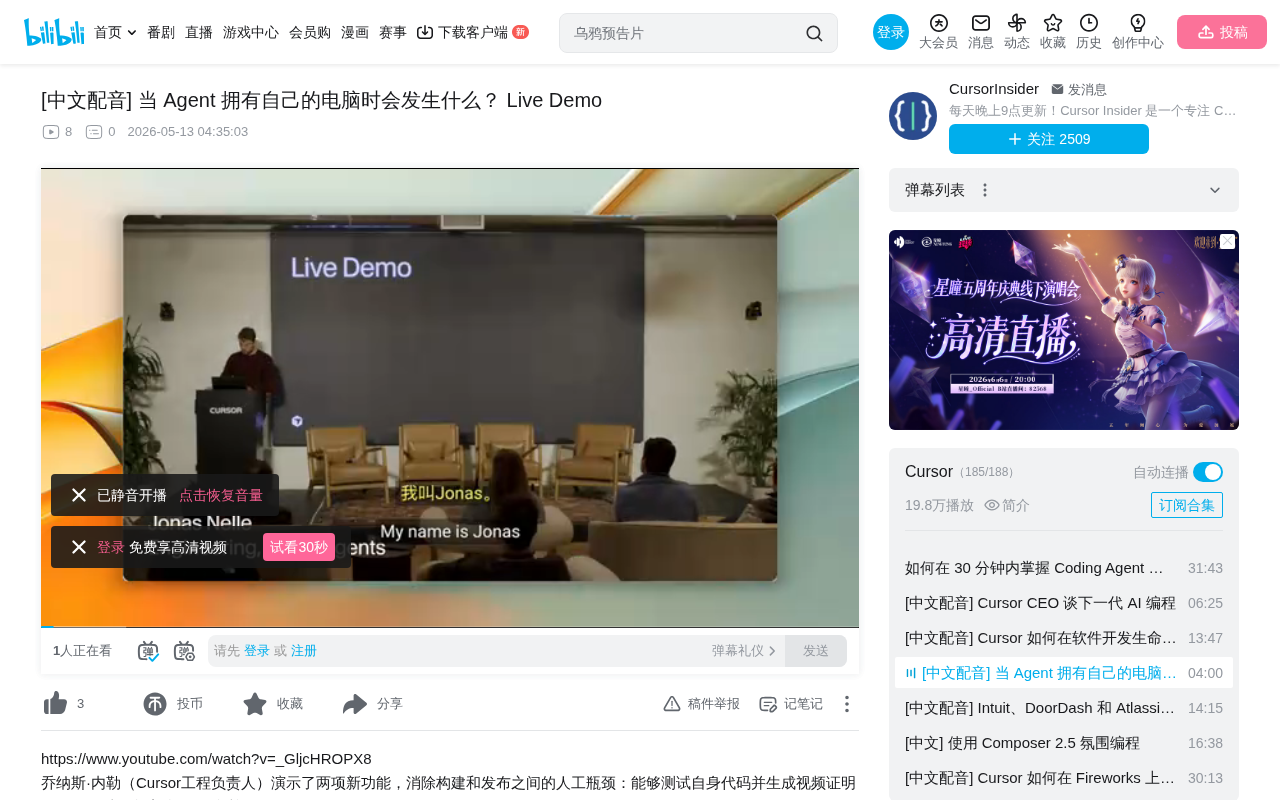
Cursor Cloud Agent Demo: Eliminating Bottlenecks Across the Entire Software Development Lifecycle
Deep analysis of Cursor's Cloud Agent demo showing how cloud VMs, automated test artifacts, and a full-chain control plane systematically eliminate human bottlenecks across the software development lifecycle.