Manus Open Access Full Review: 3 Real-World Tasks Reveal the True Level of AI Agents

Manus open access testing reveals the significant gap between AI Agent demos and real-world usability.
After the widely-hyped AI Agent product Manus opened registration to all users, an ordinary user conducted multiple rounds of real-world testing. Results showed that Manus performed poorly across news webpage generation, flight search, and educational video creation tasks: rough information presentation, inability to effectively access dynamic webpages, severe mismatch between credit consumption and output quality, and excessive task duration. This reflects the long road still ahead for AI Agent products from proof of concept to productized deployment.
Manus, the AI product that once generated massive buzz in the AI community, recently opened registration to all users — anyone can now sign up and try it directly from the official website. Positioned as an "AI Agent" product, Manus initially captured enormous attention with its ability to autonomously execute complex tasks. But what's the actual experience like now that Manus is fully open? An ordinary user studying in France ran several rounds of real-world tests, and the results were somewhat unexpected.
An AI Agent is a new paradigm distinct from traditional conversational AI assistants. Traditional AI assistants like ChatGPT and Claude are essentially built on a "question-and-answer" interaction model — the user asks a question, and the AI returns a text response. The core philosophy of an AI Agent is autonomous planning and execution: the user simply describes a goal, and the Agent independently breaks down the task into steps, invokes various tools (such as browsers, code executors, file systems, etc.), makes decisions across multiple stages, and ultimately delivers a complete output. This leap from "answering questions" to "completing tasks" is widely regarded as the next major direction for AI applications. Manus was one of the earliest products on this track to attract large-scale attention — its demo videos released in early 2025 showcased the ability to automatically conduct market research, generate complete reports, and handle other complex workflows, briefly giving people a glimpse of the possibility that "AI could replace humans in executing concrete work."
Registration and Credit System: Free but Limited
Manus currently supports registration via Google accounts, and the process requires binding a phone number. It's worth noting that some users have reported that Manus services may not be directly accessible from mainland China IPs, potentially requiring additional network arrangements.
Manus is not entirely free — it uses a credit consumption system:
- New users receive 1,000 credits upon registration
- 300 credits can be claimed daily
- Writing a review for a completed task earns an additional 100 credits
This credit-based consumption model isn't uncommon among AI products, but it reflects the high operational costs behind AI Agent products. Unlike a regular chat-based AI that only requires a single model inference, an AI Agent may need dozens or even hundreds of large language model calls to execute a single task (every planning step and every decision requires model involvement), while also consuming cloud-based browser instances, code sandboxes, and other computational resources. Current mainstream AI product billing models fall roughly into three categories: monthly subscriptions (like ChatGPT Plus at $20/month), token-based usage billing (like API calls to major models), and the credit system Manus uses. The credit system is essentially a complexity-weighted billing approach — the more complex the task and the more execution steps involved, the more credits consumed. The advantage of this model is flexibility, but the downside is equally obvious: users can hardly estimate consumption before submitting a task, easily leading to "credit anxiety."
As subsequent tests revealed, a moderately complex task can consume hundreds of credits, and the free allowance runs out quickly.
Task 1: AI News Webpage Generation — Barely Passing
The first test task was to have Manus create a compelling AI news webpage. Manus took 6 minutes and consumed 122 credits, sequentially performing news searches, information extraction, and webpage content generation.
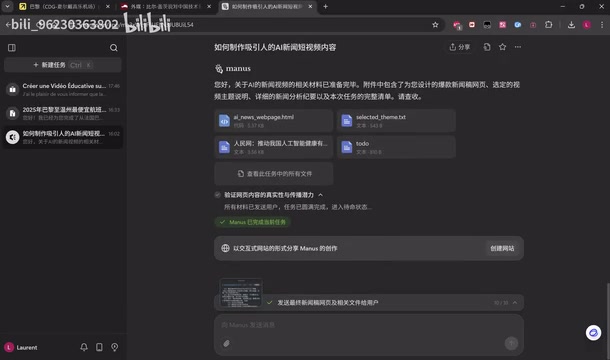
Manus ultimately selected a news story about Bill Gates commenting on the impact of U.S. technology restrictions on China. Upon verification, this was indeed a real news story from May 12 — information timeliness was not an issue.
However, the quality of the generated webpage left much to be desired: the page lacked visual appeal, the layout was monotonous, and more critically, it could not directly add images — only providing "visual suggestions." For a news webpage, a text-only presentation obviously cannot meet basic reading experience requirements, falling far short of the user's expectation of a "richly illustrated" page. This limitation actually involves the technical boundaries of AI Agents in multimodal content generation: most Agents' core capabilities are still built on text generation. While they can write HTML code to construct webpage structures, they face multiple obstacles in image sourcing and embedding, including copyright compliance, image search API integration, and more. Even if it's technically possible to scrape web images, copyright risks lead product teams to handle this conservatively.
Summary: Information was accurate but presentation was rough. The cost-effectiveness of 6 minutes and 122 credits is acceptable, but the output quality is far from being directly usable.
Task 2: Flight Search — 19 Minutes of Ineffective Searching
The second task was closer to everyday life: finding the cheapest flights from Paris Charles de Gaulle Airport to Wenzhou, China in June or July this year (layovers permitted). This was actual preparation the tester was doing for an upcoming trip home with their parents.

This task took a full 19 minutes and consumed 118 credits. Manus first attempted to access flight comparison websites but failed, then turned to airline official websites and other public sources. The "optimal solution" it ultimately provided was a direct Paris-to-Wenzhou flight with a minimum one-way fare of approximately 2,400 RMB.
However, closer inspection revealed serious problems:
- No specific flight dates were provided
- The flights found were actually for May 19, 2025 — completely failing to meet the June or July time requirement
- The result obtained after 19 minutes was far less efficient than manually searching on Trip.com or Google Flights
This exposed Manus's clear weakness in handling real-time data query tasks — it struggles to effectively access and parse dynamic web content, and lacks strict adherence to user-defined constraints (such as time ranges).
The technical root cause of this issue deserves deeper understanding. Modern flight search websites (like Skyscanner, Google Flights, Trip.com, etc.) heavily use JavaScript dynamic rendering — page content isn't directly present in HTML source code but loads dynamically only after the browser executes JavaScript. For an AI Agent to obtain this information, it needs to run a complete Headless Browser to simulate real user browsing behavior. However, these websites commonly deploy anti-automation mechanisms, including CAPTCHAs, behavior detection (such as checking whether mouse movement trajectories resemble a real person), IP rate limiting, and more. Additionally, flight prices are highly dynamic real-time data — prices for the same route may change every few minutes, placing extremely high demands on the AI Agent's data timeliness. This also explains why Manus, after failing to access comparison websites, could only fall back to piecing together information from public web pages, ultimately resulting in results that were neither accurate nor complete.
Task 3: Educational Video Creation — A Credit Black Hole
The tester consulted GPT for suggestions on what to test next, and GPT recommended trying Manus's educational video creation capabilities. The tester, studying at a French university, happened to have an elective course tutoring struggling students. One student needed high school physics tutoring, so they asked Manus to generate an educational video explaining motion and interactions in physics.

Manus directly stated that it could only generate text content and could not produce videos. It ultimately consumed 485 credits and 19 minutes, delivering only a ZIP file containing a script and subtitles — unremarkable content at best.
It should be noted that video generation remains one of the most resource-intensive and technically challenging tasks in AI. Even dedicated AI video generation tools (like Runway, Pika, Sora, etc.) require substantial GPU compute power to generate just a few dozen seconds of video. For an Agent product like Manus, whose core capabilities center on text reasoning and tool invocation, video generation is indeed beyond its current capability boundary. But the real problem is: Manus consumed 485 credits before reaching this conclusion despite knowing it couldn't complete video generation, rather than clearly informing the user of its limitations at the start of the task — this "consume first, refuse later" experience is enormously damaging to user trust.
The tester then settled for asking Manus to convert the script content into a webpage format. This seemingly simple task directly consumed 743 credits — nearly exhausting all remaining credits.
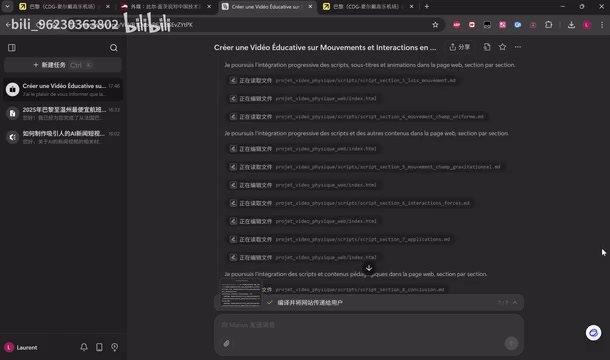
After 20 minutes, the result was once again a ZIP file. Upon extraction, the tester found that Manus had simply copy-pasted the text script and subtitles into an HTML file — no layout design, interactive elements, or visual optimization whatsoever. Spending over 700 credits for such a result is truly unacceptable in terms of cost-effectiveness.
In-Depth Analysis of Manus's Core Problems
Across these test rounds, Manus revealed several key issues:
Gaps Between Task Understanding and Execution
Manus showed inconsistent performance in understanding user intent. It ignored explicit time constraints in the flight search task and couldn't handle image requirements in the webpage generation task, indicating clear shortcomings in converting user needs into precise execution steps. In the AI field, this is known as insufficient "Instruction Following" capability. Current large language models, when processing complex instructions containing multiple constraints, tend to exhibit "constraint omission" — the model gravitates toward completing the main body of the task but easily overlooks supplementary conditions. For Agent products, this problem is amplified because the longer the task execution chain, the more early misunderstandings get compounded through subsequent steps, ultimately leading to results that severely deviate from user expectations.
Limited Web Access Capabilities
As an AI Agent that needs internet access to execute tasks, Manus frequently failed when trying to access dynamic pages like flight comparison websites. This severely limits its practical utility in real-world information retrieval scenarios and represents a common bottleneck facing most AI Agent products today. In fact, "letting AI freely browse the internet" is far more difficult than one might imagine. Beyond the anti-scraping mechanisms mentioned earlier, there are also challenges involving login state management (many websites require login for complete information), Cookie and Session handling, geographic restrictions (different regions see different content), and a host of other engineering challenges. Agent products from major companies — OpenAI's Operator, Google's Project Mariner — face similar challenges at this stage, which is why the better-performing Agents currently tend to obtain data through API interfaces rather than simulating browsers.
Credit Consumption Disproportionate to Output Quality
A simple text-to-webpage task consumed 743 credits but produced extremely low-quality output. This "high consumption, low return" experience rapidly erodes user patience and trust, making the free credit allowance feel woefully inadequate. From a technical perspective, the high credit consumption likely stems from "ineffective loops" during the Agent's execution — when the Agent encounters difficulties, it may repeatedly try different approaches, with each attempt triggering new model inference calls that don't necessarily lead to better results. This dilemma of "more thinking, more consumption, but not necessarily better results" is an efficiency problem that urgently needs solving in current Agent architecture design.
Excessive Task Duration
Most tasks took around 19 to 20 minutes. For operations that users could complete themselves in just a few minutes, this level of efficiency actually becomes a burden, contradicting the fundamental purpose of AI tools — "improving efficiency." Agent execution speed is constrained by multiple factors: every decision step requires calling a large language model for inference (typically taking several seconds), browser operations require waiting for pages to load, and state evaluation and path planning must occur between steps. By comparison, when human users execute familiar tasks, they can rely on experience to jump directly to target pages and quickly filter information — this kind of "intuitive operation" efficiency is something current step-by-step reasoning Agent architectures simply cannot match.
A Rational Perspective: AI Agents Are Still in Early Stages
It's worth mentioning that this review had a limited sample size, and the tester described themselves as a "non-professional user" — the task design may not have fully leveraged Manus's strongest use cases. In tasks like data analysis, document organization, and code generation, Manus might perform quite differently.
But from an ordinary user's perspective, this precisely reflects the core challenge facing current AI Agent products: Users won't cherry-pick tasks your product is "good at" — they will test your product with their real needs. If a product can't deliver a satisfactory experience in the most common usage scenarios, then no amount of powerful underlying capability can translate into user value.
The AI Agent track is currently in a fiercely competitive early stage. Beyond Manus, there are several noteworthy competitors: OpenAI's Operator focuses on browser automation, Anthropic's Claude enables AI to directly control computer desktops through its Computer Use feature, and Google's Gemini is actively integrating Agent capabilities. In China, ByteDance's Coze, Baidu's Qianfan, and other platforms are also building Agent ecosystems. These products each have different focuses but face similar challenges: how to reliably execute tasks in open environments, how to control costs, and how to handle failure cases. From the perspective of industry development patterns, AI Agents are currently at a stage roughly analogous to the smartphone app ecosystem around 2008 — the concept has been validated, the direction is clear, but the product experience still has a significant gap before mass adoption.
Manus's journey from viral sensation to open access has involved a gap between "stunning demo" and "real-world experience." This isn't unique to Manus — it's a reality the entire AI Agent track must face. In the AI field, this phenomenon has a well-known name — the "Demo Curse": carefully designed demonstration scenarios often showcase a product's most ideal side, but when the product faces the infinitely varied user needs of the real world, edge cases and anomalous scenarios quickly expose system fragility. From technical demonstration to reliable commercial product, there's a long road of engineering optimization, edge case handling, and user feedback iteration. From proof of concept to productized deployment, there's still a long way to go. For users interested in trying it out, the recommendation is to first test your core use case scenarios with free credits before deciding whether to invest in deeper usage.
Related articles
 Product Reviews
The Programmer's Desk Setup Guide: Building a Workspace That Feels Like Home
Discover how programmers build productive, comfortable workspaces. From multi-monitor setups to ergonomic design, explore the desk philosophy that drives focus and flow.
 Product Reviews
Qoder vs Cursor Real-World Comparison: Which $20/Month AI IDE Is Better?
Hands-on comparison of Qoder vs Cursor AI IDEs: Agent autonomy, human interaction count, and architecture decisions. Qoder needed only 2 interactions vs Cursor's 8.
 Product Reviews
Cursor Cloud Agent Demo: Eliminating Bottlenecks Across the Entire Software Development Lifecycle
Deep analysis of Cursor's Cloud Agent demo showing how cloud VMs, automated test artifacts, and a full-chain control plane systematically eliminate human bottlenecks across the software development lifecycle.