Manus Seeks $4B Valuation, Plans $500M Raise to Resume Independent Operations

Manus drops Meta merger talks and seeks $500M at a $4B valuation to go independent.
AI startup Manus is in talks to raise $500 million at roughly a $4 billion valuation after its planned merger with Meta fell through. The situation highlights a core tension in today's AI landscape: big tech aggressively consolidating talent through acquisitions and acqui-hires, while top-tier startups reconsider whether staying independent offers greater long-term upside. Manus's choice signals management confidence that their value exceeds what a merger could deliver — though the final terms and investor lineup remain unconfirmed.
Manus Returns to the Independent Track
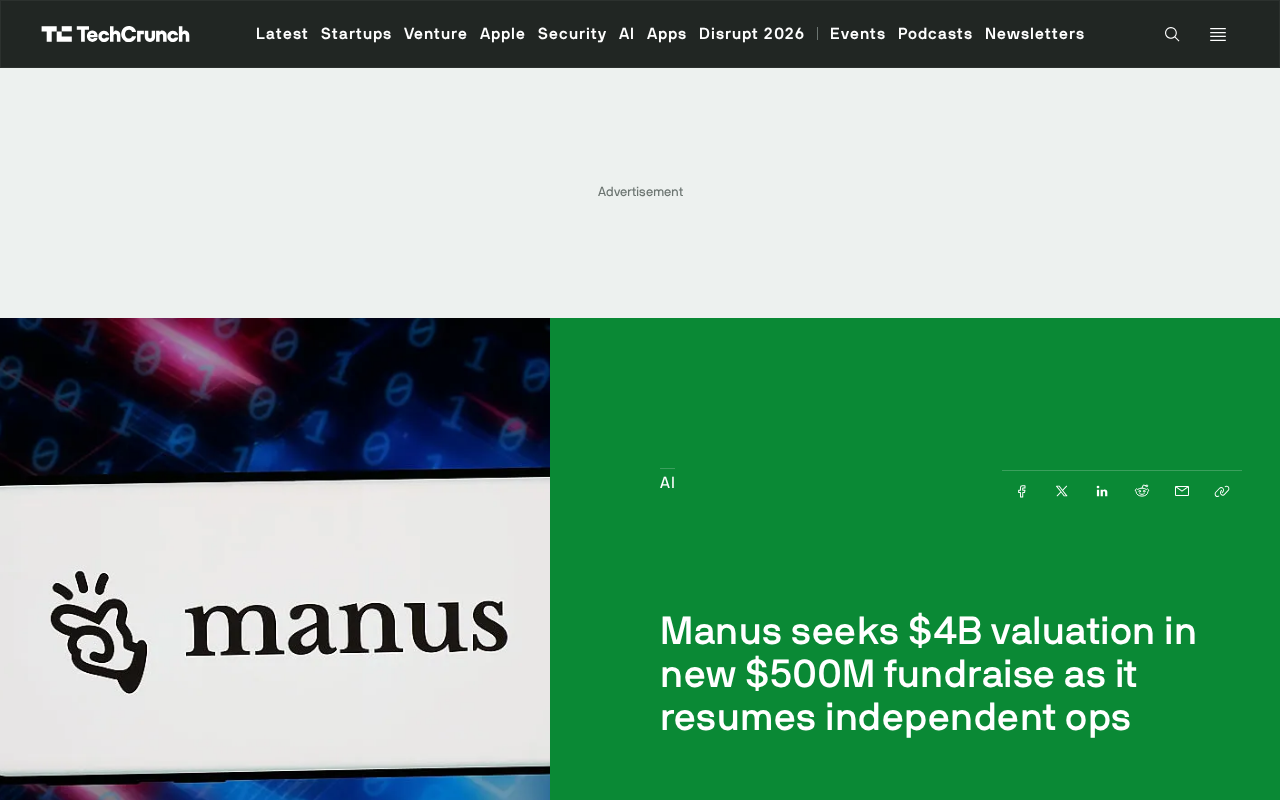
AI startup Manus is in talks with investors for a new funding round, targeting approximately $4 billion in valuation to raise $500 million. This move marks the company's formal return to an independent path after it previously called off a planned merger with Meta.
Reports indicate that Manus came close to a merger deal with Meta earlier this year, but the deal ultimately fell through. The company is now seeking external capital to pursue independent growth — a choice that reflects management's confidence in its business outlook and the market opportunity ahead.
The Valuation Logic Behind the Raise
A $4 billion valuation is no small figure for an AI startup, especially one that just walked away from a merger. The fact that investors are willing to price the company at this level suggests they still hold high expectations for Manus's technical capabilities and commercialization potential.
The $500 million raise is a mid-to-large round by today's AI industry standards. Capital at this scale typically goes toward several priorities: expanding compute resources, attracting and retaining top technical talent, accelerating product iteration, and capturing greater market share in an intensely competitive AI landscape. For a company just resuming independent operations, a strong cash reserve is critical to staying competitive.
From a capital strategy perspective, pivoting quickly to an independent raise after a failed merger is a classic playbook. Mergers often mean a team and its technology get absorbed into a large company's existing structure, while independent funding preserves the company's autonomy and room for long-term growth.
The Trade-Off Between Big Tech Acquisitions and Going Independent
The collapse of the Manus-Meta merger is a microcosm of the broader consolidation wave sweeping the AI industry. Large tech companies are aggressively acquiring AI talent and technology through outright acquisitions or acqui-hires, while startups must weigh the certainty of an exit against the potentially greater upside of remaining independent.
For Manus, choosing independence and pursuing a $4 billion valuation signals that the team believes their value is being underestimated — or that going solo opens up a larger opportunity. Whether that judgment holds will ultimately depend on execution and market performance.
It's worth noting that deals like these often fall apart due to regulatory scrutiny, cultural mismatches, or strategic disagreements about the future direction of the company. A failed merger isn't necessarily a setback — it may actually open a new window of opportunity for Manus.
What is an acqui-hire? Acqui-hire is a Silicon Valley acquisition model where the acquiring company's primary goal is not to obtain the target's product or revenue, but to bring its core team on board. In this model, the acquired company's products are typically shut down or deprioritized, while its founders and engineers join the acquirer as employees, receiving the deal value in the form of retention bonuses or stock. For AI startups, an acqui-hire can be a path to liquidity — but it also means the end of independence. That's precisely why, when a team chooses to reject or walk away from such a deal and instead raises external capital to continue operating independently, the market often reads it as a strong signal of confidence in the team's technical moat and long-term value.
Implications for the AI Startup Landscape
Manus's latest fundraising move offers a useful reference point for reading the current AI startup market. On one hand, investor appetite for high-quality AI teams remains robust, with high-valuation rounds continuing to emerge. On the other hand, startups are increasingly taking a more nuanced approach when faced with acquisition offers from big tech — and staying independent is once again being seriously considered as a viable option.
The fundraising is still in negotiation, and the final valuation, deal size, and investor lineup have yet to be confirmed. How things develop from here will reveal the market's true read on Manus — and it's a story worth watching closely.
Related articles

"Black October": Did AI Uncover 3% of All Critical Vulnerabilities Ever?
A Reddit post claims 3% of all critical software vulnerabilities ever were found in the past month, dubbed 'Black October.' We break down the statistical issues, how AI-assisted code auditing accelerates discovery, and how developers should respond.

Microsoft Project Gecko: Using AI to Bridge Language Gaps for African Farmers
Microsoft's Project Gecko launches PharmaChat, letting African farmers ask questions in their native language and get precise video clips and farming book chapters via AI. The project also releases three interactive manuals to advance inclusive AI.

Musk's Space Dominance: How Starlink Throttling Undermines Ukraine's Defense
SpaceX's Starshield throttling disabled Ukraine's high-speed interceptor drones, exposing how Musk's private control over low Earth orbit communications affects battlefield dynamics and national security, and highlighting the risks of commercial space militarization and space governance dilemmas.