ManyPI: Using AI to Precisely Target Ideal Customers and Reimagine Outbound Sales

ManyPI uses AI to connect ICP definition, intent signals, and hyper-personalized email for smarter B2B outbound sales.
ManyPI is an AI-powered outbound sales tool that appeared on Product Hunt, designed to upgrade traditional cold email blasting into signal-driven, precision outreach. Its core workflow has four steps: locating ICP-matched prospects on the live web, verifying email addresses, identifying pain points and emotional buying triggers, and generating hyper-personalized outreach emails. Unlike competitors like Clay and Apollo that rely on static databases, ManyPI emphasizes real-time scraping and intent signals. Its "10x revenue" tagline is a marketing hook — actual value should be measured by lead quality, deliverability, and reply rates.
ManyPI: Using AI to Precisely Target Ideal Customers and Reimagine Outbound Sales
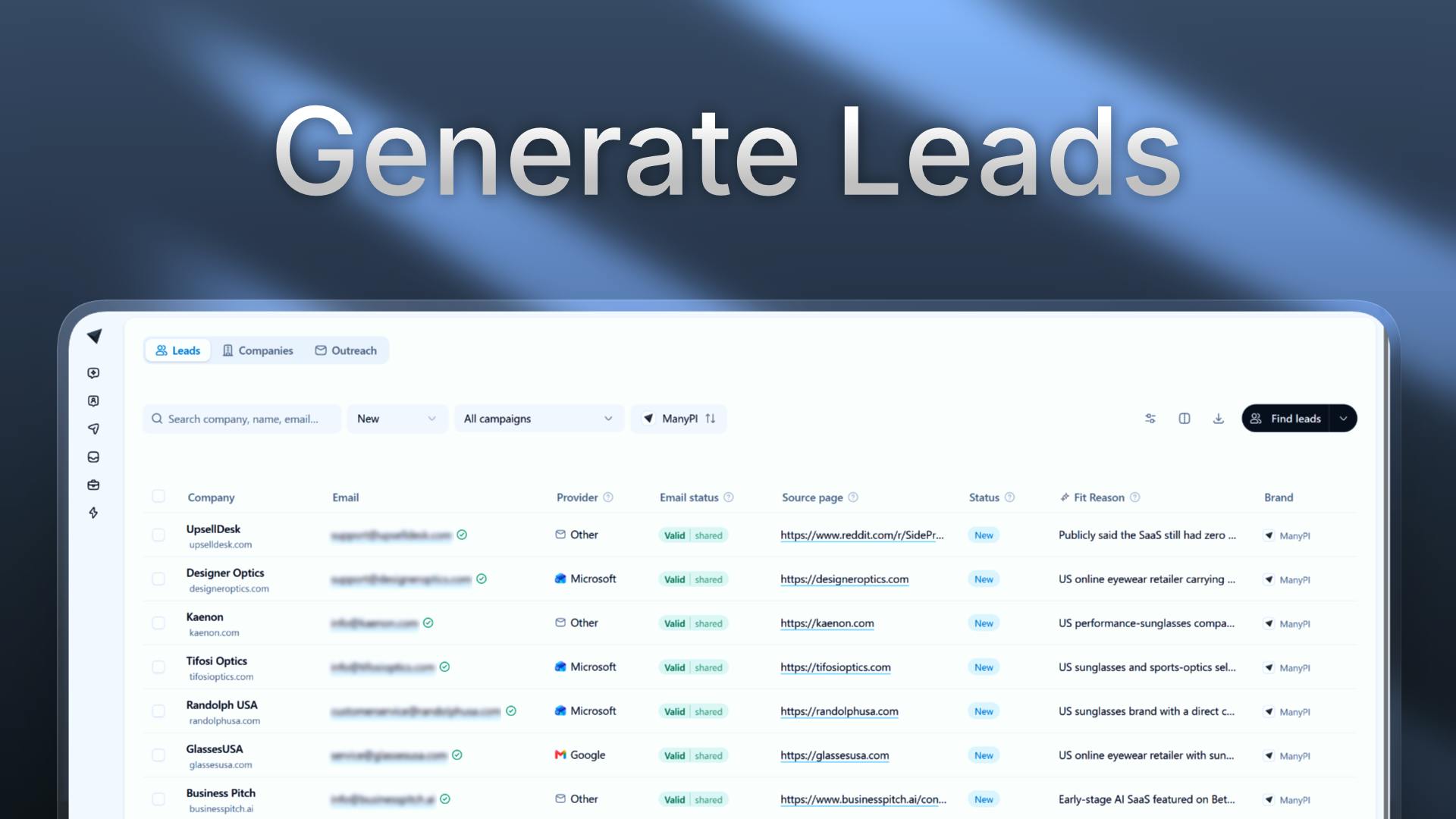
In B2B sales, finding the right customers is often harder than selling the product itself. ManyPI, a new tool that recently debuted at number seven on Product Hunt, aims to solve this age-old problem with AI — covering the entire outbound sales pipeline, from defining an ideal customer profile to scraping prospects across the live web, verifying email addresses, uncovering pain points, and automatically sending highly personalized outreach emails.
From "Spray and Pray" to Precision Targeting
The traditional outbound sales playbook involves purchasing massive email lists and blasting near-identical template emails to thousands of addresses. Conversion rates are dismal, and campaigns frequently get flagged as spam. ManyPI's core differentiator is a shift from a quantity logic to a signal logic.
According to the official description, users simply define their Ideal Customer Profile (ICP), and ManyPI searches the live web for matching prospects. The keyword here is "live" — compared to relying on stale databases, real-time scraping means fresher leads whose current status and needs more accurately reflect reality.
The Ideal Customer Profile (ICP) is a foundational concept in B2B sales. It describes the characteristics of the highest-value potential customers based on dimensions like industry, company size, geography, tech stack, and growth stage. The clearer the ICP, the more targeted the subsequent lead generation and outreach. Traditionally, building an ICP depended on accumulated experience from sales teams. AI tools make it possible to quantify this profile into actionable filtering criteria that directly drive automated searches.
A Four-Step Closed Loop: Find, Verify, Understand, Reach
ManyPI breaks down the front end of the sales process into a coherent workflow — which is what sets it apart from single-function tools.
Find and Verify
The tool first locates prospects across the web, then validates their email addresses. Email verification may seem basic, but it directly determines deliverability for all subsequent outreach — invalid addresses don't just waste opportunities, they damage the sender domain's reputation.
Validate Pain Points and Buying Triggers
One of ManyPI's most interesting features is its claimed ability to "validate pain points and emotional buying triggers." This means it doesn't just assess whether someone fits the ICP — it also tries to infer whether that person has purchase intent right now. If this capability lives up to the marketing, it upgrades a sales lead from a static contact into an opportunity carrying intent signals.
"Emotional buying triggers" come from B2B sales psychology: even though enterprise purchasing appears rational, what actually drives decision-makers to act is often specific situational pressure — a recent funding round requiring rapid scaling, recent customer churn, or a competitor launching a new product. These signals are typically scattered across public channels: job postings, press releases, LinkedIn posts, and industry forums. By continuously monitoring and semantically analyzing these sources, AI tools can theoretically reach prospects within the short window after a signal appears, converting cold leads into time-sensitive sales opportunities. This intent-signal-based approach is fundamentally different from the traditional method of filtering by company size or industry segment.
Hyper-Personalized Outreach
Armed with these signals, ManyPI generates and sends hyper-personalized outreach emails that translate the uncovered pain points and buying signals into concrete sales messaging. Personalization is often the deciding factor in outbound email reply rates, and this is where AI delivers the most tangible value.
Market Positioning and Early Reception
ManyPI falls under the Sales, Email Marketing, and Marketing categories and was built by Maker Ole Mai. On Product Hunt, it earned 86 upvotes and 5 comments, ranking seventh for the day. For a new product entering the crowded sales automation space, this traction suggests it's addressing a real and frequent pain point.
It's worth noting that the AI outbound sales tools space is already highly competitive, with players like Clay, Apollo, and Instantly each holding their ground. ManyPI's core bet on standing out is its claimed ability to identify emotional buying triggers — if it can make intent signals accurate enough, it can establish a distinct value proposition in an otherwise commoditized category.
The main competitors in the current AI outbound tools space each have different strengths: Clay excels at powerful data aggregation and workflow automation, pulling customer information from dozens of sources; Apollo.io leverages its proprietary database of 200M+ contacts combined with built-in email sequence features; Instantly focuses on deliverability optimization for high-volume cold email campaigns. A shared limitation among these products is their reliance on historical databases, with personalization typically limited to template-level customization. If ManyPI can make a genuine breakthrough in real-time intent signal detection, it can carve out a differentiated foothold in this crowded space — though that also means its technical claims will face greater scrutiny.
A Measured Look at the "10x Revenue" Promise
The product tagline touts "10x your revenue" — a type of claim that's common in marketing tools and functions more as an attention hook than a quantifiable promise. Actual results depend heavily on the user's industry, the clarity of their customer profile, and the product-market fit of their offering.
For teams considering a trial, more practical evaluation criteria would be: Is lead quality genuinely higher than existing channels? How does email verification and deliverability perform? Can the personalized emails achieve the expected reply rates? These metrics are far more meaningful indicators of real value than a revenue-multiplier tagline.
Summary
ManyPI represents a clear application of AI in the sales prospecting space — using automation to replace the tedious work of lead discovery and validation, and leveraging intent signals to sharpen outreach precision. It transforms "finding customers" from a labor-intensive task into a scalable process. Whether it can deliver on its revenue growth promises still needs validation in real-world scenarios, but its signal-driven approach to prospecting genuinely points toward where B2B sales tools are headed.
Related articles

Amphibious Transforming Drone: Beyond 100x Power Savings, What Are the Real Needs?
Is the amphibious transforming drone just a gimmick? Starting from the 100x power difference of the M4 Morphobot, explore real application scenarios and thesis topic ideas, analyzing boundary conditions where pure drones and pure ground robots both fail.

Warhound Raises $200 Million: Genetically Engineered "War Dogs" Paired with Anduril Gear
Warhound raises $200M, backed by Ben Lamm and Palmer Luckey, to genetically engineer dogs for military and law enforcement use and equip them with Anduril gear. This article analyzes its technology direction, funding logic, and ethical controversy.

Claude API Comes to Google Cloud: IAM Integration and SDK Access Guide
Anthropic hosts the full Claude API on Google Cloud with IAM-controlled permissions and unified billing. This guide covers the Vertex AI and Anthropic-hosted entry points, IAM role configuration, and SDK access.