Marble MCP: A New Way to Manage CMS Content Directly from Claude, Cursor, and More
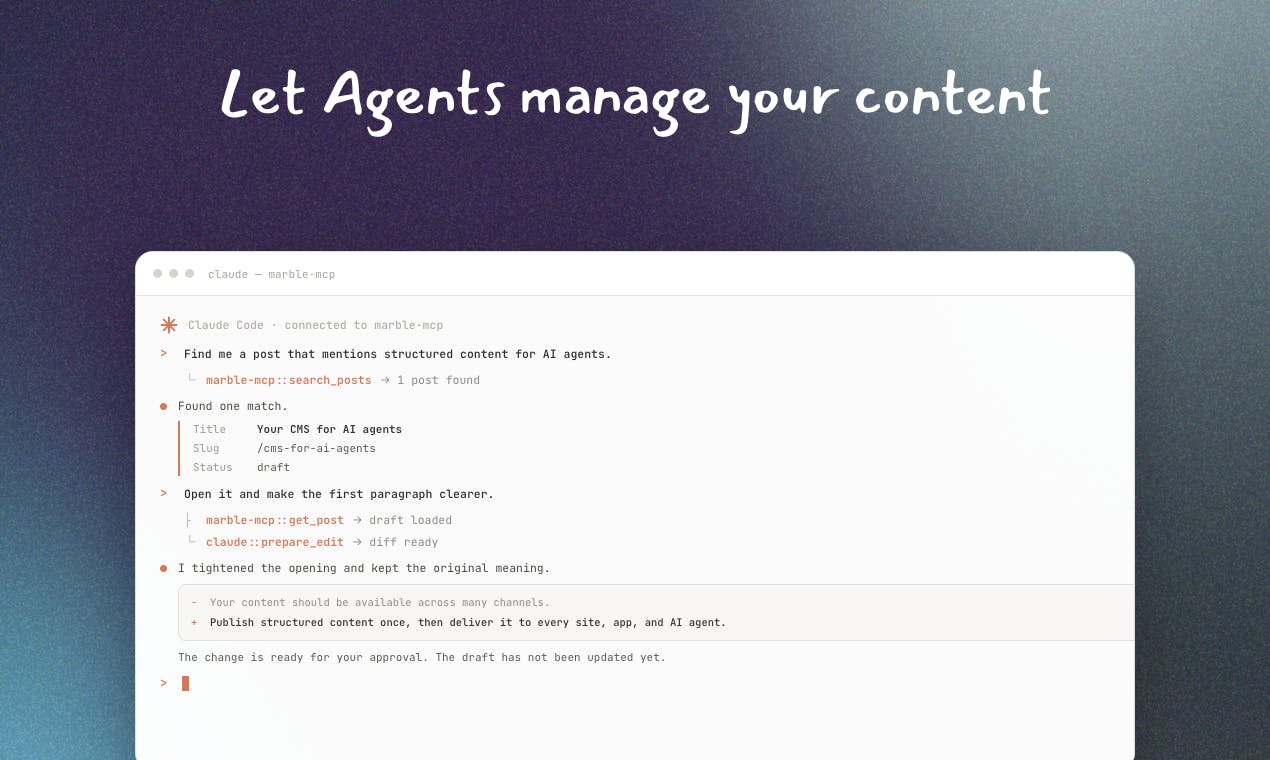
Marble's MCP server lets you create posts, update content, and manage media without leaving your AI coding tool.
Marble has launched an MCP server that connects its CMS directly to AI coding tools like Claude, Cursor, and Codex. By leveraging the Model Context Protocol, developers can create articles, update content, and manage media assets through natural language — without switching away from their editor or terminal. The product targets technical creators who work across both code and content, and reflects a broader trend of AI assistants evolving into full operational hubs for the developer stack.
When AI Coding Tools Become the New Gateway to Content Management
The developer workflow is being redefined. Managing a CMS used to mean constantly switching between a code editor, a terminal, and an admin dashboard — finishing a block of code only to open a browser, log into the backend, create a post, upload media, and update content. Cognitive science research suggests that each context switch takes an average of about 23 minutes to fully recover from. This "context-switching cost" is one of the core drains on developer productivity, breaking focus and slowing everything down.
Marble's newly launched MCP server takes an elegant approach to solving this problem: it lets you manage CMS content directly from AI coding tools like Claude, Cursor, and Codex, without ever leaving your editor or terminal. The product earned 73 upvotes on Product Hunt and ranked 14th — not a viral hit, but the trend it represents is well worth paying attention to.
What Is the MCP Protocol, and Why Does It Matter for CMS Management
A Quick Introduction to MCP (Model Context Protocol)
MCP (Model Context Protocol) is an open standard proposed by Anthropic that enables AI models to connect with external tools and data sources in a standardized way. Think of it as a "USB port" for AI applications — through a unified protocol, any MCP-compatible AI client can call any compliant server to extend its capabilities.
MCP was officially open-sourced in late 2024. Its design draws on the success of the Language Server Protocol (LSP) — the same approach that allowed code completion, diagnostics, and other features to work across editors through a shared standard. MCP uses a client-server architecture: AI tools act as MCP clients, third-party services act as MCP servers, and they communicate via standardized JSON-RPC messages. Servers expose three types of capabilities to clients: Tools (callable functions), Resources (readable data), and Prompts (preset prompt templates). This layered design lets AI models safely invoke external capabilities without needing to understand implementation details, dramatically lowering the bar for integration. By early 2025, major AI coding tools including Claude, Cursor, and Zed had all announced MCP support.
For a CMS like Marble, offering an MCP server means exposing its content management capabilities to the entire AI tool ecosystem. Developers no longer need to build custom integrations for each AI tool — as long as the tool supports MCP, it can call Marble's features directly.
What Marble MCP Changes About Content Management
Marble MCP's core capabilities include creating posts, updating content, and managing media assets. These operations previously required navigating the CMS admin UI; now they can be triggered directly inside an AI coding assistant via natural language instructions.
The technical foundation for all of this is the LLM's tool-calling capability (Function Calling / Tool Use). This allows the model to recognize mid-reasoning when an external tool is needed, generate structured call parameters, and incorporate the tool's return values into subsequent reasoning. Unlike traditional RPA (Robotic Process Automation), which relies on preset rule scripts, AI-driven tool use can interpret ambiguous instructions, handle edge cases, and maintain context consistency across multi-step tasks.
A practical example: you're building a blog in Cursor and just finished a feature. You can tell the AI directly, "Create a release post in Marble about the new feature," and it will complete the entire operation via MCP — no switching to any other interface required.
A Product Positioned Precisely for Developers
Marble MCP's Product Hunt category tags make its positioning clear — it sits across Writing, Developer Tools, Artificial Intelligence, and GitHub. That cross-category placement points to a specific target user: the technical creator who both writes content and writes code.
For indie developers, technical bloggers, and documentation maintainers, code and content are two sides of the same job. They're used to getting most things done in the terminal and editor, and any task that pulls them out of that environment is a productivity tax. Marble MCP targets exactly that pain point, embedding content management directly into the toolchain they already live in.
The Broader Industry Trends at Play
AI Tools Are Becoming the Developer's Operating Hub
Marble MCP isn't a one-off. As MCP is adopted by mainstream AI tools, more and more SaaS products are shipping their own MCP servers. This reflects an important shift: AI coding assistants are evolving from pure "code generators" into operational hubs that connect a wide range of services.
When tools like Claude and Cursor can call into databases, CMSes, deployment platforms, and payment systems, the way developers work will change fundamentally — driving an entire tech stack with natural language, rather than manually operating dozens of tool interfaces.
The Line Between Content and Code Keeps Blurring
For the content management space, Marble's approach represents the next step in the headless CMS evolution. The headless CMS concept emerged in the mid-2010s as an architectural rebellion against traditional "coupled" CMSes like WordPress and Drupal: the backend handles only content management and API output, while the frontend is entirely free to choose its own stack — enabling modern multi-channel publishing. Contentful, Sanity, and Strapi are the defining products of this wave. But the API-first approach, while flexible, requires developers to be comfortable with REST or GraphQL calls, which carries its own operational overhead.
MCP support can be seen as yet another layer of abstraction on top of the API — reducing content operations from "writing an HTTP request" to "saying a sentence." It's the natural evolution of headless CMS into the AI-native era.
A Few Things Worth Keeping in Mind Before You Use Marble MCP
As a newly launched product, Marble MCP is still in its early stages. Based on public information, it has only one review so far, and real-world user feedback and long-term stability remain to be seen.
Beyond that, handing content management permissions to an AI tool introduces security risks that don't exist in traditional workflows. The key challenges span three dimensions: permission boundaries — AI tools should follow the principle of least privilege, obtaining only the minimum permissions needed for a given task; operation auditing — all AI-initiated content changes should leave a traceable log; and misoperation prevention — high-risk actions (such as bulk deletion or publishing to production) should require human confirmation via a "Human-in-the-loop" mechanism. Also worth watching: prompt injection attacks, where malicious content embedded in user-generated CMS data could "contaminate" the AI's instruction parsing and trigger unintended actions. These are open problems across the entire MCP ecosystem right now, with no established best practices yet.
That said, the direction Marble MCP points toward is clear and valuable. For technical creators chasing maximum workflow efficiency, the experience of "managing everything without leaving the editor" could easily become the new default. And as the MCP ecosystem matures, there's good reason to expect more integrations like this — ultimately reshaping how developers interact with their tools.
Key Takeaways
Related articles

Amphibious Transforming Drone: Beyond 100x Power Savings, What Are the Real Needs?
Is the amphibious transforming drone just a gimmick? Starting from the 100x power difference of the M4 Morphobot, explore real application scenarios and thesis topic ideas, analyzing boundary conditions where pure drones and pure ground robots both fail.

Warhound Raises $200 Million: Genetically Engineered "War Dogs" Paired with Anduril Gear
Warhound raises $200M, backed by Ben Lamm and Palmer Luckey, to genetically engineer dogs for military and law enforcement use and equip them with Anduril gear. This article analyzes its technology direction, funding logic, and ethical controversy.

Claude API Comes to Google Cloud: IAM Integration and SDK Access Guide
Anthropic hosts the full Claude API on Google Cloud with IAM-controlled permissions and unified billing. This guide covers the Vertex AI and Anthropic-hosted entry points, IAM role configuration, and SDK access.