Master LLMs in Six Weeks: A Beginner's Learning Roadmap from AI Concepts to Enterprise Applications

A six-week, three-stage roadmap from AI basics to enterprise LLM application development.
This article outlines a practical LLM beginner curriculum using a three-stage, six-week roadmap: LLM fundamentals and prompt engineering, RAG and Agent development, and fine-tuning with private deployment. The first lesson traces the progression from AI and machine learning through deep learning and Transformer's attention mechanism, explaining how the field evolved from rule-based judgment to generative content creation. The core message: learners don't need to train models from scratch — they should build on existing LLMs to create knowledge bases and automated Agents for real business use cases.
Many people who want to learn about large language models get stuck right at the starting line. Online courses typically begin with machine learning fundamentals, spending hours on theories from decades ago — and most learners give up halfway through. Jinze, a Bilibili content creator, offers a more pragmatic approach in his introductory LLM series: skip the outdated curriculum order, and instead use a three-stage, six-week framework to build a complete understanding of large models from scratch, ultimately landing on real enterprise-level projects.
This article breaks down that learning framework and reconstructs the first lesson's walkthrough of core AI concepts, helping beginners build an accurate mental map of the field.
The Three-Stage Learning Roadmap: From Theory to Practice
The roadmap itself isn't complicated — the real value lies in the order and the trade-offs it makes.
Stage One focuses on LLM fundamentals and prompt engineering. The goal is to give learners a foundational understanding of what large models are and what they can do. No deep dives into math or algorithms here — just a clear grasp of what these models are capable of.
Stage Two moves into core application areas like RAG and Agents, working through the full application technology stack. This is the critical leap from "knowing how to use" to "knowing how to build."
Stage Three combines the knowledge from the first two stages, then adds fine-tuning and private deployment to the mix, leading directly into hands-on project work. Recommended practical scenarios include enterprise-grade applications such as medical customer service chatbots, stock analysis tools, and digital human systems.
The framework's real value is in drawing a clear line between general practitioners and AI researchers: you don't need to train a model from scratch. You stand on top of existing large models and build real applications.
Clearing Up the Concepts: How AI, Machine Learning, and Deep Learning Actually Relate
The biggest source of confusion for beginners is treating artificial intelligence, large models, machine learning, deep learning, and generative AI as interchangeable — or completely unrelated. Some people think AI is just ChatGPT. Others see these as separate, disconnected technologies. In reality, they have a clear developmental relationship.
Artificial Intelligence (AI) is the broadest category. It's the study of enabling computers, software systems, and robots to learn, understand, reason, and act in ways similar to humans. It's not a specific product — it spans the entire field across computer science, mathematics, statistics, linguistics, and even neuroscience.
The course uses two historical milestones to sketch the early AI trajectory: IBM's Deep Blue defeating chess champion Garry Kasparov in 1997, and AlphaGo defeating Go champion Lee Sedol in 2016. Deep Blue's approach was fundamentally different from today's large models — it relied on search algorithms, analyzing vast numbers of possible moves in advance and selecting the one with the highest estimated winning probability according to predefined evaluation rules.
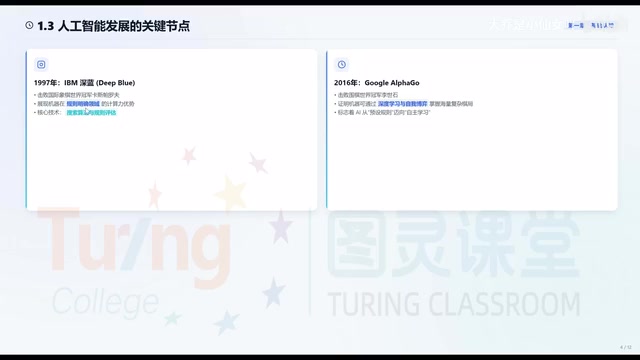
This approach worked for chess because the rules are explicit and can be defined in advance by a program. But countless real-world tasks have no clear rules — determining whether an image contains a cat, or analyzing the sentiment of an article, can't be solved by pre-written rules. That's precisely what drove AI into its next phase.
Machine Learning: Letting Machines Find Patterns in Data
When rules can't be exhaustively specified, the approach changes: instead of telling the machine all the answers, you feed it large amounts of data and let it discover the hidden patterns on its own. That's machine learning.
The course divides classical machine learning into three categories:
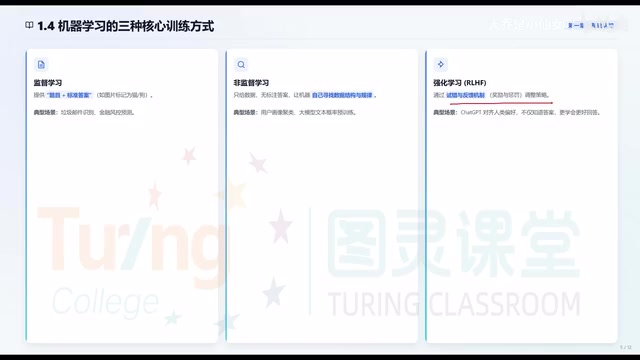
Supervised learning gives the machine both the questions and the answers — like a student working through math problems with full solutions. When recognizing cats and dogs, every image is labeled, and the model continuously learns the relationship between images and labels until it can make predictions on new images. Spam filtering and financial risk control both use this approach.
Unsupervised learning provides no answers, letting the machine find structure in the data on its own. Given a large dataset of user ages, browsing habits, and purchase histories, the model discovers which users behave similarly and might belong to the same group. LLM training draws heavily on this idea — feed the model massive amounts of text and have it predict missing content, thereby learning the patterns of language.
Reinforcement learning adjusts behavior through trial and error based on feedback, similar to how a child learns to walk: fall down and adjust, take a successful step and receive positive reinforcement. After its initial training, ChatGPT was further refined through Reinforcement Learning from Human Feedback (RLHF), improving not just the accuracy of answers, but how well the model communicates them.
Deep Learning and Transformer: The Technical Foundation of Modern LLMs
As tasks like image recognition, speech understanding, and natural language processing grew more complex, traditional machine learning hit a wall, and deep learning emerged. At its core is the neural network — a computational model inspired by the way neurons connect in the human brain, linking large numbers of processing nodes so that information passes through multiple layers: the first layer learns edges and colors, the second learns shapes and structures, the third learns object composition. The more layers, the richer the representations the model can learn.
Early deep learning had its own problems: the deeper the network, the more information was lost as it traveled through many layers. One important innovation was residual connections, which allow information to skip over certain layers and be added directly to the output — a critical foundation for modern deep learning models.
The real turning point came with Google's paper Attention is All You Need. Human language is notoriously difficult because the same word can mean different things in different contexts, and text is full of implicit information. For example, "This project is really tough" might refer to technical complexity, organizational friction, or simply emotional frustration.
The attention mechanism introduced by Transformer allows the model to consider contextually relevant information when processing any given word. Take the sentence "Apple released a new phone, and it became very popular with users" — the model can establish the semantic link between "it" and "Apple's phone" while reducing attention to irrelevant words.
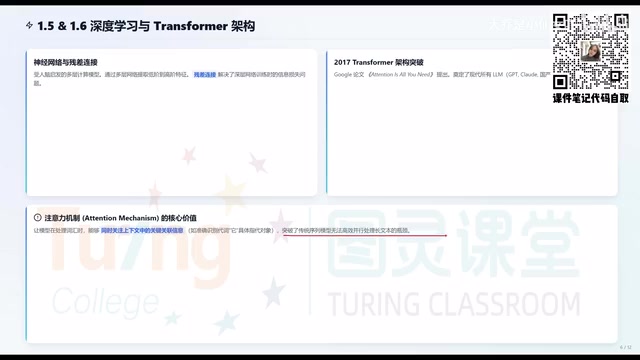
Transformer's bigger contribution is handling massive amounts of text. Traditional recurrent neural networks tend to "forget" earlier content as text length increases. Transformer's attention mechanism processes multiple parts of the text simultaneously, making it possible to handle longer, more complex information. Researchers discovered that as they scaled up model size, added more data, and increased compute, model capability kept improving — and that's the underlying logic behind the LLM explosion.
Residual Connection: Proposed by Microsoft Research in the 2015 ResNet paper, the core idea is to add a "shortcut" between network layers so that the input signal can bypass several layers and be added directly to that layer's output. This solves the vanishing gradient problem in deep network training — during backpropagation, the gradient signal travels back intact via the shortcut, allowing networks to be stacked hundreds of layers deep without degradation. The Transformer architecture in Attention is All You Need also uses residual connections, which is one of the key engineering reasons it can scale to extremely large sizes (hundreds of billions of parameters).
Generative AI and LLMs: From Judgment to Creation
Looking back at the entire development arc (rules → machine learning → deep learning → Transformer), one shift stands out: earlier AI was mostly doing classification and judgment, while recent generative AI can create content from scratch.
Getting a computer to write an essay used to be extremely difficult — it required understanding a topic, organizing a structure, and choosing the right expression. Today's large language models (LLMs) can generate full articles, code, and images from a simple prompt. The explosion of ChatGPT 3.5 was the result of three forces converging: accumulated data, a leap in compute, and architectural breakthroughs — pushing model capability from incremental improvement to a qualitative leap.
After hands-on testing of various LLM applications, the course reaches a pragmatic conclusion: large models are currently best suited not to fully replace roles, but to serve as highly efficient assistants — handling large volumes of repetitive work and freeing up human time for goal-setting, decision-making, and creative work. Just as most people after the invention of the automobile didn't need to understand how engines work, but learned to drive to move more efficiently.
RLHF (Reinforcement Learning from Human Feedback) is the key training step that enables ChatGPT to produce answers aligned with human expectations. The process works like this: human annotators rank multiple model responses, which trains a "reward model" to score outputs; then a reinforcement learning algorithm (such as PPO) is used to optimize the language model to pursue higher reward scores. This step transforms the model from "predicting the next word" to "organizing responses according to human preferences," directly determining how natural the conversational experience feels. Without RLHF, large models might generate grammatically correct but irrelevant or even harmful content.
How to Choose an LLM and Where Things Are Headed
The course offers a brief overview of mainstream large models: OpenAI's GPT series has the widest influence, covering text generation, code assistance, and data analysis; Claude excels at long-form analysis and logical reasoning, making it a favorite among developers writing code; Google's Gemini is a multimodal model capable of handling text, images, audio, and video. Domestic Chinese options include Alibaba's open-source Qwen (通义千问Ad), Baidu's ERNIE series, and DeepSeekAd.
There's no universal standard for choosing a model — it depends on the task, environment, and goals. For learning and organizing information, a general-purpose model is fine; for software development, Claude or Gemini may be preferable; enterprise scenarios require additional consideration of data security, private deployment, cost control, and system integration.
For future trends, the course identifies three main directions: continuously improving model capabilities (reasoning, coding, multimodality); increasing specialization by industry (domain-specific LLMs for finance, law, and healthcare); and Agents becoming a major application paradigm — capable not just of answering questions, but of understanding goals, planning steps, calling tools, and executing tasks in an intelligent feedback loop. For instance, ask it to analyze a company's sales performance, and it can automatically pull data, identify trends, generate a report, and offer recommendations.
For everyday learners, rather than getting lost in low-level theory, the better path is to build on the general capabilities of existing LLMs — combining them with specific business contexts to build knowledge bases and automated Agents, and actually putting this three-stage roadmap into practice.
RAG (Retrieval-Augmented Generation) is one of the most widely used technical approaches for deploying LLMs in enterprise settings, and it's the core focus of Stage Two in this curriculum. The basic idea: before the model generates a response, it first retrieves the most relevant document chunks from an external knowledge base, then feeds those chunks as context into the model alongside the query — so the model answers based on real, up-to-date enterprise data rather than only the knowledge baked in during training. This addresses two classic LLM weaknesses: information becoming stale after the training cutoff date, and complete ignorance of a company's private data. Nearly all of the course's recommended hands-on scenarios — medical customer service chatbots, stock analysis tools, and more — use RAG as their underlying architecture.
Related articles

Java Engineers Transitioning to Agent Development: A Complete Four-Week Learning Roadmap
A roadmap for Java engineers transitioning to AI Agent development: a four-week learning plan from core theory, the ReAct paradigm, and multi-agent collaboration to hands-on projects, analyzing the strengths, gaps, and job-market realities of a career change.

LangGraph Multi-Agent in Practice: Key Takeaways from a Bilibili Tutorial
A breakdown of a Bilibili LangGraph multi-agent tutorial covering architecture choices, core LangGraph components, and three hands-on projects: a code assistant, a prompt generation assistant, and a WebRTC digital human.

Backend to AI Agent Engineer: What Are P7 Interviewers Really Testing?
Based on a popular Bilibili AI Agent course, this analyzes backend developers' real path to Agent engineer: P7 interviews test engineering stability like strong validation, fallback degradation, and Semantic Cache—not Prompt tricks.