Mathematician and Claude Claim Proof of Riemann Hypothesis, Sparking Debate on AI's Mathematical Abilities

Mathematician Alpöge claims a Riemann Hypothesis proof with Claude, but verifiable materials are missing.
Mathematician Levent Alpöge posted a statement claiming that, with Anthropic's Claude, he discovered a proof of the Riemann Hypothesis and that the method extends to the Generalized and even Extended Riemann Hypothesis, adding that the argument was formalized without assumptions. The news spread quickly after being shared by Simon Willison and others. Yet no proof paper, formalization code, or peer review has been provided, and Alpöge uses "I believe" rather than "proven." The Riemann Hypothesis is a Millennium Prize Problem unsolved for over 150 years, and history has seen many disproven claims. Reaction is split between those highlighting AI's progress in formal math and those insisting it remains unverified. The episode reflects large models' shift from tools to research collaborators and raises new questions about verification and authorship.
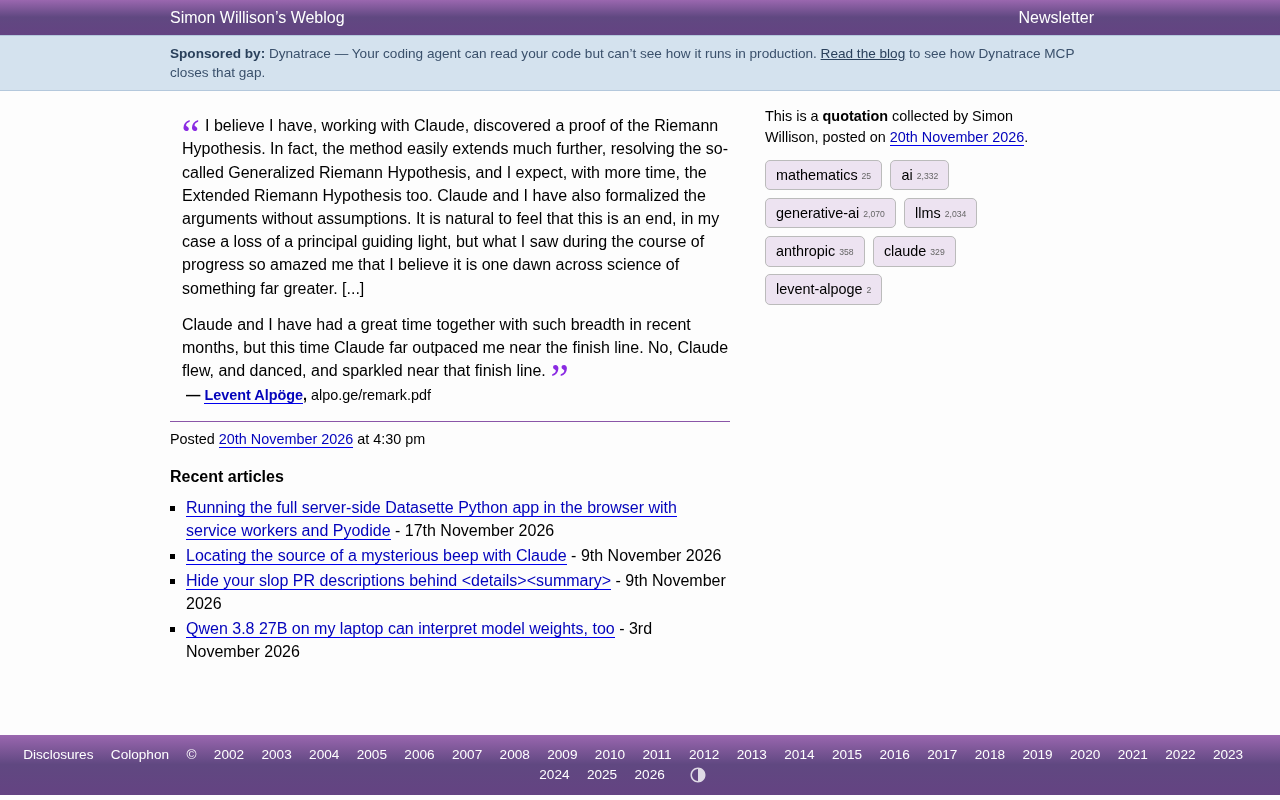
A brief statement posted on his personal website by mathematician Levent Alpöge has dropped a bombshell on the mathematics and AI communities. He claims that, working with Anthropic's Claude model, he has discovered a proof of the Riemann Hypothesis, and further states that the method can be extended to the Generalized Riemann Hypothesis and even potentially to the Extended Riemann Hypothesis. The news spread rapidly after being shared by tech observers such as Simon Willison, but the statement itself provides no complete proof details or peer review information, and discussion about its authenticity continues.
What the Original Statement Says
Alpöge's wording is quite direct. He writes that he "believes" he has discovered a proof of the Riemann Hypothesis in collaboration with Claude, that the method "easily extends" to the Generalized Riemann Hypothesis, and that he expects more time will be needed to address the Extended Riemann Hypothesis. He also mentions that the two have "formalized the argument without assumptions"—a point that would be especially critical if true, because formal verification means the proof can be checked line by line by machine.
The most striking part of the statement is the description of Claude's role. Alpöge says that in the final stretch, Claude "far exceeded me," and that "Claude flew, danced, and shone." This kind of anthropomorphic expression, coming from a serious mathematical researcher, surprised many readers.
Why the Riemann Hypothesis Matters So Much
The Riemann Hypothesis is one of the most famous unsolved problems in mathematics, closely tied to the distribution of prime numbers. It has remained unresolved for more than a century and a half since it was proposed, and it is listed among the Clay Mathematics Institute's Millennium Prize Problems. Any claim to have proven it will naturally invite scrutiny or even skepticism—history is full of cases where proofs were claimed but ultimately disproven.
For this reason, the word "formalized" in Alpöge's statement deserves particular attention. If the argument really has been fully formalized, then verification could in theory be carried out by a proof assistant, rather than relying entirely on human review. However, the public text of the statement does not include formalization code or proof files, and this is currently the biggest information gap.
The Millennium Prize Problems were established by the Clay Mathematics Institute in 2000 and consist of seven mathematical problems, each carrying a one-million-dollar prize for a solution. The Riemann Hypothesis is the earliest proposed and most widely known of them. The other six are the P versus NP problem, Yang–Mills existence and mass gap, Navier–Stokes existence and smoothness, the Hodge conjecture, the Poincaré conjecture (solved by Perelman in 2003), and the BSD conjecture. The Millennium Prize Problems were created to concentrate resources on advancing the core unsolved problems of mathematics, so any claim related to them automatically receives far more attention than an ordinary paper—and also faces stricter scrutiny.
Formal verification refers to translating a mathematical proof into a formal language that a computer can check line by line, with common tools including Lean, Coq, and Isabelle. In a formal system, every step of reasoning must be mechanically verified by the kernel according to axioms and already proven theorems, with no hidden assumptions or skipped steps allowed. This stands in sharp contrast to the traditional mathematical paper's reliance on human peer review. For this reason, if a proof really has been fully formalized, the threshold for verifying its correctness is significantly lowered—but only on the premise that the formalization code itself is publicly available and the set of axioms it relies on is explicitly stated. The phrase "formalized without assumptions" in Alpöge's statement refers precisely to the argument not introducing any additional unproven premises.
The Role of AI in Mathematical Research Is Changing
This statement reflects a broader trend: large models are shifting from "problem-solving tools" to "research collaborators." In Alpöge's account, Claude is not passively performing calculations, but contributing insights beyond those of a human collaborator at a key stage of advancing the proof.
What needs to be viewed calmly is that a single-source statement cannot serve as a conclusion. At present, no proof paper has been publicly released, nor has any third-party mathematician provided an independent analysis of the argument's content. Alpöge himself uses the wording "I believe" rather than "proven," and this caution itself should prompt readers to remain equally cautious.
The Generalized Riemann Hypothesis (GRH) extends the classical Riemann Hypothesis from the integers to more general number fields—that is, for the zeta function over any algebraic number field, the real part of every nontrivial zero is 1/2. Its impact on number theory is even more profound, and many theorems can only be obtained in strong form under the assumption that GRH holds. The Extended Riemann Hypothesis further involves a broader family of L-functions. The three form a progression: the classical conjecture is a special case, the generalized version covers number fields, and the extended version covers objects such as automorphic forms. Alpöge's claim that the method "easily extends" to GRH implies that its argument structure may not depend on special properties of the integers—if true, its significance would far exceed the proof of a single conjecture.
Community Reaction and Points to Watch
This statement has provoked two kinds of responses in the interdisciplinary mathematics and AI community. One view holds that even if it is ultimately disproven, AI's progress in formal mathematics and proof search is still worthy of attention; the other emphasizes that, until testable materials are available, any claim to have "proven the Riemann Hypothesis" should be treated as an unverified assertion.
Signals worth watching next include: whether a preprint or formalization code repository will be made public, whether independent mathematicians will comment on the basis of verifiable materials, and whether Alpöge will further explain the details in academic settings. Until such information appears, this statement is better understood as a high-profile assertion about the boundaries of AI's mathematical abilities than as an accepted mathematical result.
For those interested in AI programming and AI applications, the value of this episode lies not in whether the conclusion is true, but in the new question it raises: when AI participates deeply in frontier mathematical reasoning, how should the academic community design mechanisms for verification and authorship? This question is probably more worthy of long-term discussion than the proof of any single conjecture.
One-line Summary
Mathematician Alpöge claims to have discovered a proof of the Riemann Hypothesis with Claude, but verifiable materials are lacking.
Paragraph Summary
Mathematician Levent Alpöge posted a statement on his personal website claiming that, in collaboration with Anthropic's Claude model, he discovered a proof of the Riemann Hypothesis, stating that the method extends to the Generalized Riemann Hypothesis and even the Extended Riemann Hypothesis, and mentioning that the argument was formalized without assumptions. The news spread rapidly after being shared by tech observers such as Simon Willison. However, the statement includes no proof paper, formalization code, or peer review information, and Alpöge himself uses the wording "I believe" rather than "proven." The Riemann Hypothesis is a Millennium Prize Problem that has remained unsolved for more than a century and a half, and history contains no shortage of claims that were later disproven. Community reaction is split: one side values AI's progress in formal mathematics, while the other insists that until testable materials appear, it should be treated as an unverified assertion. The episode reflects large models' shift from problem-solving tools to research collaborators, and raises a new question about how the academic community should design verification and authorship mechanisms.
Related articles

Detonating a Large Pile of Lead Azide: A Dangerous Chemical Experiment
Science blog records an experiment detonating a large pile of lead azide, sparking Hacker News debate. This article analyzes lead azide's dangerous properties, experimental risk boundaries, and the scale of reporting dangerous experiments in science communication.
Yung Pueblo on Self-Awareness: A 365-Day Guide to Inner Transformation
Yung Pueblo shares his new book Journey's 365-day self-awareness structure on Talks at Google, discussing meditation, intuition, co-leadership in relationships, and gratitude practices.

FBI and USDA Hit by Cyberattacks: Critical Infrastructure Security Alarms Sound Again
FBI and USDA reportedly hit by cyberattacks; the FBI was breached for the second time in recent months, this time targeting the National Crime Information Center (NCIC). This article analyzes the incident details, NCIC's strategic value, and common security challenges facing government agencies.