Maven Robotics Emerges from Stealth with $100M Series A Bet on Robot Deployment
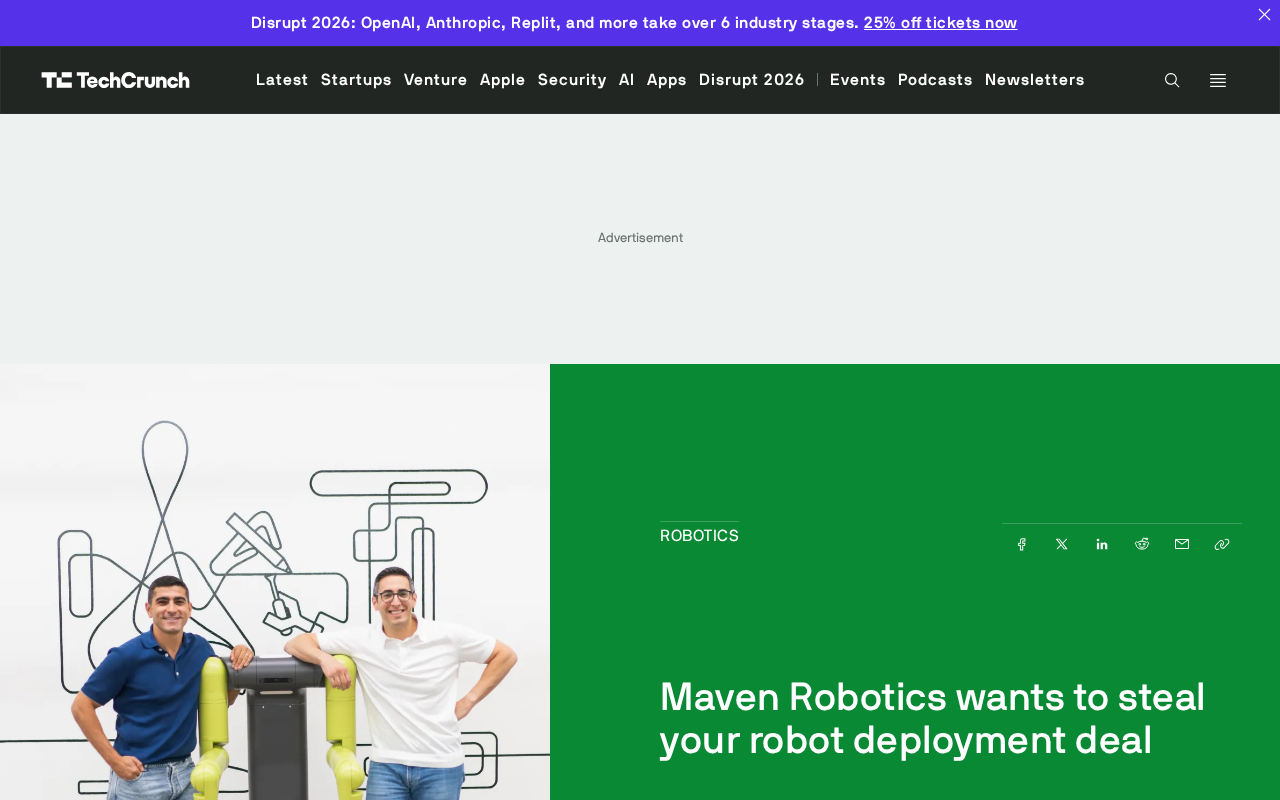
Maven Robotics exits stealth with $100M Series A, targeting robot deployment as the key bottleneck to industry scale.
Maven Robotics has officially gone public, announcing a $100M Series A with real commercial deployments already in place — a rare feat for a robotics startup. Rather than building robot hardware, the company focuses on solving the "last-mile" deployment challenge: environment adaptation, system integration, and ongoing operations. Maven likely pursues a platform or services model, positioning itself as a middleware layer between robot vendors and enterprise customers. Its emergence signals a capital market shift from frontier concepts like humanoid robots toward the more pragmatic work of commercial deployment — marking a new competitive phase for the robotics industry.
Maven Robotics Makes a Bold Debut After Years in Stealth
Maven Robotics today officially emerged from stealth mode, making a powerful entrance with a $100 million Series A round. What makes this even more compelling is that the company isn't just at the concept stage — it already has real commercial deployments under its belt.
In the robotics startup landscape, companies that secure nine-figure funding at the Series A stage are exceptionally rare. That number alone signals strong investor conviction in its technical approach and business model. For a startup that had never appeared in public before, this is an aggressive opening move.

Robot Deployment: The Core Pain Point Maven Robotics Is Targeting
Maven Robotics isn't positioning itself as a robot manufacturer. Instead, its core focus is on the deployment side of robotics — which happens to be the hardest problem in the entire value chain.
Why Robot Deployment Is the Critical Bottleneck
Across the robotics industry, hardware manufacturing has matured considerably. What consistently blocks scale is the "last-mile" deployment challenge:
- Complex environment adaptation: Every warehouse, factory, and retail floor is different, requiring extensive on-site configuration and integration work.
- High system integration barriers: Robots must connect with a company's existing ERP, WMS, and other enterprise systems — a highly customized engineering effort.
- Ongoing operational costs: Post-deployment maintenance, troubleshooting, and software updates often represent the largest share of long-term costs.
If Maven can standardize and modularize these steps — offering customers a near plug-and-play deployment experience — it has the opportunity to occupy an indispensable middleware position between robot vendors and enterprise clients.
Maven Robotics' Business Model and Growth Potential
Based on available information, Maven appears to be pursuing a platform or services-oriented strategy. Rather than competing directly with hardware manufacturers, it may act as a bridge connecting robot suppliers with end customers.
This positioning carries several distinct advantages:
- Asset-light operations: No need to bear the high costs of hardware R&D and manufacturing — focus stays on software, integration, and deployment services.
- Strong network effects: The more robot brands it supports and the more customers it serves, the more valuable its deployment knowledge and data become.
- Declining marginal costs: Codifying deployment processes into reusable tools and methodologies can significantly reduce the cost of each subsequent project.
That said, this model faces real-world challenges — robot deployment is highly context-dependent, and standardization is widely recognized as one of the industry's toughest problems. The $100M raise is likely intended to build out deployment case studies across multiple industries early on and establish a scalable methodology.
What This Signals for the Robotics Industry
Maven Robotics' high-profile debut reflects renewed investor interest in the "robot deployment services" niche. Over the past few years, investment enthusiasm has been concentrated in humanoid robots and embodied AI. Maven redirects attention to the more pragmatic side of commercialization.
As more robot hardware enters the market, the ability to deploy it efficiently and cost-effectively into real business environments is becoming the decisive variable in whether the robotics industry can truly scale. Whoever solves the deployment problem will have a significant competitive advantage in the next phase of the race.
Conclusion: The Second Half of Robot Commercialization Is Won in the Field
Public information remains limited for now — Maven Robotics' specific technology, customer base, and deployment scale have yet to be fully disclosed. But the combination of a $100M Series A and existing commercial deployments is enough to establish it as a new player worth watching closely in the robotics space.
Maven's emergence is also a reminder to the broader industry: in the second half of robot commercialization, the decisive battles may not be fought in the lab — they'll be fought on the deployment floor.
Related articles
Open-Source Python SDK: Measuring AI Agent Reliability with SRE Principles
Agent Reliability is an open-source Python SDK that applies SRE's SLO and error budget concepts to AI Agent evaluation, with PASS/FAIL/UNKNOWN states, CI assertions, and zero forced dependencies.
MiniMax RefMod: A Complete Guide to Training-Free Reusable Identity Workflows
MiniMax RefMod offers training-free reusable identity workflows for image, video, and audio generation. Includes Runpod template and tutorial for quick setup.

Invalid Source Material Notice
The source material provided lacks substantive information and is unrelated to AI/tech topics, making it impossible to produce a complete professional article.