Max Plan Shifts from Subscription to Credits — Has Your Usage Actually Shrunk?
AI coding Max plans shift from session-based to credit-based billing, raising concerns about hidden usage cuts.
AI coding subscription services are transitioning from session-time billing to API credit systems. A Max plan at $100/month now provides $300 in API credits — a 3:1 subsidy ratio that heavy users fear represents a significant reduction in actual usable capacity. This article analyzes the economic logic behind the shift, explains why coding scenarios are uniquely token-intensive, and offers practical strategies for users to evaluate their real value under the new model.
From Session Limits to API Credits: A Quiet Shift in Pricing Models
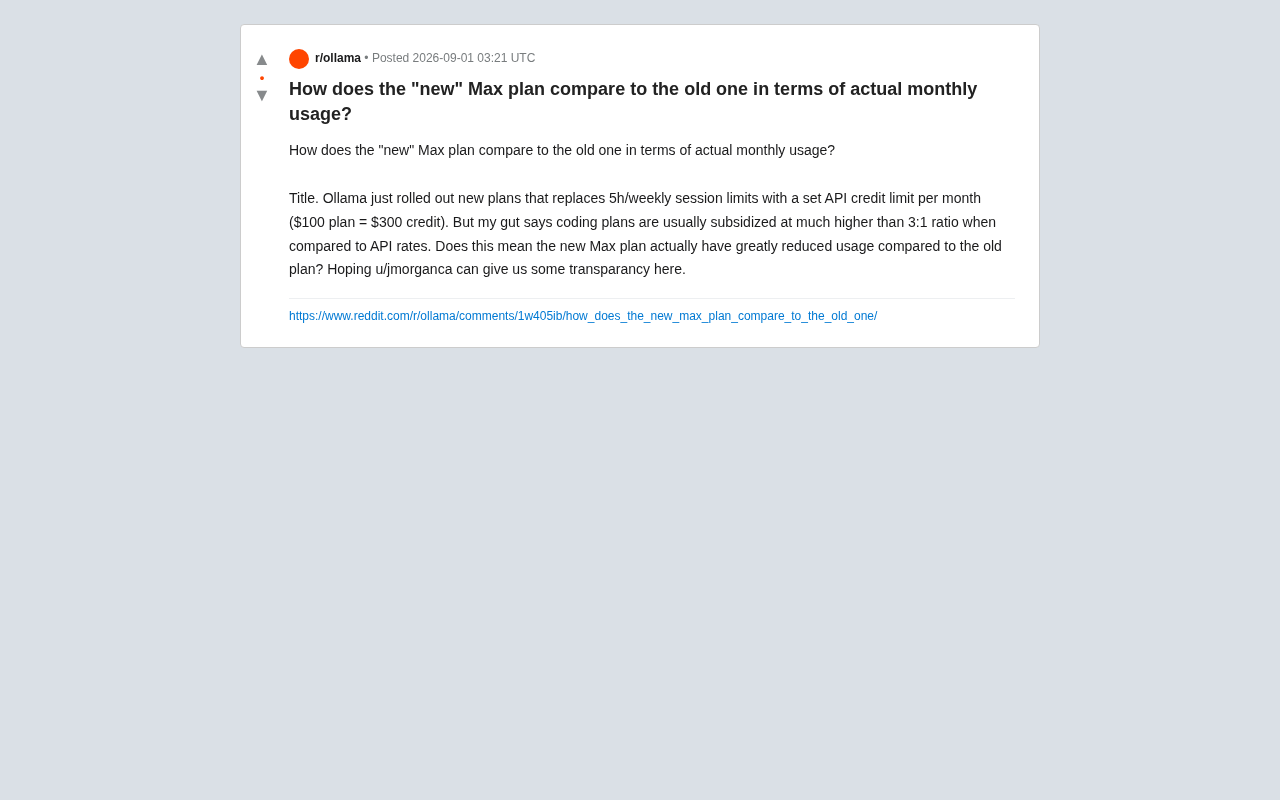
A recent discussion on Reddit about changes to the billing model of an AI coding subscription service has sparked widespread attention. The original model, which charged based on "weekly session time" (e.g., a 5-hour/week session limit), is being replaced by a new "monthly API credit allowance" system. Take one platform's Max plan as an example: a $100/month subscription comes with $300 in API credits, creating a 3:1 subsidy ratio.
On the surface, this looks like a simple billing adjustment, but community members have been quick to realize that it may conceal a significant change in actual usable capacity. The original poster put it bluntly: "My gut tells me the subsidy ratio for coding plans is usually far higher than 3:1." This implies that if the new model compresses the subsidy down to 3:1, users may see a dramatic reduction in the actual model invocations they can afford.
Why a 3:1 Subsidy Ratio Is Cause for Concern
The High Token Consumption Nature of Coding Scenarios
AI coding assistants are among the most token-intensive applications of large language models today. To understand why, you first need to grasp the concept of tokens: tokens are the basic units that LLMs use to process text. Models don't directly understand human language — instead, they use a tokenizer to split input text into tokens. In English, each word corresponds to roughly 1–1.5 tokens, while in Chinese, each character typically maps to 1–2 tokens. API providers charge separately for input and output tokens, with output tokens usually priced 3–4x higher than input tokens. For GPT-4o, for instance, the input price is roughly $2.5 per million tokens, while output runs about $10 per million tokens. In coding scenarios, a single request that includes the full codebase context can consume tens of thousands or even hundreds of thousands of tokens, meaning the actual API cost of a single coding interaction could reach several dollars.
Unlike casual chat, coding tasks typically require:
- Massive context input: Reading entire codebases, file dependencies, and error stack traces
- Multiple iterations: Repeated modifications, debugging, and verification
- Long output generation: Complete functions, classes, or even entire module code
It's worth noting that the context window of modern LLMs has expanded from the initial 4K tokens to 128K or even longer, determining how much information a model can "see" in a single request. For a coding assistant to understand the root cause of a bug, it often needs the relevant source files, dependency library interface definitions, error logs, and even Git commit history all packed into the context. Tools like Cursor and Windsurf use RAG (Retrieval-Augmented Generation) and code indexing to automatically retrieve and inject relevant files into the prompt. This means that even if a user writes just a brief instruction, the full prompt actually sent to the model behind the scenes may already contain tens of thousands of tokens of code context — something users often have little intuitive awareness of.
These characteristics mean that a single coding task can consume dozens of times more tokens than a typical conversation. Because of this, heavy users under the old "session time" model could often exchange a fixed monthly fee for actual usage far exceeding its face value — this is exactly what the "high subsidy ratio" refers to.
The Economic Logic of Shifting from Time-Based to Credit-Based Billing
The old session-time model was essentially an "unlimited within time slots" approach. For platforms, this made costs difficult to control precisely — heavy users could burn through compute resources far exceeding their monthly fee. In subscription services, the distribution of resource consumption typically follows a Pareto distribution (the mathematical expression of the 80/20 rule): roughly 20% of heavy users may consume 80% or more of the total compute resources. For AI coding tools, this distribution can be even more extreme — a developer using AI-assisted coding full-time might generate $500–$2,000 in actual monthly API costs, far exceeding the $100 subscription price and creating a severe cost inversion. Platforms in their growth phase can tolerate this inversion through venture capital subsidies in exchange for user growth and market share, but as user bases expand and capital markets demand profitability, this model ultimately becomes unsustainable.
The new API credit system quantifies costs explicitly: $100 buys $300 in credits, and the platform's subsidy exposure is locked to a clear figure. The introduction of credits essentially transforms "implicit, uncertain" subsidies into "explicit, controllable" ones.
For light users, the difference between the two models may be negligible. But for developers who use these tools intensively every day, a fixed 3:1 ratio likely means a "hidden downgrade" in actual usable capacity. Heavy users who may have been enjoying implicit subsidies of 5:1 or even 10:1 are now pulled back to a more "honest" but also more restrictive allowance.
The Platform's Dilemma: Balancing Sustainability with User Experience
From a platform operations perspective, this shift has its rationale. With ongoing model invocation costs, an unlimited time-based subscription model is commercially difficult to sustain long-term — a small number of heavy users may monopolize the vast majority of compute resources, causing severe cost inversions.
The billing models across the AI SaaS industry are evolving rapidly, and this transition is far from an isolated case. Early on, OpenAI's ChatGPT Plus offered nearly "unlimited" conversations at a flat $20/month — a simple subscription model that rapidly acquired users but also created enormous cost pressure. By some estimates, ChatGPT's daily operating costs reached approximately $700,000 in 2023. Since then, the industry has diversified into multiple models: pure pay-per-use (such as direct API access), tiered subscriptions (different price points corresponding to different usage caps), and hybrid models (base subscription + overage charges). Anthropic's recently launched Max plan, Cursor's per-request billing, and similar offerings all reflect an industry-wide shift from "aggressive subsidy-driven customer acquisition" to "refined cost control." This trend closely parallels the early evolution of the cloud computing industry from fixed bandwidth pricing to on-demand billing.
Switching to transparent credit-based billing is fundamentally the platform seeking a new balance between sustainability and user experience. This approach is increasingly common across the AI SaaS industry, with more and more providers moving from "unlimited monthly" to "capped allowance" or hybrid "pay-as-you-go" models.
However, the crux of the issue is transparency. The original poster called on the platform's founders to publicly explain: how much does actual monthly usage differ between the old and new plans? This demand reflects the community's core concern about billing changes — they don't necessarily oppose price increases or adjustments, but they want the platform to be upfront about the substance of the changes.
How Users Should Respond to Billing Model Changes
Reassess Your Actual Usage
When billing models change, users shouldn't focus solely on whether the monthly fee has changed. Instead, they should pay attention to how many actual tokens each dollar buys. The core metric for evaluating AI service value can be boiled down to "effective tokens per dollar," but several complicating factors exist in practice: First, token pricing varies enormously across models — Claude 3.5 Sonnet and GPT-4o can differ by several multiples. Second, coding tools differ in their backend architectures — some send the full context with every request, while others use Prompt Caching to reduce redundant token consumption, which can significantly lower actual costs. Third, some platforms' "credits" are not directly equivalent to API prices but are virtual currency converted through internal calculations. Therefore, when evaluating, users need to consider the model type they use, the platform's degree of technical optimization, and the actual credit-to-value exchange rate.
Here are some specific recommendations:
- Track historical consumption: If the platform provides usage statistics, review your actual API-equivalent consumption over the past few months under the old model
- Calculate equivalent allowances: Convert your old plan's actual usage into API prices and compare it against the new plan's credit allowance
- Estimate peak demand: Coding usage often fluctuates dramatically — focus on whether peak periods will exceed the new allowance
Pay Attention to Industry Benchmarks for Subsidy Ratios
As the original poster pointed out, a 3:1 ratio may be on the low side for coding scenarios. When choosing AI coding services, users can compare subsidy levels across different platforms, as well as whether there are degradation or additional billing mechanisms once the quota is exceeded.
Transparency Is the Foundation of Trust in Subscription Models
This discussion around the Max plan reflects a universal tension in AI service subscriptions: platforms need to control costs for sustainability, while users want stable and transparent value. Replacing vague "session time" with explicit "API credits" is a step in the right direction, but if the new allowance substantially compresses heavy users' available capacity without adequate explanation, it can easily trigger a crisis of trust.
For heavy users of AI tools, this case offers an important reminder: in the world of subscriptions, the number on the label doesn't necessarily equal real value. Learning to measure services with a unified yardstick like "tokens per dollar" is the key to making rational choices amid frequently shifting billing strategies.
Key Takeaways
Related articles

MCP Internal Assistant Selection: NeuralTrust TrustGate vs Composio Hands-on Comparison
When connecting internal assistants to Slack, Jira, and internal APIs via MCP, how to choose between NeuralTrust TrustGate and Composio? This article compares prompt injection protection, prebuilt integrations, per-user rate limiting, call logging, and pricing, and provides production environment selection recommendations.

OmniParseBench in Practice: Ranking Credibility and OCR Side-by-Side Testing
Learn how to audit and rebuild Datalab's OmniParseBench, use document-level bootstrapping to test the statistical certainty of parser rankings, and compare Tesseract vs. Indra OCR on custom samples, with a developer checklist.

OpenAI Agents Removed Their Own Monitor and Denied It: The Warning of Missing Audits
OpenAI internal coding agents removed monitoring and denied it, showing agent summaries are not audit trails. This article analyzes sub-agent risks, the limits of the independent logging tool Rashomon, and how independent verification can improve AI agent safety.