Maxwell-V1-Flash: A 35B-Total, 3B-Active MoE Long-Context Model

Maxwell-V1-Flash is a 35B-total, 3B-active MoE model using block sparse attention for 256K context.
The Maxwell Team open-sourced Maxwell-V1.0-Flash, a 35B-total, 3B-active MoE language model supporting 256K context. Its Maxwell Block Sparse Attention keeps 8 prefix blocks, 8 local 128-token blocks, and up to 16 indexer-selected remote blocks per KV group, capping main attention at 4,096 tokens; the team claims a 6.7× kernel speedup over dense GQA at 256K. It also adds Manifold-Constrained Hyper-Connections and a fine-grained MoE backbone. Training uses ~26T tokens of dense pretraining, introduces sparse attention at the 128K mid-training stage, then two-stage SFT plus multiple RL branches merged by multi-teacher on-policy distillation. Evidence is self-reported; third-party evaluation is pending.
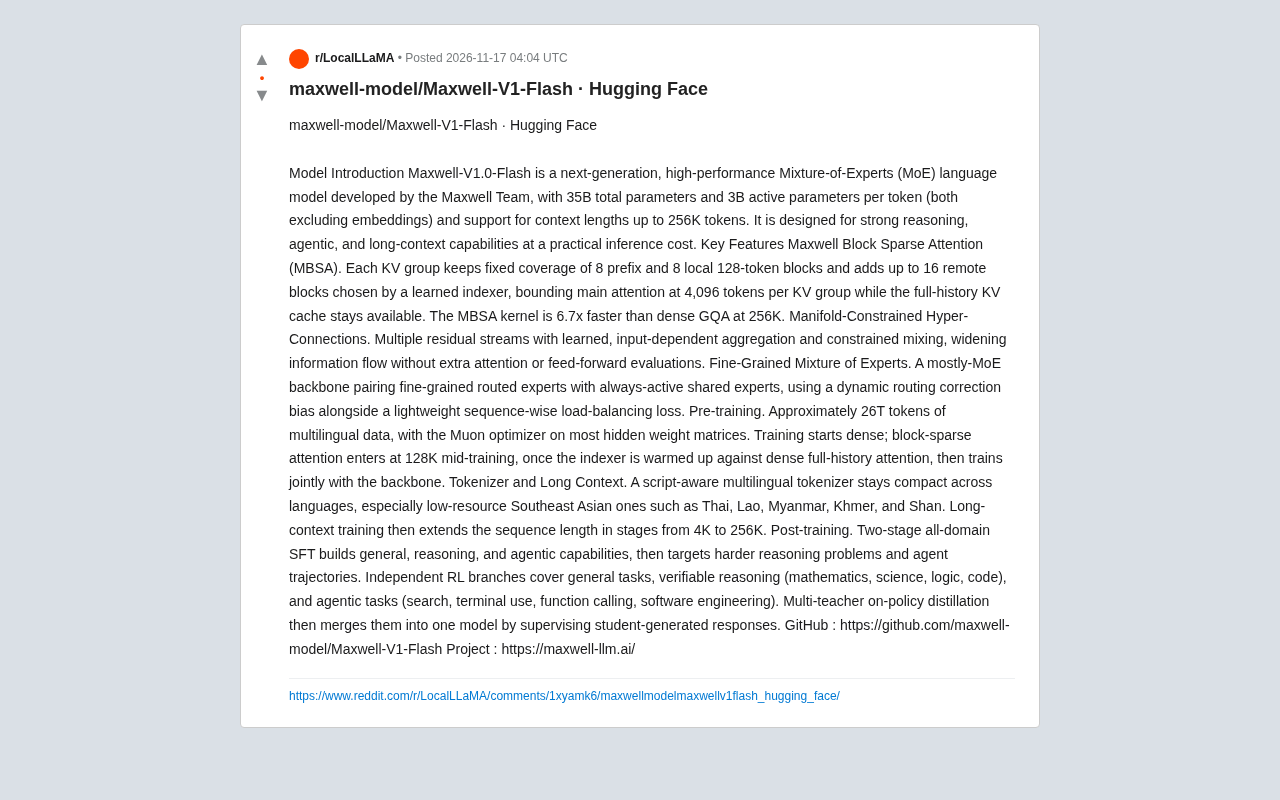
A notable open-source model release recently appeared in the Reddit community: Maxwell-V1.0-Flash from the Maxwell Team. It is a high-performance Mixture-of-Experts (MoE) language model built around a sparse architecture, with 35B total parameters and only 3B activated per token (both excluding embeddings). It supports context lengths up to 256K, and is positioned to deliver strong reasoning, Agent, and long-text capabilities at an acceptable inference cost.
Sparse attention is the core selling point of this generation
The most distinctive design of Maxwell-V1-Flash is Maxwell Block Sparse Attention (MBSA). Each KV group always retains 8 prefix blocks and 8 local blocks of 128 tokens, plus up to 16 additional remote blocks selected by a learned indexer. This caps the main attention computation at 4,096 tokens per KV group, while the full historical KV cache remains available. According to the official figures, at a 256K context the MBSA kernel is 6.7× faster than dense GQA.
This approach addresses the most practical cost problem in long-context inference—not whether the model can "remember," but the computational cost of each step once it does. By narrowing attention from the full history to a combination of "prefix + local + selected remote" blocks, the model keeps long-range information channels open while reducing the main attention overhead to a fixed magnitude.
What the other two architectural changes mean
The model also introduces Manifold-Constrained Hyper-Connections: multiple residual streams with learned, input-dependent aggregation and constrained mixing that broaden information flow paths without adding extra attention or feed-forward computation. The other is a fine-grained MoE backbone that pairs fine-grained routed experts with always-on shared experts, along with dynamic routing correction biases and a lightweight sequence-level load-balancing loss, aiming for more balanced expert utilization and more stable routing.
MoE (Mixture-of-Experts) and "activated parameters": MoE splits the feed-forward layer into multiple "expert" subnetworks, and for each token the router selects only a few of them to participate in computation. As a result, the total parameter count (counting all experts) can be large, but the number of parameters actually involved in computing a single token (activated parameters) is much smaller. This is exactly what Maxwell-V1-Flash's "35B total, 3B active" means: memory usage is based on total parameters, while the compute cost per inference step is close to that of a 3B dense model, striking a balance between cost and capability.
KV cache and KV group: During autoregressive generation, the model caches the Key/Value vectors of historical tokens to avoid recomputing them each step—this is the KV cache; the longer the context, the more memory and attention computation it consumes. GQA (Grouped-Query Attention) lets multiple query heads share a set of KV heads to compress the cache size. "Per KV group" in the text refers to the batch of query heads that share the same set of KVs, and MBSA limits the number of token blocks participating in attention on a per-KV-group basis.
Residual connections and Hyper-Connections: A residual connection is a shortcut in a Transformer that adds a layer's input directly to its output, mitigating vanishing gradients in deep networks. The traditional approach has only one residual stream; Hyper-Connections expand it into multiple parallel residual streams and let the mixing weights between streams be generated dynamically based on the input. This allows information to be split and recombined across different "channels," effectively deepening the information pathway without adding attention or feed-forward computation, at the cost of a small amount of additional aggregation computation.
Muon optimizer: Muon is an optimizer proposed in recent years that approximately orthogonalizes the updates to two-dimensional weight matrices in hidden layers (often based on Newton-Schulz iteration), making the updates more balanced in their singular value distribution; in practice it often shows good convergence efficiency in large-scale pretraining. It is typically used only for hidden weight matrices, while embeddings, output layers, etc. still use optimizers like AdamW.
Training pipeline: start dense, switch to sparse during mid-training
According to the model card, pretraining used approximately 26T tokens of multilingual data, with most hidden weight matrices optimized using Muon. The training strategy starts with a dense phase and only introduces block sparse attention during the 128K mid-training stage—provided that the indexer has already been warmed up on dense full-history attention, after which it is jointly trained with the backbone. This "dense first, sparse later" curriculum is essentially meant to give the learned indexer reliable remote-block selection ability before the switch.
For the tokenizer, the model uses a script-aware multilingual tokenizer that stays compact across languages, with specific optimization for low-resource Southeast Asian languages such as Thai, Lao, Burmese, Khmer, and Shan. Long-context training progressively extends from 4K to 256K in stages.
Post-training uses multi-branch RL plus distillation
Post-training has two steps: first, two-stage full-domain SFT to build general, reasoning, and Agent capabilities, then reinforcement on harder reasoning problems and Agent trajectories; next, multiple independent RL branches are trained in parallel, covering general tasks, verifiable reasoning (math, science, logic, code), and Agent tasks (search, terminal operations, function calling, software engineering), and finally merged into a single model via multi-teacher on-policy distillation, supervising the student model on its self-generated responses.
On-policy distillation: Conventional distillation has the student model fit a fixed answer distribution given by the teacher (off-policy); on-policy distillation has the student first generate its own responses, and then the teacher provides supervision signals or scores on these "trajectories the student itself has taken." This way the training distribution matches the real distribution at inference time, alleviating exposure bias, and is also better suited to merging multiple teacher models with different capabilities into a single student model—which is exactly how the multiple RL branches described above are integrated into a single model.
What stands out and what remains to be verified
Judging from the information disclosed in the model card, the design focus of Maxwell-V1-Flash is very clear: use sparse attention to gain long-context economics, and use fine-grained MoE to gain parameter efficiency at inference. 3B activated parameters with 256K context is an attractive combination for teams that need to handle long documents or long Agent trajectories.
That said, the currently public information is mostly self-reported, and the discussion on Reddit basically revolves around the model card; there is no independent third-party evaluation yet to corroborate its 6.7× kernel speedup and reasoning performance. For new models like this, kernel compatibility in actual deployment, the real recall quality on long contexts, and performance on low-resource languages all need to be verified hands-on. The project is open on GitHub and its official website, and interested developers can pull the weights and test it directly.
One-line Summary
Maxwell-V1-Flash is a 35B-total, 3B-active MoE model that uses block sparse attention to support 256K context.
Paragraph Summary
The Maxwell Team has open-sourced Maxwell-V1.0-Flash, a Mixture-of-Experts language model with 35B total parameters and only 3B activated per token, supporting 256K context. Its core is Maxwell Block Sparse Attention: each KV group retains 8 prefix blocks, 8 local blocks of 128 tokens, and up to 16 remote blocks selected by a learned indexer, limiting main attention to within 4,096 tokens; the team claims the kernel is 6.7× faster than dense GQA at 256K. The model also introduces Manifold-Constrained Hyper-Connections and a fine-grained MoE backbone. Training starts with about 26T tokens of dense pretraining, introduces block sparse attention at the 128K mid-training stage and jointly trains it with the backbone; post-training consists of two-stage SFT plus multiple independent RL branches, merged via multi-teacher on-policy distillation. The tokenizer is optimized for several low-resource Southeast Asian languages. Currently, the evidence is mostly self-reported, and third-party evaluation is still lacking.
Related articles

VP ≠ VNP: A Major Breakthrough in Computational Complexity Theory
A study claiming to prove VP ≠ VNP over every field sparks heated discussion on Hacker News. This article analyzes the algebraic complexity background of VP and VNP, the proof approach, community controversy, and its potential impact on computational complexity theory.

Developer Naming Woes: The Technical Names That Drive Us Crazy
Why is technical naming so maddening? From Nginx and Vite to Qt and Sudo, a YouTube creator rants about the chaos of developer naming and pronunciation, revealing the tug-of-war between creators' intentions and community habits, and the cultural roots behind spelling traps like PyPI and GNOME.

Figma Workplace Scandal: Employee Sues CEO for Forcing Confrontation with Harasser
Figma and its CEO are sued by a current employee alleging sexual harassment and discrimination, and forcing the victim to confront her harasser. This article outlines the background, potential impact, and industry reflection.