Mazama Raises $135M to Drill Deep Into Super-Hot Rock Geothermal Energy
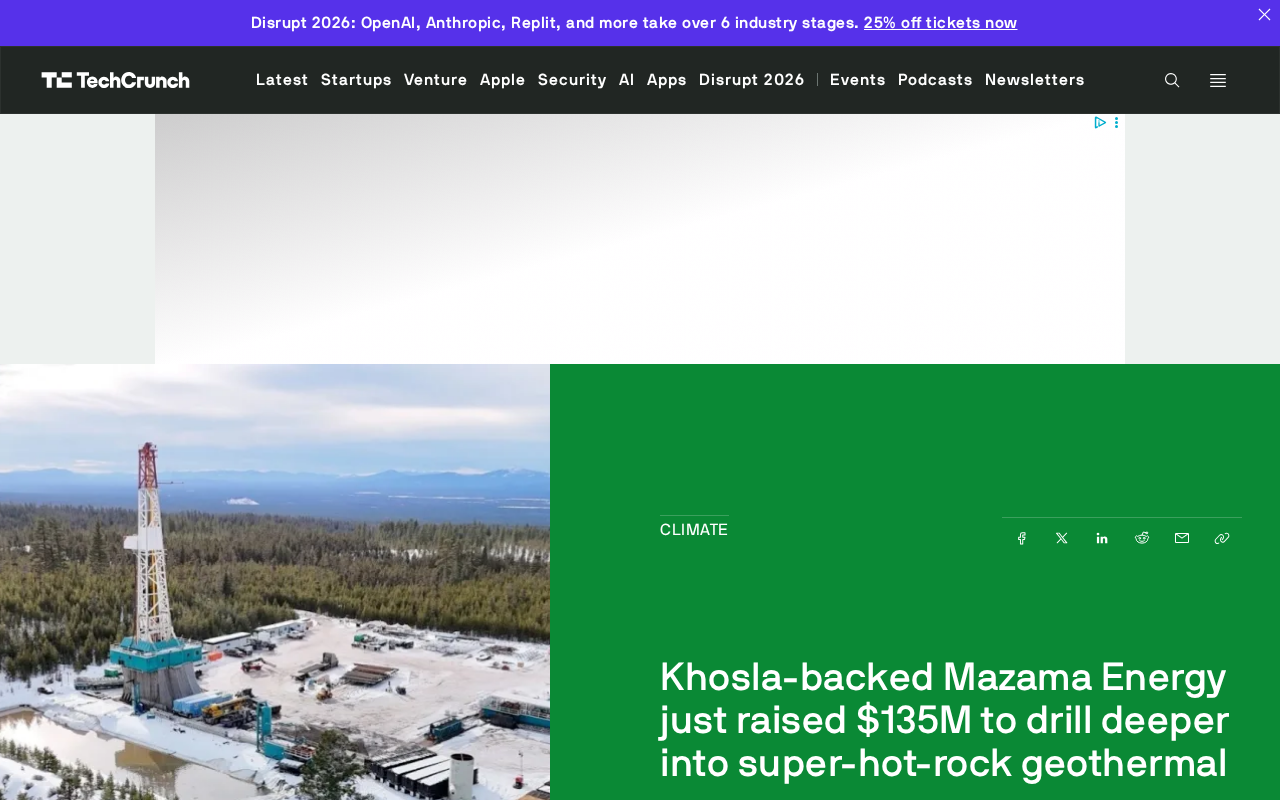
Mazama Energy raises $135M to drill 3 miles deep into super-hot rock for 15 MW of round-the-clock geothermal power.
Geothermal startup Mazama Energy has closed a $135 million funding round led by Khosla Ventures to advance super-hot rock geothermal technology. The company plans to drill three miles underground, tapping rock formations above 350°C where supercritical fluids carry 5–10x the energy density of ordinary steam — enabling 15 MW of uninterrupted power per well. Unlike intermittent renewables, this approach provides stable baseload electricity. The funding will validate drilling reliability under extreme conditions and drive the technology toward commercialization, though significant engineering, economic, and regulatory challenges remain before demonstration wells can scale into commercial power plants.
Super-Hot Rock Geothermal: A New Frontier in Energy
The geothermal energy sector is undergoing a technological transformation. Mazama Energy, a geothermal startup backed by the prominent venture firm Khosla Ventures, recently closed a $135 million funding round to advance its super-hot rock geothermal technology. The capital will support the company's efforts to drill three miles (approximately 4.8 kilometers) underground, reaching rock formations that hold enormous thermal energy.
Compared to conventional geothermal projects, Mazama is targeting deeper, hotter rock layers. The core advantage of super-hot rock geothermal lies in the higher energy density of heat extracted from greater depths, which translates into significantly more electricity output under comparable conditions.
15 MW Per Well: Around-the-Clock Power
According to Mazama's published figures, its technology can deliver 15 megawatts (MW) of electricity from a single well, operating 24/7 without interruption. This metric highlights the unique value proposition of super-hot rock geothermal compared to other renewable energy sources.
Solar and wind power have grown rapidly, but both are constrained by intermittency — when the sun sets or the wind dies down, generation drops off, requiring energy storage or backup sources to compensate. Geothermal energy, by contrast, functions as a baseload power source, delivering continuous and stable electricity. A single-well capacity of 15 MW means that, for a given land footprint, a super-hot rock geothermal project can contribute substantial, reliable power — making it a valuable anchor for grid stability.
What is baseload power? Baseload power refers to energy sources that can deliver electricity continuously and steadily over the long term, independent of external conditions like weather. They typically correspond to the minimum load that a grid must always meet. Nuclear, large-scale hydro, and coal plants are today's primary baseload sources, but each carries carbon emissions or siting constraints. Solar and wind are classified as "variable" sources, with output that fluctuates with natural conditions and must be smoothed by battery storage or pumped hydro. Geothermal energy is inherently baseload, with capacity factors (actual generation as a share of theoretical maximum) typically exceeding 90% — far above solar's ~25% or wind's ~35%. This characteristic gives geothermal irreplaceable scheduling value in grid planning, especially as high shares of variable renewables make stable baseload increasingly scarce and valuable.
The Engineering Challenge of Drilling Three Miles Down
Drilling three miles underground is no small feat. As depth increases, rock temperature and pressure rise sharply, imposing extreme demands on drilling equipment, wellbore materials, and the overall engineering approach. In ultra-high-temperature environments, conventional drilling tools and well-sealing materials are prone to failure — and this is precisely the technical bottleneck that has long prevented super-hot rock geothermal from scaling.
A significant portion of Mazama's $135 million raise is aimed squarely at solving these deep-drilling engineering challenges. The funds will be used to validate the reliability of its drilling technology under extreme temperatures and to advance the technology from demonstration toward commercial deployment.
What makes super-hot rock different? Super-Hot Rock Geothermal (sometimes described as an extreme extension of Enhanced Geothermal Systems, or EGS) differs from conventional geothermal in its target temperature range. Traditional geothermal typically taps existing underground hot water or steam at 150–300°C. Super-hot rock technology, by contrast, targets dry rock formations above 350°C, where water exists in a supercritical fluid state with an energy density 5–10 times higher than ordinary steam — the physical basis for achieving 15 MW from a single well. Operating in such extreme environments requires drill bit materials that can withstand hundreds of degrees of heat, cementing compounds that resist cracking under thermal shock, and measurement instruments that maintain accuracy under high temperature and pressure. No mature commercial drilling standards yet exist for this temperature range, which is why companies like Mazama are considered high-risk, high-potential deep-tech bets.
What Khosla Ventures' Backing Signals
Khosla Ventures, one of Silicon Valley's most prominent deep-tech investors, sends an important signal simply by supporting Mazama. In recent years, as global demand for clean, stable energy has grown, next-generation geothermal technology has re-entered the investment spotlight. Super-hot rock geothermal — with its potential for high output and round-the-clock operation — is increasingly seen as a key technology pathway to fill the baseload gap in the clean energy mix.
Beyond providing capital, backing from a top-tier venture firm lends market-level validation to Mazama's technical approach, helping to attract further industry partnerships and follow-on funding.
The Road Ahead for Geothermal Energy
Super-hot rock geothermal represents the cutting edge of geothermal technology. If Mazama can successfully prove out its deep-drilling capabilities and achieve scale, it could substantially reduce the levelized cost of electricity from geothermal sources, giving this technology a more prominent role in the clean energy portfolio.
For regions committed to energy transition, a power source that is clean, stable, and weather-independent holds enormous appeal. That said, the path from a demonstration well to a commercial-scale power plant still requires Mazama to clear significant engineering, economic, and regulatory hurdles. This $135 million round is an important step — but the real test lies in translating results from the lab and demonstration phase into a replicable, commercially viable business.
Related articles

Prompt → MCP → Agent → Skill: The AI Terminology Evolution Chain Explained in 5 Minutes
A clear guide to five core AI concepts — Prompt, MCP, Agent, Skill, and Cowork — and how they connect in a layered evolution chain from simple instructions to multi-agent teamwork.

OpenAI Discloses Model Anomalies, DeepMind Launches AGI Forum, NVIDIA Partners on Grid Power Management
Sept 17 AI roundup: OpenAI publishes model anomaly disclosure framework with 6 reports, Google DeepMind launches AGI public forum, NVIDIA leads AI energy management alliance with 18 partners.
Build a Local AI Agent with Python in 10 Minutes: Ollama + PydanticAI in Action
A hands-on guide to building a fully local AI agent with Python, Ollama, and PydanticAI in 10 minutes — covering model selection, tool functions, and conversation loops.