MCP Architectural Mediation: Enabling LLM Agents to Securely Access Data Spaces

An MCP-based mediation layer lets LLM agents access governed Data Spaces without bypassing governance constraints.
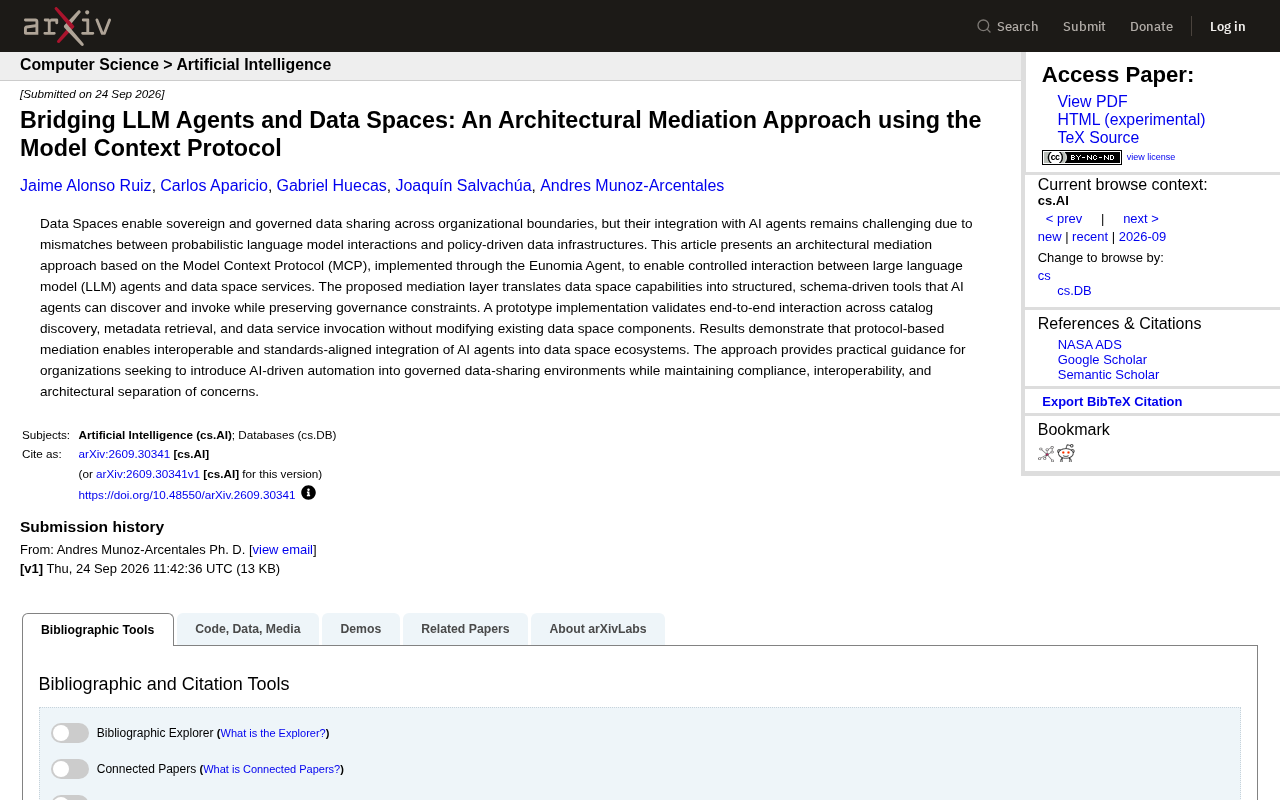
This arXiv paper addresses the fundamental mismatch between LLM agents — which are probabilistic by nature — and Data Spaces, which rely on strict policy-driven governance. The proposed solution introduces an MCP-based architectural mediation layer using the Eunomia Agent, translating Data Space capabilities into schema-driven tools that agents can invoke while governance constraints remain fully intact. A prototype covering the full pipeline from catalog discovery to data service invocation was validated without modifying any existing Data Space components, demonstrating a low-invasive, standards-aligned path for layering AI automation onto managed data infrastructure.
The Gap Between Data Spaces and AI Agents
Data Spaces have emerged as critical infrastructure for cross-organizational data sharing, with their core value lying in enabling sovereign, governance-constrained data flows. However, when enterprises attempt to integrate large language model (LLM) agents into these environments, a fundamental tension surfaces: LLM interactions are inherently probabilistic and non-deterministic, while Data Spaces rely on policy-driven, rule-strict governance frameworks. This mismatch makes deploying AI automation in managed data-sharing scenarios exceptionally challenging.
A recent arXiv paper proposes an architectural mediation approach that bridges the two without breaking existing governance constraints. The central component is the Eunomia Agent, implemented using the Model Context Protocol (MCP).
A Data Space is a decentralized data-sharing architecture in which participants retain sovereign control over their own data. Access and data flows require explicit policy negotiation and compliance verification. The most representative implementation today is built on IDSA (International Data Spaces Association) specifications, with core components including Connectors, Metadata Catalogs, and identity authentication infrastructure. Every data exchange must go through the full lifecycle of contract negotiation → policy validation → controlled transfer, ensuring that participant obligations and permissions are technically enforced.
The key distinction from traditional API calls is this: data providers always maintain auditable control over who uses data under what conditions, rather than losing control the moment an API is opened. This rigid governance mechanism is precisely why Data Spaces are favored for cross-organizational, cross-jurisdictional data collaboration — but it also creates integration barriers for AI agents accustomed to flexible, on-demand invocation.
MCP as a Mediation Layer: The Design Rationale
The paper's key innovation is introducing a mediation layer that translates Data Space capabilities into structured, schema-driven tools. This allows AI agents to discover and invoke Data Space services just like any other tool call, while remaining protected by governance constraints throughout.
The elegance of this design lies in separation of concerns: the Data Space handles governance and compliance; MCP handles protocol translation and tool exposure; the LLM agent handles intent understanding and task orchestration. Each layer has a distinct responsibility with no cross-contamination.
As a rapidly proliferating protocol standard, MCP provides exactly this kind of "toolification" abstraction. It enables agents to perform standardized capability discovery and invoke services on demand, without requiring any custom modifications to the underlying Data Space.
Why Not Modify the Data Space Directly?
A natural question arises: why not simply modify the Data Space components to accommodate AI? The paper's answer is clear — maintaining architectural independence and backward compatibility is critical. Data Spaces often carry strict compliance requirements and cross-organizational trust relationships; any changes to core components risk introducing governance vulnerabilities. The mediation approach avoids this entirely, making integration low-invasive and reusable.
Model Context Protocol (MCP) is an open-source standardization protocol released by Anthropic in late 2024, designed to unify interactions between AI agents and external tools and data sources. Its design philosophy resembles a USB-C interface — eliminating the fragmented adaptation costs between AI applications and various backend services through a single standard.
In the MCP architecture, service providers expose Tools, Resources, and Prompt templates as an "MCP Server," while the agent-side "MCP Client" communicates via standardized JSON-RPC messages. Tool capabilities are strictly defined through JSON Schema, giving LLMs access to structured parameter specifications before any invocation — significantly reducing the risk of hallucinated invocations. This characteristic is especially critical for Data Space integration: Schema constraints impose implicit norms at the agent reasoning layer, complementing the explicit policy controls at the governance layer to form a dual-protection mechanism.
Prototype Validation: A Complete End-to-End Pipeline
The research team built a prototype implementation validating a complete end-to-end interaction flow — from catalog discovery and metadata retrieval to data service invocation.
Notably, the entire validation process required no modifications to any existing Data Space components. This speaks directly to deployability: organizations can layer AI capabilities on top of existing data infrastructure without rebuilding from scratch.
Experimental results demonstrate that protocol-based mediation can achieve interoperable, standards-compliant AI agent integration. In other words, LLM agents can now enter originally closed, strictly governed data-sharing ecosystems in a way that is both flexible and controlled — for the first time.
Practical Implications for Enterprise Deployment
For organizations looking to introduce AI-driven automation in managed data-sharing environments, this work provides an actionable architectural framework. It simultaneously addresses three goals that are typically seen as difficult to balance:
- Compliance: Governance constraints are preserved throughout all interactions; AI invocations cannot bypass policy controls.
- Interoperability: Built on the MCP standard, the approach aligns with the broader agent ecosystem and avoids vendor lock-in.
- Architectural separation of concerns: Data governance, protocol mediation, and agent logic each evolve independently.
As MCP's role in the agent ecosystem continues to grow, this "protocol-as-mediator" paradigm could well become a general pattern for enterprise-grade AI integration. Data Spaces are just one representative scenario — similar architectural patterns apply equally to other policy-driven, strictly governed data infrastructure.
Summary
This paper confronts a real and thorny engineering challenge: how to safely connect probabilistic AI agents to deterministic, governance-constrained Data Spaces. Through the architectural mediation layer implemented via MCP and the Eunomia Agent, the paper charts a technical path that balances flexibility with compliance. Prototype validation confirms its feasibility, and its low-invasive, standards-aligned characteristics make it genuinely attractive for enterprise deployment. For teams exploring the intersection of AI and managed data infrastructure, this is an architectural blueprint well worth studying.
Related articles

ChatGPT Space Launches: Team Collaboration and New Pages Features Explained
ChatGPT Space is OpenAI's new team collaboration feature with Pages, real-time collaboration, and Slack/Google Drive sync. We break down its privacy design, multi-platform integration, and the full workflow from conversation to document.

Migrating Apache Spark UDFs to GPU Acceleration with AI Agents
NVIDIA developer blog explains how AI Agents rewrite Apache Spark UDFs for GPU acceleration, covering migration criteria, agent rewriting and verification workflows, plus pitfalls like result consistency and CPU-GPU transfer overhead.

Zed Editor v0.40.4-rc2 Released: Usage Credits Now Available Without Upgrading
Zed editor releases v0.40.4-rc2, allowing users to use usage credits for AI features without upgrading to a paid plan, lowering the trial barrier.