MCP Official Server Suite v2.3.0 Released: Major Upgrades to Filesystem and Fetch Capabilities

MCP Server Suite v2.3.0 upgrades six server packages, strengthening permission control, stability, and model friendliness.
The Model Context Protocol official server suite released v2.3.0, updating packages on npm and PyPI including everything, filesystem, memory, sequential-thinking, fetch, git, and time. filesystem had the most changes, adding append_file, copy_file, directory tree depth parameter, and file:// resource templates, and introducing --read-only and --confine-roots to tighten permissions; fetch moved Readability.js into a controlled subprocess, added host whitelist, configurable timeouts, and native Markdown negotiation; git added merge and remote read-only tools, time supports local timezone and get_time_ago; memory and sequential-thinking strengthened tool annotations and resource boundaries. The release notes also reveal the repository's issues-not-PRs policy, with community prototypes rebuilt and acknowledged by maintainers.
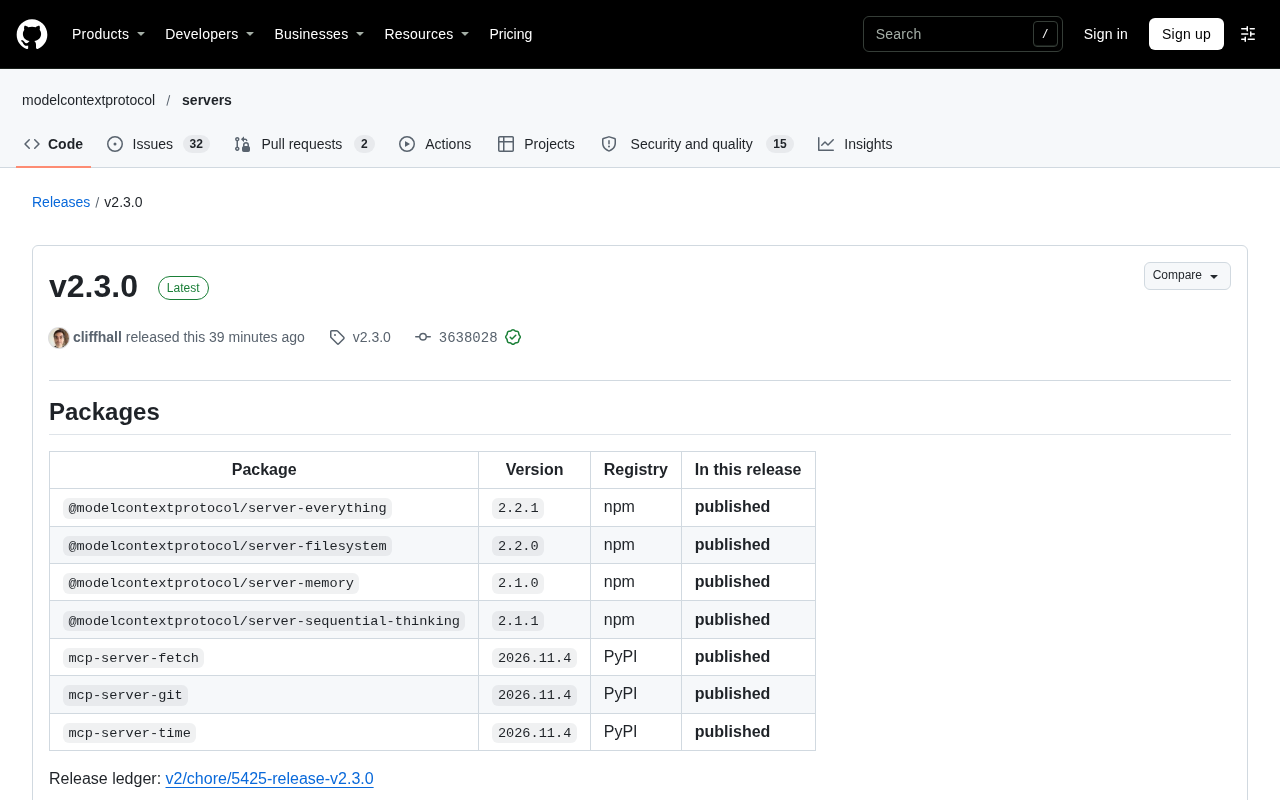
The Model Context Protocol (MCP) official repository's server suite has received a concentrated update. Version v2.3.0, released by maintainer cliffhall, refreshes six server packages on both npm and PyPI: everything, filesystem, memory, sequential-thinking, fetch, git, and time. Judging from the changelog, the focus of this upgrade isn't on any single feature, but on making these servers more controllable, safer, and more model-friendly in real-world usage scenarios.
filesystem: Expanded Capabilities and Tighter Boundaries
The filesystem server was upgraded from 2.2.0 to the release following 2.2.0, with the most changes among all packages, and it best reflects the philosophy of this release. New capabilities include append_file and copy_file tools, an optional depth parameter for directory_tree, files can be exposed as resources via file:// template, and edit_file displays the closest matching file lines when no match is found, helping the model self-correct.
On the controllability side, a --read-only mode was added that only exposes read-type tools; a new --confine-roots option restricts client Roots to the command-line directory range; and the actual effective allowed directories and their sources are logged. Additionally, the description of search_files was corrected to match file names rather than file contents, preventing model misuse. A batch of edge cases were also fixed: head/tail of 0 now returns empty lines, entries that cannot be stat'd show as unknown size in listings, dangling symlinks are correctly reported as broken, and ~\ expands to the user home directory on Windows. On the dependency side, minimatch was upgraded to ^11.0.4 to address security advisory GHSA-g3hv-75wg-m249.
Roots and the Meaning of --confine-roots
Roots in the MCP protocol are the "workspace boundaries" that the client declares to the server — the client tells the server "the project I currently have open is in these directories." The server can use this to limit the visible scope of file operations, preventing the model from accessing paths the user hasn't authorized. The role of --confine-roots is to further clip the client-declared Roots to within the command-line specified directories; even if the client declares a wider range, the server will only work within the intersection. This follows the "least privilege" approach: permissions are gated once more on the server side, rather than fully trusting client declarations. For scenarios where the filesystem server is handed to the model for autonomous invocation, this two-way constraint can significantly reduce the risk of accidental deletion or reading of system files.
fetch: Liberating Web Scraping from the Event Loop
The fetch server's changes focus on stability and configurability. Readability.js now runs in a controlled subprocess, no longer occupying the event loop and standard output, which directly improves process behavior during long scraping sessions. New additions include an --allowed-hosts operational-level host whitelist, configurable HTTP request timeouts, native Markdown requests via Accept content negotiation, and opening simplified results with the page title. Invalid prompt URLs are now rejected with error code -32602.
Why Subprocesses Improve Stability
Node.js uses a single-threaded event loop model, where synchronous or CPU-intensive parsing tasks block the entire process. Readability.js can take a long time to extract main content from complex HTML. The original implementation ran directly in the main process, during which other server requests (including MCP protocol responses) would be delayed, and standard output could be polluted by parsing logs, interfering with JSON-RPC messages. After moving it to a subprocess, parsing completes in a separate process while the main process continues responding to requests; if the subprocess crashes or times out, it won't take down the server itself and can be terminated and restarted independently. This is a common isolation technique for MCP servers handling heavy external content processing.
git and time: Closer to Daily Development Workflows
The git server added a git_merge tool and a read-only git_remote, git_diff supports revision ranges like main..feature; it also added prompts that can embed repository changes, and documented how to set commit identity via environment variables or gitconfig. The time server now defaults omitted timezone parameters to the local timezone, added get_time_ago, and fixed an issue where convert_time only reported the first occurrence under time ambiguity caused by daylight saving time rollback.
Protocol Hints and Memory Service Refinements
The memory server now declares idempotentHint for create_entities, create_relations, and add_observations, letting clients know that repeated calls are safe; read tools gained a lightweight read mode, duplicate observations within a single add_observations are stored only once, a warning is given when the memory file is located inside node_modules, and the persistent MEMORY_FILE_PATH is now documented.
sequential-thinking trimmed tool descriptions to under 1024 characters, limited the thought history retained per connection, and fixed the display issue where multi-line thoughts were drawn line-by-line in the terminal. The everything example server now requires every registered tool to carry all four annotation hints, and adds light/dark theme icons for each primitive.
The Role of Tool Annotations like idempotentHint
MCP tool definitions support several behavioral annotations that help clients and models understand tool semantics: readOnlyHint indicates the call doesn't change state, destructiveHint indicates it may cause irreversible changes, idempotentHint indicates that repeated calls with the same parameters have the same effect as a single call, and openWorldHint indicates interaction with the external world. These hints don't change server behavior but guide the model in deciding whether to retry and whether user confirmation is needed. The memory server declaring idempotentHint for write tools like create_entities means it's safe for the model to retry on timeout or unclear results without creating duplicate entities — this is crucial for fault tolerance in autonomous invocation chains.
Signals About Community Collaboration Approach
One notable aspect of this release note is how contributors are handled. The repository enforces an "issues, not pull requests" policy; prototype PRs submitted by the community are closed, and maintainers rebuild the changes based on the corresponding issue and acknowledge the contributor in the issue. The changelog shows that features like the copy tool, read-only mode, fetch host whitelist, and time default timezone all originated from community prototypes. This process ensures consistency in code style and testing, but it also means contributors' direct code won't be merged as-is.
For developers building MCP clients, what's worth noting in v2.3.0 is the proliferation of tool annotations, least-privilege options like read-only and directory confinement, and the stability improvements from fetch's subprocess architecture — these determine whether these servers can be confidently handed to models for autonomous invocation.
Trade-offs of the issues-not-PRs Policy
This policy requires the community to first file an issue describing the problem and idea, then maintainers implement it themselves based on the issue and close prototype PRs submitted by the community. The benefit is that code style, test coverage, and protocol consistency are uniformly controlled by maintainers, preventing low-quality or inconsistent patches from entering the main branch; for small maintenance teams, the communication cost of reviewing external PRs often exceeds rewriting them. The cost is that contributors' work won't be directly reflected in the commit history, potentially reducing participation motivation, which is why acknowledging contributors in issues serves as a compensatory practice. Similar "issue-first" models are not uncommon in protocol and specification-oriented open-source projects.
One-line Summary
MCP Server Suite v2.3.0 upgrades six server packages, strengthening permission control, stability, and model friendliness.
Paragraph Summary
The Model Context Protocol official server suite released v2.3.0, synchronously updating packages on npm and PyPI including everything, filesystem, memory, sequential-thinking, fetch, git, and time. filesystem had the most changes, adding append_file, copy_file, directory tree depth parameter, and file:// resource templates, and introducing --read-only and --confine-roots to tighten permissions; fetch moved Readability.js into a controlled subprocess, added host whitelist, configurable timeouts, and native Markdown negotiation; git added merge and remote read-only tools, time supports local timezone and get_time_ago; memory and sequential-thinking strengthened tool annotations and resource boundaries. The release notes also reveal that the repository enforces an issues-not-PRs policy, with community prototypes rebuilt by maintainers and acknowledged.
Related articles
 Tech Frontiers
Gemini Omni 1.2 Flash: AI Video Moves Toward Draft-Style Editing
Google's Gemini Omni 1.2 Flash update enables conversational, draft-style editing of the same video—swap scenes while keeping products, adjust lighting while keeping characters. Clips up to 15s, 720p costs 30% less than the previous Flash—ideal for e-commerce ads, previs, and short-asset production.

Codex Tutorial: One-Command Install and Run Your First Task
Codex tutorial: one-command install and run your first task. Covers the four Codex forms, sandbox and approval guardrails, AGENTS.md and MCP configs, cloud network policy, and the iron rule of human review—everything you need to get started with this autonomous coding agent.
 Tech Frontiers
Localix: An Open-Source Agentic Development Environment with Multi-Model and Local AI Integration
Localix is an MIT open-source Agentic Development Environment (ADE) supporting seamless Claude Code plugin loading, multi-model cloud and local execution, Mini Apps extensions, and agent context management—an open AI collaboration workbench for developers.