MCP Protocol Explained: How AI Agents Connect to External Tools

MCP is the universal standard protocol that lets AI agents reliably connect to and use external tools.
Using a controlled experiment as its entry point, this article explains the core value of MCP (Model Context Protocol). Without MCP, an AI agent facing databases, APIs, and file systems cannot bridge their incompatible protocols — so it fabricates answers, exposing the fundamental bottleneck of Agentic AI deployment: the connection layer, not the model. MCP solves this by providing a unified standard bridge, enabling agents to discover and call all tools and complete tasks based on real data. Rather than replacing AI models, MCP acts as the connectivity layer that gives models access to the real world.
One Experiment That Reveals MCP's Value
Imagine giving an AI agent a task: summarize this week's sales data. To complete it, the agent has five tools at its disposal — a file system, a database, an API endpoint, developer tools, and a business application. But here's the critical constraint: there are no instructions for connecting to any of them.
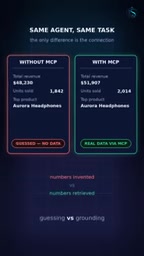
This is the exact scenario designed in a 60-second explainer video on YouTube. Without MCP, the agent is stuck. Each tool "speaks a different language," and every one requires custom integration code written from scratch. Faced with data it cannot read, the AI does what it does best — and most dangerously — it guesses. The numbers it produces are confident and specific. They're also completely wrong.
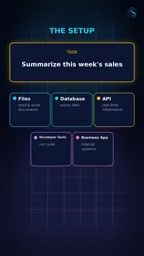
This scenario vividly illustrates the core pain point of deploying Agentic AI today: no matter how capable the model is, once it's cut off from real data, its output is nothing more than a confident hallucination.
Without a Standard, You Have to Build a Bridge for Each Tool
The traditional approach to giving AI access to the outside world means building a separate interface for every tool. Databases have their own protocols, APIs have their own specs, and business applications follow entirely different logic. This "one-to-one custom integration" model is expensive to develop and nearly impossible to scale — every new tool requires building another bridge from scratch.
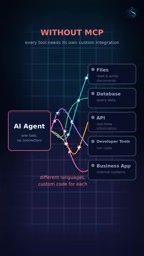
The result is exactly what the video demonstrates: the agent has a pile of tools it can't use, and ends up fabricating an answer out of thin air. This isn't a problem with the model's capabilities — it's a problem with the connection layer. What's missing is a common "language" that tools and models can both speak.
MCP: A Standard Bridge to All Tools
MCP stands for Model Context Protocol. It was designed to solve exactly this connectivity problem. The video sums up its essence in a single sentence: MCP provides a standard bridge that connects to all tools.
When the same agent is connected through MCP, everything changes. It can actively discover available tools, query the database and retrieve real numbers, read files, check APIs, and ultimately write a report grounded in actual data.
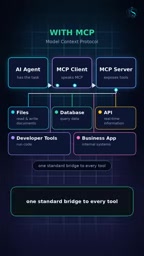
What makes this comparison compelling is its rigor — same agent, same task, one variable: the connection method. Whether or not MCP is present directly determines whether the output is real data or pure fabrication.
The design philosophy behind MCP is analogous to USB or network protocols: once a universal standard exists, devices no longer need custom adapters for every possible combination. For the AI ecosystem, this means tool providers only need to implement the MCP interface once to be callable by any agent that supports the protocol.
From a technical architecture standpoint, MCP uses a client-server model: the AI agent acts as the client, while various tools (databases, file systems, APIs, etc.) expose their capabilities as MCP Servers. Both sides communicate via a unified JSON-RPC message format. The protocol defines three core primitives — Tools (executable actions), Resources (readable data), and Prompts (preset prompt templates) — covering the primary patterns through which agents interact with the outside world. MCP was open-sourced by Anthropic in November 2024. Leading AI products including Claude and Cursor have already integrated it, and major players like Microsoft and Google have also announced support, with the ecosystem expanding rapidly.
MCP Doesn't Replace the Model — It Gives the Model a Way to Reach the World
There's a common misconception worth clearing up: MCP is not meant to replace AI models. The video makes this explicit — MCP doesn't replace the AI model; it gives the model a standardized way to reach the external world.
In other words, the model handles the "thinking," and MCP handles the "connecting." No matter how strong a model's reasoning capabilities are, without access to real data it's working with nothing. MCP is like giving a brain a pair of hands and eyes — it enables genuine interaction with the real environment.
This is also why MCP is so critical to Agentic AI. The core value of an agent lies in autonomously completing tasks, and completing tasks requires calling tools, retrieving data, and executing actions. As the video concludes: agents need tools, and MCP is how they connect to them.
Agentic AI refers to AI systems capable of autonomously planning steps, iteratively calling tools, and adjusting actions based on intermediate results to accomplish complex goals — as distinct from traditional single-turn question-and-answer language model applications. A typical agent workflow looks like: perceive input → form a plan → invoke tools → observe results → iterate. Each step depends on real-time read/write access to the external environment. This is precisely why "how to reliably connect to tools" has become the central engineering challenge of deploying agents — not model reasoning itself — and it's the exact layer that MCP is designed to address.
What This Means for Developers and the Industry
From a broader perspective, MCP represents an important trend in AI engineering: the standardization of infrastructure. In the past, every team was reinventing the wheel, writing custom integrations for their own agents. With a unified protocol, the entire ecosystem can share a common tool layer, freeing developers to focus their energy on model capabilities and application logic.
The network effects of this kind of standardization are significant: the more tools that support MCP, the wider an agent's capability horizon; and the more widely agents are adopted, the more tools are incentivized to integrate the protocol. This positive feedback loop is a key driver moving Agentic AI from demos into production environments.
Of course, a 60-second explainer can only sketch out MCP's core concepts and value proposition. The specific protocol details, security mechanisms, and real-world performance in complex multi-tool scenarios all require further validation in engineering practice. But it clearly conveys one central judgment: in the age of agents, how you connect matters just as much as how well you reason.
Related articles

How Big Can Stars Really Get? The Physical Limits of the Largest Stars
Red supergiants are the largest stars by volume, with radii up to 2,000 times the Sun, engulfing the inner solar system. But there is no precise upper limit on stellar size—models predict up to 15,000 solar radii. The most massive blue stars are far smaller than red supergiants—biggest and heaviest are two different things.

Apple HomeView Smart Display Full Feature Breakdown: Wall-Mount or Desktop, $299
Apple launches HomeView, a $299 smart display with wall-mount and desktop options, 12MP camera for facial recognition, smart home control, music playback, and recipe step-by-step cooking. Full breakdown of watch faces, apps, privacy, and cooking integration.

Where Did the Promised New Studio Go? Craft Computing Answers After Five Years
Craft Computing's host responds to viewer questions: the new studio promised five years ago was shelved as construction costs soared from $30,000 to $75,000, and was replaced by a 168-square-foot garage conversion.