MCP Protocol Explained: How AI Standardizes Calls to Your Java Backend

MCP is the standard protocol that lets AI models discover and call Java backend capabilities in a unified way.
MCP (Model Context Protocol), an open protocol led by Anthropic, solves the fragmented, one-off integration problem that arises when connecting AI applications to external tools and services. Without a common standard, every new tool requires custom integration logic, and maintenance costs skyrocket as capabilities grow. MCP introduces a universal protocol layer so AI can discover and invoke external capabilities consistently, while backends simply expose services according to the spec. Using a Java order-query example, the article shows how AI makes standardized requests via MCP without knowing backend implementation details. For Java developers, MCP complements rather than replaces REST APIs, but its tool-discovery mechanism and AI-first design make it an essential concept for entering the AI integration space.
What Is MCP: A Common Language for AI and Backend Communication
If you're a Java developer, you've probably wondered: how does an AI application actually call your backend services? The answer is MCP — the Model Context Protocol.
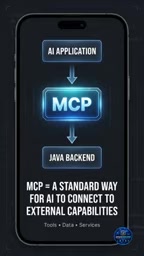
In a nutshell, MCP gives AI applications a standardized way to connect with external tools, data, and services. Think of it as the universal interface specification for the AI world.
Before a unified standard existed, integrating AI with various systems meant building custom, one-off connections. Every new tool or data source required designing a fresh integration from scratch. That's manageable when you have only a handful of tools — but as capabilities multiply, maintaining all those disparate integrations becomes overwhelming.
MCP was released and open-sourced by Anthropic in November 2024, and has since gained support from major AI vendors including OpenAI and Google DeepMind, making it the de facto standard for AI tool invocation. Technically, MCP uses a client-server architecture: the AI application (MCP Client) communicates with an MCP Server via standardized JSON-RPC messages, and the Server exposes specific tools, data sources, or service capabilities to the AI model. MCP defines three core primitives: Tools (functions/operations the AI can invoke), Resources (data the AI can read, similar to a file system), and Prompts (predefined prompt templates). For Java developers, you can think of an MCP Server as an "AI-aware service adapter layer" — your Spring Boot service implements the MCP Server interface, enabling AI models to discover and invoke its business capabilities on demand.
Why a Unified Standard Matters
Imagine if every AI integration were built as a one-off custom connection. The system would quickly become an unmaintainable tangle of dependencies. More tools means tighter coupling, which means higher costs for debugging and scaling.
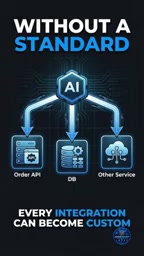
This is exactly the problem MCP solves: it introduces a common protocol so that AI applications can communicate with different capabilities in a consistent way. Developers no longer need to reinvent the wheel for every new integration — everyone follows the same specification.
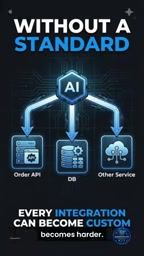
The immediate benefit of this standardization is decoupling and maintainability. The AI side only needs to know how to request capabilities according to the protocol — it doesn't need to care about the implementation details of each backend.
A Concrete Example: Exposing an Order Capability
Theory can get abstract fast, so let's walk through a scenario familiar to Java developers.
Suppose your Java backend exposes an "order capability." When the AI needs to look up an order, it can send a request via MCP — for example, fetching the details for order ORD101. The backend receives the request and returns the result according to the protocol.
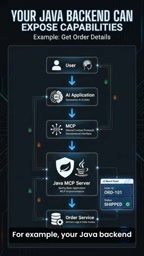
In this flow, the AI application doesn't need to understand how your order system is implemented. It simply "asks the right question in the right format," and the backend "answers in the right format." This is the core value of MCP as a protocol layer: making interactions between AI and real business capabilities predictable and reusable.
MCP vs. REST API: A Useful Comparison
For Java developers, REST APIs are practically second nature. The original author mentioned at the end of the video series that a deeper comparison between MCP and REST API is coming in future content.
It's a worthwhile comparison. REST is a resource-oriented, HTTP-verb-driven interface specification that has long served as the de facto standard for service-to-service communication. MCP, on the other hand, is a protocol designed specifically for AI applications, focused on enabling models to discover and invoke external capabilities in a unified way. Both aim to standardize communication, but they differ in their intended consumers (human-written clients vs. AI models) and their usage contexts.
Understanding this comparison helps Java developers quickly transfer their existing engineering knowledge to the AI integration space — many interface design principles accumulated during the REST era remain applicable in MCP practice.
The core difference lies in the cognitive ability of the caller. REST APIs assume that the client developer already knows the endpoint paths, parameter structures, and when to make calls — humans write the invocation logic. MCP, by contrast, is designed for a world where the AI model discovers available tools at runtime and autonomously decides whether and how to call them. This process is known as Tool Discovery. The MCP Server declares to the AI what Tools it provides along with their parameter descriptions, and the model dynamically selects which tool to call based on user intent. Additionally, REST APIs are typically stateless single request-response interactions, while MCP supports persistent sessions, allowing the AI to continuously use the same set of tools across a multi-turn conversation. From a migration standpoint, existing REST interfaces can be wrapped into MCP Tools at relatively low cost — the two are not mutually exclusive and can coexist within the same system.
Summary
A few key takeaways from this piece: MCP is a standard protocol designed to help AI applications interact with real business capabilities; it solves the pain point of traditional custom integrations that don't scale; and for Java developers, it means you can expose backend business capabilities (such as order queries) through MCP for AI models to call.
It's worth noting that this article is based on the first part of a video series and leans toward conceptual introduction. More detailed coverage of MCP's implementation in Spring AI and an in-depth comparison with REST APIs will follow in subsequent content. For developers looking to connect their Java backends to the AI ecosystem, MCP is undoubtedly a foundational concept worth getting familiar with sooner rather than later.
Related articles

Felix Rieseberg Personal Homepage
Felix Rieseberg's personal homepage sparks attention on Hacker News. This article covers the Slack engineer's technical background, the rise and fall of nativefier, and the value of a developer homepage as a tech calling card.

@ai-sdk/vue 3.0.306 Patch Release Syncs with [email protected] Update
@ai-sdk/vue 3.0.306 released, synced with [email protected]. A routine patch release for the Vercel AI SDK ecosystem with no public API changes; the Vue adapter layer stays version-aligned with the core package.

Gemini 4 Argon API Launches: The Era of Million-Token Output Begins
Google launches Gemini 4 Argon with sparse MoE architecture, up to 1M output tokens, and a 68.90% Vals Index score, available across API, AI Studio, and the Gemini app.