MCP Protocol Explained: The Unified Standard for AI Tool Calling and a Practical Guide

MCP unifies how LLMs call tools, enabling model-agnostic, reusable AI tool integrations.
MCP (Model Context Protocol) is an open standard by Anthropic that unifies how different LLMs call external tools. It eliminates the need to rewrite tool calling code when switching models, enables cross-Agent tool reuse, and decouples tool maintenance from Agent logic — much like how USB standardized peripheral connections.
What is the MCP Protocol
MCP stands for Model Context Protocol, an open protocol released and open-sourced by Anthropic in November 2024. It defines how LLM applications communicate with external tools and data sources — essentially serving as a unified "tool calling standard."
Anthropic is an AI safety company founded in 2021 by siblings Dario Amodei and Daniela Amodei, former OpenAI research executives, best known for developing the Claude series of large language models. The company chose to release and open-source MCP during the AI Agent development boom, adopting a strategy similar to how the USB standard unified peripheral interfaces — driving industry unification through open standards rather than closed ecosystems. Before MCP's release, each vendor's tool calling interfaces were fragmented and incompatible, and the industry urgently needed a universal protocol to break down these barriers.
For developers, the core problem MCP solves is straightforward: how to enable LLMs from different vendors to call tools in a unified way, and how to standardize the parsing of tool responses. While this may seem like an engineering detail, it directly determines the efficiency and maintainability of AI application development.
Today, virtually all mainstream LLMs — whether DeepSeek, OpenAI's GPT, Anthropic's Claude, or Chinese models like Zhipu and Tongyi Qianwen — support MCP at the underlying level. This means MCP is becoming foundational infrastructure in AI development.
Pain Points Before MCP
To understand MCP's value, we first need to see what the world looked like without it.
Before MCP, the way different model vendors implemented tool calling was known as Function Calling. OpenAI first introduced this capability for GPT models in June 2023, allowing models to recognize user intent during conversations and generate structured function call requests. Other vendors quickly followed suit, but their implementations varied significantly: OpenAI uses a tools parameter with JSON Schema to describe function signatures, Anthropic uses tool_use type content blocks, and domestic models like DeepSeek and Zhipu each have their own parameter formats and calling conventions. These differences manifest not only in API request formats but also in function description methods, parameter validation rules, return value handling, and more.
Imagine we've built three Agents using different models: one based on DeepSeek, one on Claude Code, and one on GPT. All three Agents need to call the same set of tools (say, Tools A, B, C, and D).
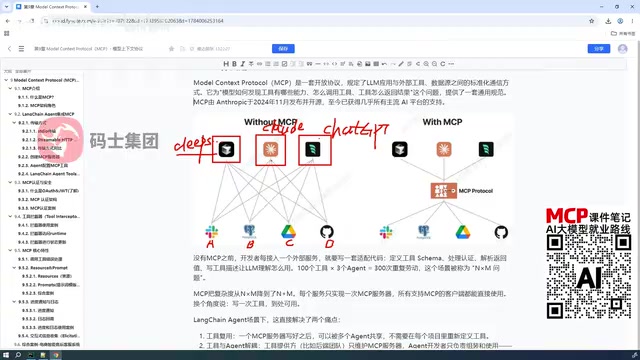
The problem is: each model has its own unique way of calling tools at the underlying level. DeepSeek calls A, B, C, D with its own syntax, Claude has Claude's syntax, and GPT uses yet another approach. These three approaches are mutually incompatible and highly inconsistent.
The direct consequence: once the underlying model of an Agent is swapped, developers must rewrite all tool calling code from scratch. This repetitive work is not only tedious but also error-prone, severely slowing down development iteration speed.

How MCP Unifies Tool Calling Standards
The core idea of MCP is to use a single unified protocol standard to smooth out the differences between how different models call tools.
Specifically, MCP defines two things:
- How tools should be called: providing a standardized calling method;
- How tool responses should be parsed: providing a standardized result handling method.
MCP adopts the classic Client-Server architecture. The MCP Server exposes tool capabilities and communicates with the MCP Client via the standardized JSON-RPC 2.0 protocol. The MCP Client is embedded within the AI application (the Host) and is responsible for establishing connections with Servers, discovering available tools, forwarding call requests, and receiving results. At the transport layer, MCP supports two communication methods: standard input/output (stdio) based local inter-process communication, suitable for development and debugging scenarios; and Server-Sent Events (SSE) based HTTP remote communication, suitable for distributed deployment in production environments. This design allows MCP Servers to run either as local processes or as remote services.
As long as all models and tools comply with the MCP protocol, the tool calling code remains unchanged regardless of which underlying model the Agent uses. In other words, the underlying model can be freely swapped without rewriting any tool calling logic.
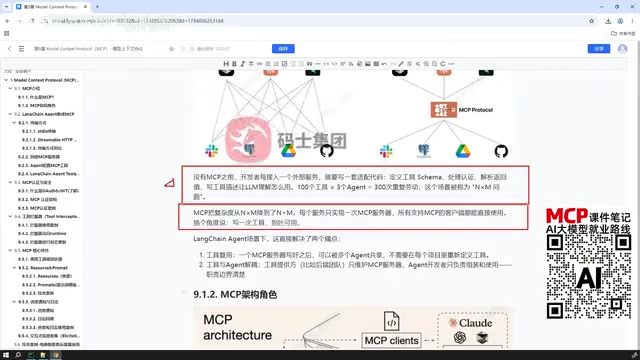
This is the fundamental shift from "rewrite everything every time you switch models" to "write once, reuse across any model." For teams that frequently experiment with and switch between models, the efficiency gains from this unification are enormous.
Two Key Pain Points MCP Solves in LangChain
Taking LangChain, a mainstream Agent development framework, as an example — it natively supports swapping between various underlying models like DeepSeek, GPT, Claude, Zhipu, and Tongyi Qianwen, while also supporting tools built on the MCP protocol. In this context, MCP primarily addresses two key pain points.
LangChain is one of the most popular LLM application development frameworks, founded by Harrison Chase in 2022. Its core design philosophy is to modularize LLM calls, prompt management, chain-of-thought calls, and Agent decision-making through abstraction layers. LangChain's Agent module allows LLMs to dynamically select and call tools based on user input, with its built-in Tool abstract class requiring developers to define a tool's name, description, and input Schema. Similar frameworks include LlamaIndex, CrewAI, AutoGen, and others — all facing the same multi-model adaptation and tool management challenges. MCP's emergence provides these frameworks with a unified tool integration solution.
Pain Point 1: Cross-Agent Tool Reuse
In the traditional approach without MCP, tools must be written inside the Agent — marking a function as a tool with something like an add_tool decorator, then registering it in the create_agent tool list. This means if Agent 1 uses a certain tool, it needs to be written once; if Agent 2 needs the same tool, it has to be written all over again.
With MCP, we can package a set of common tools into an independent MCP toolkit. This way, Agent 1 can call these tools, and Agent 2 can equally call them, truly achieving tool reuse across different Agents.

Pain Point 2: Decoupling Tools from Agents
The second pain point is essentially the same issue at its core. With MCP, we can build independent MCP Servers that expose a set of tools. The Agent side is only responsible for "using" tools, while the MCP Server side is only responsible for "maintaining" tools.
This separation of responsibilities creates clear architectural boundaries: tool development, maintenance, and upgrades can proceed independently, no longer tied to specific Agent implementations. This approach is highly consistent with the microservices architecture philosophy in software engineering — where each service is independently deployed, independently scaled, and communicates via standard APIs. Similarly, an MCP Server functions as an independent tool service that can be maintained by a dedicated team, supporting version management and canary releases without affecting the Agent applications that depend on it. This Separation of Concerns design pattern enables large-scale AI system development to support the same division of labor and collaboration as traditional software engineering, which is especially important for engineering management of large projects.
Summary
MCP is essentially a protocol that defines the standard processes and specifications different vendors should follow when calling tools. Its core benefit can be summarized in one sentence:
Regardless of which model provider you use, the underlying tool calling code remains fixed and unchanged.
Compared to the traditional approach of "rewriting tool calling code every time you switch models," MCP makes AI application development more concise, reusable, and maintainable. With virtually all mainstream LLMs now supporting this protocol, mastering MCP has become a core skill for AI developers. For programmers looking to build scalable Agent applications, understanding and practicing the MCP protocol is an essential step toward production-grade AI engineering.
Related articles

A Beginner's Guide to Vibe Coding: A Comprehensive Look at AI-Native Development
A comprehensive guide to Vibe Coding, the AI-native development paradigm covering core concepts, workflows, tech stack recommendations, pros and cons, and future trends.

RAGFlow Deep Dive: An Open-Source Knowledge Engine Combining RAG and Agent Capabilities
Deep dive into RAGFlow, an open-source RAG engine with 87K+ GitHub Stars. Explore its deep document understanding, Agent orchestration, traceable Q&A, and enterprise knowledge base applications.

Qwen 3.8 Weights Open-Sourced: Technical Analysis and Ecosystem Impact of Alibaba's Open-Source Model
Alibaba's Qwen 3.8 model weights are now open-source. This article analyzes Qwen's open-source strategy, the value of weight release for private deployment and fine-tuning, and its competitive position in the global open-source LLM landscape.