MCP Server Suite v2.4.0 Released: Security Hardening and Improved Tool Discoverability

MCP official server suite v2.4.0 updates six packages in sync, tightening security boundaries and completing tool schema descriptions.
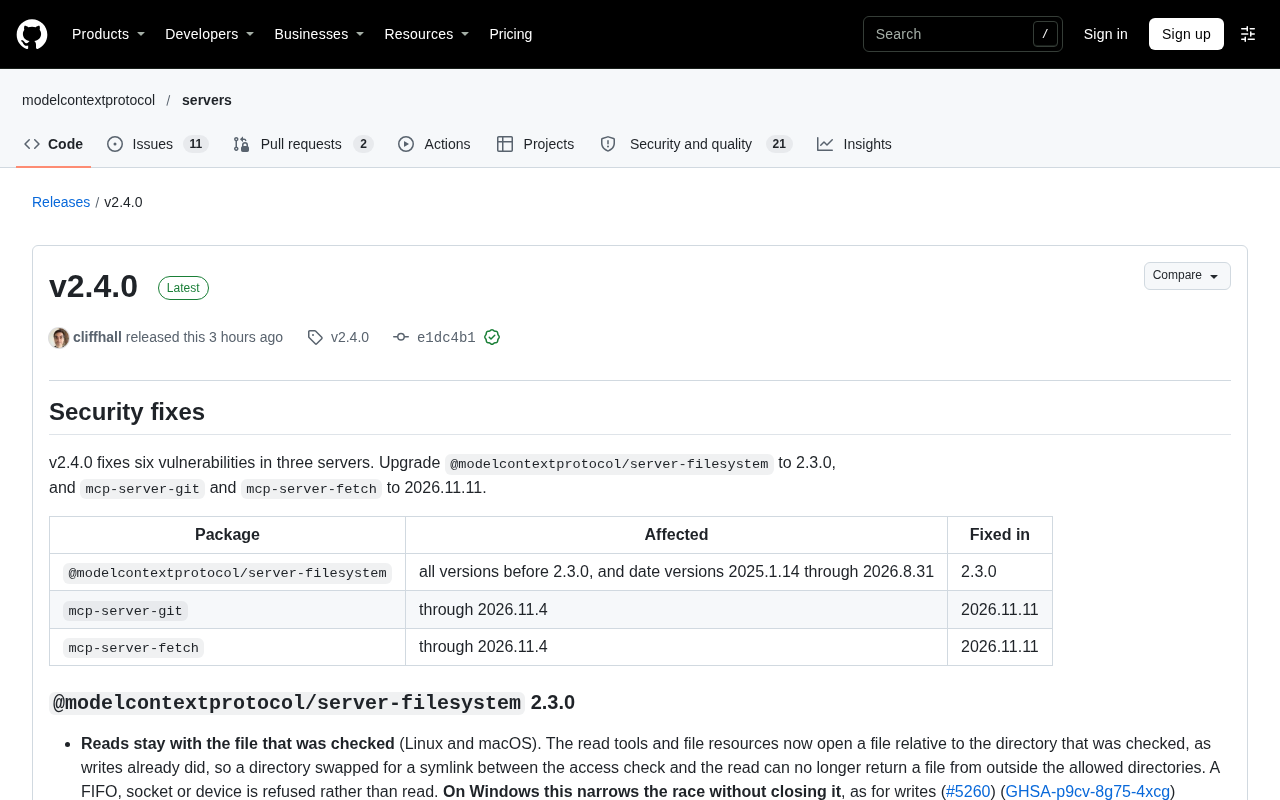
The official MCP server suite has released v2.4.0, updating the everything, filesystem, memory, fetch, git, and time packages in sync across npm and PyPI, with the Python side uniformly adopting CalVer 2026.11.11. The update has two main threads: moving the security defense line forward, including multiple GHSA advisory fixes, the everything HTTP transport binding to loopback by default, all images running as non-root, filesystem rejecting path traps such as NTFS alternate data streams and Windows device names, and a new directory-granular --read-only-dir; and improving tool discoverability by completing descriptions for every tool input property and explaining when to use each list/delete tool, reducing the probability of model misuse. It also fixes edge cases such as filesystem glob pruning and edit_file matching, fetch response body streaming limits, and memory heartbeat lock ownership verification.
Article Content
The official MCP (Model Context Protocol) server suite has reached version v2.4.0. This update, released by maintainer cliffhall, covers six npm and PyPI packages: everything, filesystem, memory, fetch, git, and time. The core direction boils down to two points: tighten the security boundary and make the tool interfaces clear.
One Release, Six Packages Advanced in Sync
Unlike typical single-package releases, v2.4.0 is a coordinated release across languages and repositories. On the npm side, @modelcontextprotocol/server-everything and server-filesystem were bumped to 2.3.0, server-memory to 2.1.1, and server-sequential-thinking stayed at 2.1.1; on the PyPI side, mcp-server-fetch, mcp-server-git, and mcp-server-time all adopted the CalVer version number 2026.11.11.
This versioning strategy itself is telling: TypeScript servers follow semantic versioning, Python servers follow date-based versioning, but all changes are tracked under the same release ledger (v2/chore/5509-release-v2.4.0). For users, this means you don't have to infer compatibility package by package when upgrading—the behavior changes across the suite come as a group.
Security: Tightening Everything from Default Binding to Path Validation
The most notable aspect of this update is the density of security fixes. Multiple GitHub Security Advisory (GHSA) identifiers appear in this release: GHSA-p9cv-8g75-4xcg for filesystem, GHSA-3rxj-6jhw-qfv7 for fetch, GHSA-6hqx-gqrx-c5r2 for git, plus community-reported GHSA-q74p-4wrc-q7w6, GHSA-7m4x-rv66-mxhh, and GHSA-f9hh-cmx9-2f23. Behind these identifiers are real exploit surfaces, not routine dependency refreshes.
Several specific changes show how the defense line has moved forward:
Narrower default network exposure. The everything server's HTTP transport now binds to the loopback address by default; external access requires explicitly setting HOST to relax this. This is a shift from "open by default" to "closed by default."
Container privilege reduction. All server images now run as a non-root user (#5473). This change was driven by a community PR prototype (contributors associated with #4741) and ultimately reimplemented by the maintainer.
Closing off attack surfaces at the path level. The filesystem server now rejects Windows NTFS Alternate Data Stream (ADS) paths, and also rejects Windows device names and paths ending with a dot or space (#5450, #5458). Both are Windows-specific path parsing traps that often bypass expected checks on paths that "look legitimate."
More granular read permissions. A new --read-only-dir parameter allows read-only access to be set per directory (#5451). Compared to an all-or-nothing permission model, this is a substantive move toward the principle of least privilege.
NTFS Alternate Data Streams (ADS) and Windows Device Names
NTFS Alternate Data Streams are a feature of the Windows file system: a file can have multiple data streams attached, with the main stream being the regular file content and other streams accessed via the filename:streamname syntax. The problem is that many path validation routines only check whether the main file exists and whether the extension is valid, while paths like readme.txt:hidden.exe still appear to point to readme.txt in Explorer and some APIs, but actual reads and writes land on the alternate stream, bypassing whitelists or extension checks based on the main filename. Windows device names (such as CON, NUL, COM1, LPT1, and CON.txt with an extension) are another trap: these names are resolved by the system as devices rather than files in any directory, allowing an attacker to make path checks and the ultimately opened target disagree. Paths ending with a dot or space are silently truncated during Windows normalization, similarly causing a mismatch between the checked path and the actual path. The filesystem server in v2.4.0 directly rejects all three types of paths, effectively placing a normalization defense line at the parsing layer.
Tool Discoverability: Writing Descriptions for Every Input Property
If security fixes are defense, then #3669 is an improvement on the offensive side: adding descriptions to every tool input property. This change spans the everything, filesystem, and memory servers, was reported by KryptosAI, and had prototype PRs submitted by six contributors (radeshgovind-2005, Jim1874, Lubrsy706, go165, m9ter1a, yash161004).
The significance of this change is easy to underestimate. The value of MCP lies in enabling models to call tools correctly, and a model's understanding of a tool comes entirely from the schema description. When property-level descriptions are missing, the model can only guess semantics from field names, making wrong parameters and tool misuse almost inevitable. Completing this layer of description is equivalent to adding an instruction manual to tool calls, directly affecting the reliability of downstream agents.
There is also a companion change: feat(filesystem, memory): say when to use each list and delete tool (#5460)—not only explaining what the parameters are, but also when the tool should be used. Tool selection itself is another area where models easily make mistakes.
MCP Tool Schemas and Model Invocation
MCP servers return each tool's name, description, and JSON Schema input parameter definitions to clients via tools/list, and the model uses this schema to decide whether to call the tool and how to fill in parameters. JSON Schema allows a description field at the property level, but that field is optional; when missing, the model can only infer meaning and format constraints from property names (such as path, max_count, pattern). Property names are often ambiguous: whether path is absolute or relative, whether pattern is a glob or a regex, whether max_count allows 0—without descriptions, the model can only learn by trial and error. Once property-level descriptions are completed, the schema itself becomes model-readable usage documentation, reducing the probability of parameter type errors and tool misselection, which is especially critical for agent scenarios that rely on multi-tool orchestration.
Detail Fixes for filesystem and fetch
The filesystem server fixes quite a few edge cases in this release: search_files's excludePatterns now aligns with the behavior of directory_tree (#5446); exclusion globs ending with /** now correctly prune the directories they name (#5456); edit_file can match oldText ending with a newline (#5447); and missing parent directories now report a clear error instead of a raw chdir exception (#5448). These are all pitfalls you would actually run into in practice.
On the fetch server side, response bodies are now size-limited during reading (#5453) rather than after reading completes, which avoids large responses blowing up memory—a prototype PR from community contributor neuralmanacle led to this change. In addition, the Python side was uniformly upgraded to ruff 0.17 and newly appearing lint issues were cleaned up (#5479).
Reliability Fixes for memory and git
The memory server fixes a tricky lock issue: heartbeats no longer renew a lock that is no longer yours (#5462). In concurrent scenarios, this kind of bug can cause a lock to never be released. The documentation also adds Docker upgrade steps to ensure containers still work after upgrading (#5474).
The git server requires git_log's max_count to be at least 1 (#5455), and clarifies the scope of --repository in both --help and validate_repo_path (#5454). In the documentation, the Zed configuration snippet was corrected to valid JSON (#5464), and dead links and alt text in the README and ADDITIONAL.md were also fixed (#5467).
Distributed Locks and Heartbeat Renewal
The memory server uses a lock mechanism with heartbeat renewal: the process holding the lock periodically sends heartbeats to extend the lease, preventing long-running operations from being preempted by other processes when the lease expires. The key constraint of this design is that renewal must verify the holder's identity—only the current lease holder may renew. If the heartbeat logic does not check lock ownership, then a process that has already lost the lock (for example, because the lease expired due to a pause, GC, or network partition and was acquired by someone else) will continue to renew, resulting in the lock being "held" by two processes simultaneously, or renewal requests constantly refreshing a lock that should have been released, causing permanent occupancy. The v2.4.0 fix makes the heartbeat confirm the lock still belongs to it before renewing—a typical fencing check, and also the most easily overlooked part of lease-based distributed lock implementations.
Signals on Community Collaboration and Maintenance Model
There is a noteworthy passage in the release notes: the repository enforces a policy of "only accepting issues, not PRs," so contributors' PRs were closed, and the changes were reimplemented by the maintainer with attribution in the issue. This model was practiced extensively in this release—the tool property description change alone had prototypes from six contributors as references.
For developers relying on this server suite, the upgrade recommendation for v2.4.0 is straightforward: filesystem usage involving path handling, deployments running on Windows, and configurations exposing the HTTP transport beyond loopback should all be upgraded as a priority. The existence of security advisories means older versions have exploitable paths under certain conditions.
This article is based on the GitHub Release v2.4.0 release notes; version numbers and GHSA identifiers are quoted from the original release record.
One-line Summary
The official MCP server suite v2.4.0 updates six packages in sync, tightening security boundaries and completing tool schema descriptions.
Paragraph Summary
The official MCP server suite has released v2.4.0, updating the everything, filesystem, memory, fetch, git, and time packages in sync across npm and PyPI, with the Python side uniformly adopting CalVer 2026.11.11. This update has two main threads: first, moving the security defense line forward, including fixes for multiple GHSA advisories, the everything HTTP transport binding to loopback by default, all images running as non-root, filesystem rejecting path traps such as NTFS alternate data streams and Windows device names, and a new directory-granular --read-only-dir; second, improved tool discoverability, completing descriptions for every tool input property and explaining when to use each list/delete tool, reducing the probability of model misuse. It also fixes edge cases such as filesystem glob pruning and edit_file matching, fetch response body streaming limits, and memory heartbeat lock ownership verification.
Related articles

Prompt Engineering for Beginners: From Writing Prompts to Engineering Thinking
Starting from the essence and four functions of prompts, this article systematically explains the six-step process, four success criteria, learning value, and practical limitations of prompt engineering to help you build a complete understanding.

Anthropic Launches Nasdaq IPO: AI Giant's Listing and Risk Disclosures
Anthropic officially launches its Nasdaq IPO under ticker ANT, with market valuation expected to potentially exceed SpaceX's record. The prospectus devotes nearly 100 pages to AI risks, while first-half revenue grew over 14x but net losses widened sharply, reigniting the AI bubble debate.

Rust cURL Clone Uses 4,832 unsafe Blocks—Is the Memory Safety Myth Broken?
A Rust cURL clone uses 4,832 unsafe keywords, challenging Rust's memory safety narrative. We analyze what unsafe really means, compare Fil-C, and examine rewrite motives.