MCP: The New Standard for AI Tool Integration — Are You Still Not On Board?

MCP ends AI integration fragmentation with a unified discovery, invocation, and permission model — but shipping it requires starting narrow.
Using the "USB-C for AI integration" metaphor, the article explains how the Model Context Protocol solves repeated wrapping of the same data interface across chatbots, reporting agents, and dashboards. Its core is host-discovered tools, structured invocation, and structured returns across processes, languages, and networks. The shipping principle is "start narrow" — one read-only MCP server per domain, run as a sidecar or local process to control blast radius, with human gates on writes and versioned servers. It also highlights common first-week mistakes and recommends building an internal MCP registry.
Why MCP Is Becoming the New Standard for AI Integration
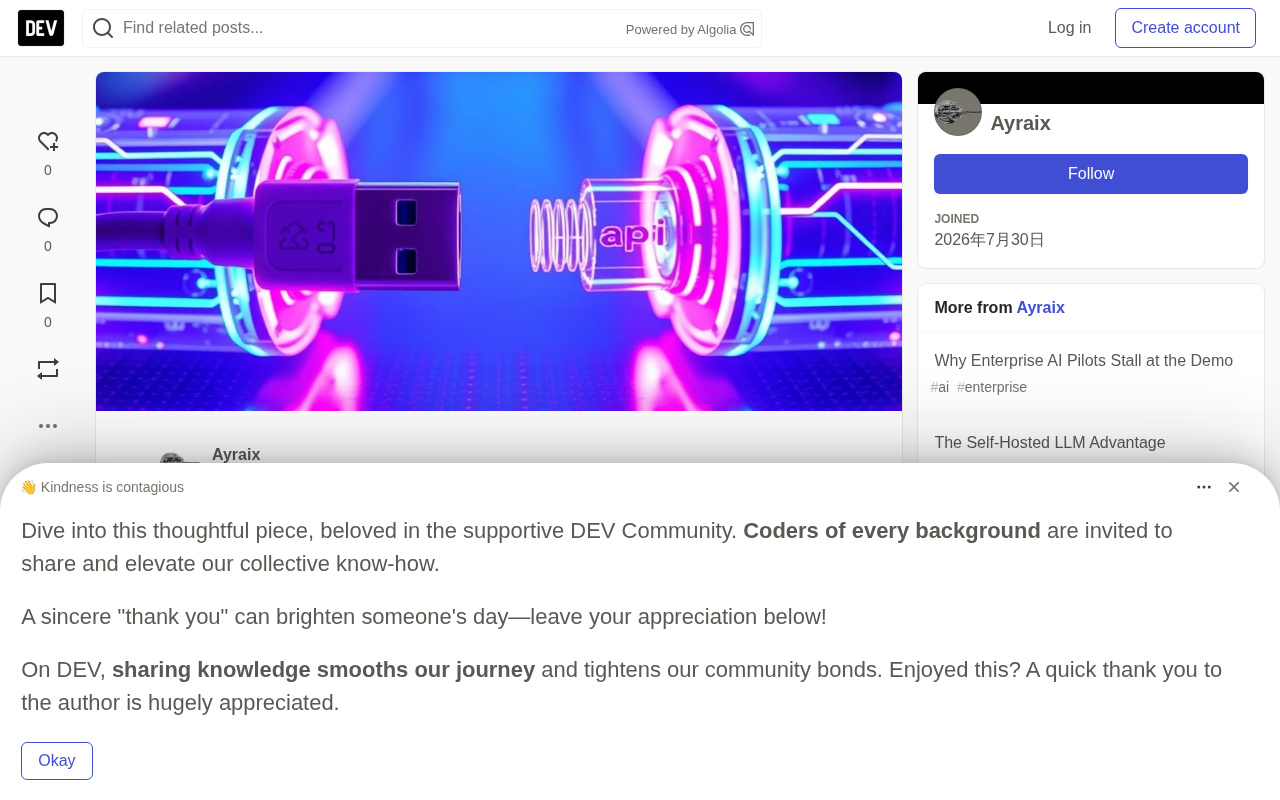
Every AI team has lived this nightmare: the same data interface, integrated separately for a chatbot, a reporting agent, and an executive dashboard — and then each one breaks on a different Friday. According to analysis from Ayraix.com, the Model Context Protocol (MCP) is trying to end this chaos. It's often described as "USB-C for AI integration": one wire format, one discovery mechanism, one permission model.
The core logic of MCP isn't complicated. A host discovers tools, invokes them with structured input, and gets structured output — across processes, languages, and networks. An agent without tools is just a chatbot with ambition; an agent with twelve incompatible tool interfaces is a production incident waiting for a calendar invite. What MCP provides is a tool catalog: the host asks "what can you do," and the server returns typed capability descriptions, schemas, and boundary definitions. Swap Jira for Linear, swap Postgres for Snowflake — as long as both sides speak MCP, the agent's mental model doesn't need to be rebuilt.
MCP won't make your agent smarter. It makes your stack readable to agents — which is rarer and more valuable.
Model Context Protocol (MCP) is a protocol specification open-sourced by Anthropic in November 2024, aimed at standardizing how large language model applications communicate with external data sources and tools. It uses a client-server architecture: the Host (such as Claude Desktop, an IDE plugin, or a custom orchestrator) acts as the client, while MCP Servers expose three categories of capabilities — Tools (callable functions), Resources (readable data), and Prompts (preset prompt templates). The protocol is based on JSON-RPC 2.0, giving it inherent cross-language and cross-process characteristics. Official and community SDKs are available for Python, TypeScript, Java, Kotlin, and more. The key difference between MCP and traditional Function Calling is that Function Calling hardcodes tool definitions into application code or prompts, whereas MCP uses an independent discovery mechanism to let hosts dynamically fetch tool lists and schemas at runtime — decoupling tools from agents.
An Architecture That Actually Ships
The keyword for shipping MCP is "start narrow." One MCP server per domain: finance read-only, HR ticketing, document search. Run them as sidecars or local processes — not because MCP requires it, but because blast radius matters. An agent that can read everything shouldn't get write access just because someone merged a permissive config on a Friday.
Four principles for a shippable architecture:
- Discovery first — Agents list tools at session startup; don't hardcode function names in prompts
- Typed boundaries — JSON Schema beats writing "please return JSON" in the system prompt
- Human gates on writes — MCP doesn't replace judgment; design approvals into destructive tools
- Version your servers — Like any API, breaking changes need a migration path
| Comparison Dimension | Custom Wrapper | MCP Server |
|---|---|---|
| Time for new integration | Days per data source | Hours by applying an existing pattern |
| Agent portability | Locked to a single framework | Host-agnostic |
| Discovery | Hardcoded in prompts | Dynamic catalog |
| Operational ownership | Scattered scripts | Versioned service |
This comparison table reveals MCP's real value: it turns scattered one-off scripts into services with ownership, versioning, and a discovery mechanism.
Blast Radius is a common concept in security and reliability engineering, referring to the maximum scope that a failure, a misoperation, or an abuse of privileges can affect. In the MCP context, it specifically means: if a server with broad credentials is injected with malicious instructions or invoked incorrectly, how much data could be read, modified, or even deleted. Common ways to control blast radius include the principle of least privilege (each server is granted only the scopes necessary to fulfill its own responsibilities), splitting servers by domain, introducing human approval or secondary confirmation for write operations, and applying rate limits and audit logs to high-risk tools. This aligns with the "one service does one thing" philosophy in microservice architecture — clear boundaries not only make maintenance easier but also determine whether an incident can be quickly isolated when it occurs.
Where It Fits in Your Existing Stack
Most teams have already accumulated three and a half half-baked integration patterns: the LangChain tool wrapper someone wrote at a hackathon, the Zapier webhook the ops team refuses to maintain, and the "temporary" data warehouse REST proxy that has become a load-bearing wall. MCP won't delete these overnight — it gives you a named migration target that both vendors and hosts can agree on.
Treat MCP servers like microservices for agent capabilities: each server owns one bounded context, exposes one schema, and logs every invocation. Key decision points include:
- Host choice — Claude Desktop, Cursor, a custom orchestrator; MCP travels with you
- Transport — stdio for local development, SSE or streamable HTTP when network isolation is needed
- Auth model — OAuth for SaaS, mTLS internally, API keys kept only in dev sandboxes
- Observability — Trace tool calls the same way you trace HTTP requests
Transport determines how JSON-RPC messages are passed between an MCP client and server. There are currently two mainstream options: stdio communicates over standard input/output, with the server running as a child process of the host — suitable for local development, desktop applications, and latency-sensitive scenarios, and inherently avoiding network exposure risks. SSE (Server-Sent Events) and the newer Streamable HTTP pass messages over HTTP long-lived connections, suitable for scenarios where the server is deployed remotely, network isolation is needed, or multiple people share it. When choosing a transport, weigh three things: deployment topology (local or remote), security boundaries (whether TLS, mTLS, or gateway authentication is needed), and operational cost (process management vs. service governance). For authentication, public SaaS typically uses OAuth 2.0, enterprise internal services commonly use mTLS or service mesh identity, and API keys are generally recommended only for development sandboxes, avoiding the production path.
Common Mistakes in the First Week
The do-everything server syndrome — one MCP process with forty tools and admin credentials. Split it. Prompt-defined tools — hardcoding function names into the system prompt while claiming to have adopted MCP. Discovery exists for a reason. Shipping writes on day one — always start read-only, and only add destructive capabilities after you trust the audit trail.
An effective rollout move: schedule a lunch-and-learn where the engineering team demonstrates a real MCP server calling a real internal API — not slides, but a live tool list, live invocation, live logs. Those fifteen minutes will convert skeptics better than another "AI strategy" deck.
When your second MCP server takes less time than your first, you've crossed from experiment into platform.
The Vendor Landscape and Internal Politics
Every platform will claim MCP support in its slides. Your job is to press: which tools, which auth, what SLA — and whether their server runs in your VPC or phones home. Internal politics matter just as much: the team that owns the data API may resist wrapping an interface for agents. Frame MCP as reducing their support burden ("integrate once, serve many hosts"), not as AI hype stealing budget.
One practice worth adopting: publish an internal MCP registry — server names, owners, scopes, date of last security review. Agents discover services from the registry, and shadow servers get blocked at the gateway.
The USB-C analogy is overused but still accurate: the winners aren't the ones with the most exotic connector, but the ones where everything clicks into place.
Internal MCP Registry is a governance artifact that naturally evolves as teams scale, functioning similarly to an enterprise internal API catalog or service registry. It typically records: server name and purpose, owning team and contact, exposed tool list and schema versions, authentication and authorization scopes, date of last security review, and SLA and change history. The registry delivers value on three levels: first, it lets agents or developers discover available services through a unified entry point, avoiding reinventing the wheel; second, it lets the security team audit the full surface of exposed capabilities; third, combined with an API gateway, it can block unregistered "shadow servers," preventing integrations that bypass the process from quietly reaching production. At small scale, a Markdown table suffices; as you grow, you can migrate to a developer portal like Backstage or a custom catalog service.
One-line Summary
MCP ends AI integration fragmentation with a unified discovery, invocation, and permission model — but shipping it requires starting narrow.
Paragraph Summary
The article uses "USB-C for AI integration" as a metaphor to explain how the Model Context Protocol solves the problem of the same data interface being wrapped repeatedly for chatbots, reporting agents, and dashboards. MCP's core is host-discovered tools, structured invocation, and structured returns across processes, languages, and networks, so an agent's mental model doesn't need rebuilding when the underlying data source is swapped. The shipping principle is "start narrow": one read-only MCP server per domain, run as a sidecar or local process to control blast radius, with human gates on writes and versioned servers. The article provides a comparison table against custom wrappers and highlights common first-week mistakes — do-everything servers, hardcoded tool names in prompts, and premature write access. Finally, it reminds readers to press vendors on specific tool support, auth, and SLAs, and recommends building an internal MCP registry to govern service discovery and shadow servers.
Related articles

WorkBuddy Full Tutorial: Build an AI Office Automation Agent from Scratch
A complete WorkBuddy tutorial: installation, three working modes, multimodal picture book video practice, expert team agent building, and workflow configuration for low-cost AI office automation.

WorkBuddy Agent Complete Guide: From Beginner to Automation in 7 Days
Based on Bilibili's 256-episode WorkBuddy masterclass, this systematically breaks down Tencent's AI office workbench core capabilities: Agent principles, Skill encapsulation, cross-platform connectors, scheduled automation, knowledge bases, and zero-code development, with learning path recommendations.

8 AI Accounts, 7 Failed: An Honest Review of Using AI to Get Work Done
Only 1 of 8 AI-run Bilibili accounts succeeded. We break down the real difference between "performing AI" and "using AI to get work done."