MCPA Certification Study Guide: Mastering the Security and Governance Domain
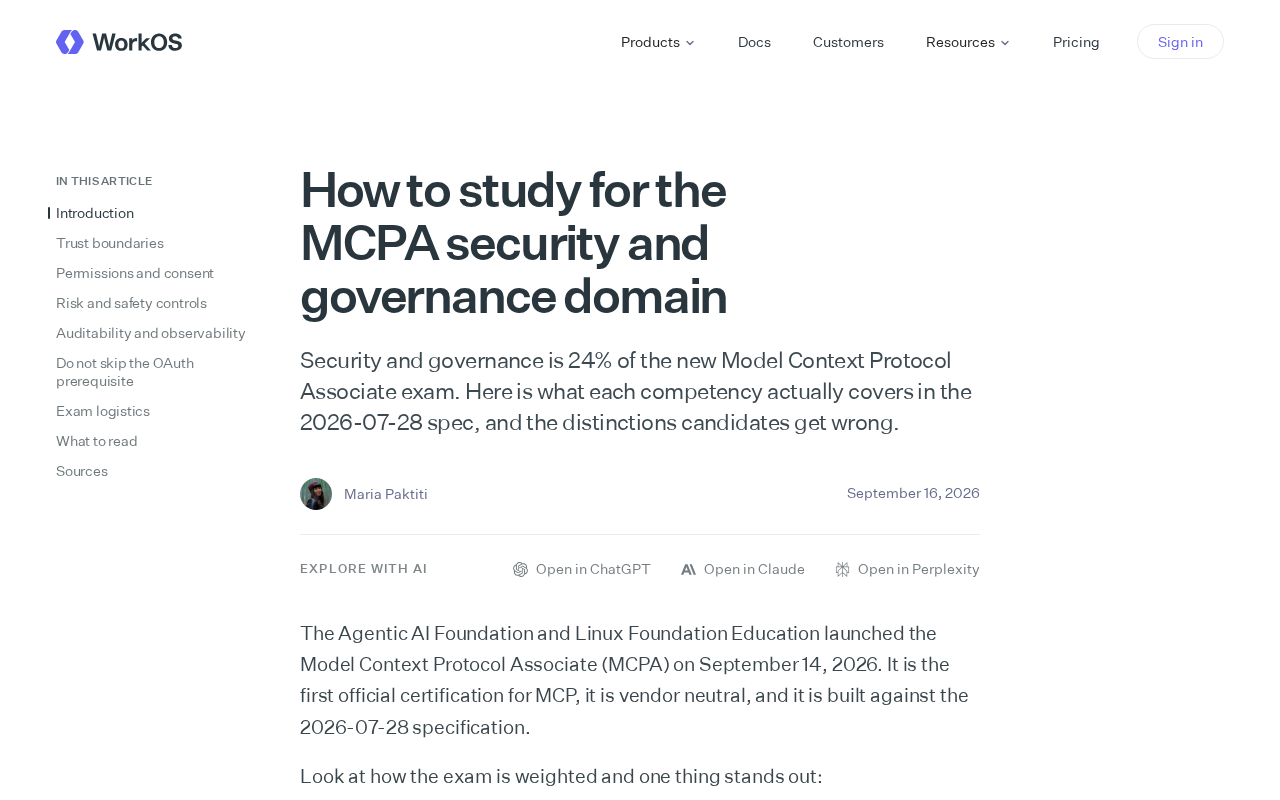
MCPA's Security and Governance domain carries 24% exam weight, with key challenges in distinguishing auth, governance, and protocol vs. app-layer security.
The Security and Governance domain accounts for 24% of the MCPA certification exam, reflecting the core risks MCP faces in real-world deployment. It spans three main competencies: authentication and authorization, data protection and privacy, and governance and compliance — all based on the 2026-07-28 spec. The real challenge isn't memorizing definitions but correctly distinguishing paired concepts like authentication vs. authorization, security vs. governance, and protocol-layer vs. application-layer responsibilities in context.
Model Context Protocol Associate (MCPA) certification is a professional exam built around Model Context Protocol (MCP) competencies, and the Security and Governance domain carries 24% of the total exam weight — making it one of the heaviest-weighted areas across the entire test. For candidates preparing for the exam, understanding every competency in this domain and clearing up the most commonly confused concepts is the key to passing.
Why Security and Governance Deserves Your Primary Focus
A 24% weighting means that roughly one in every four questions on the MCPA exam touches on Security and Governance. This isn't arbitrary — as MCP is increasingly used to connect large language models with external tools, data sources, and services, security boundaries and governance rules have become the central risk points in real-world deployments.
The exam spec is based on version 2026-07-28, which means candidates must prepare against the latest version rather than relying on outdated materials. The protocol itself is evolving, and permission models, authentication mechanisms, and data handling rules can all change between versions. Studying from old content makes it easy to lose points on detail-oriented questions.
What Each Competency Actually Tests
Security and Governance isn't a vague catch-all concept — it's made up of several specific competencies, each corresponding to a real security concern that MCP must address in practice.
Authentication and Authorization
This area focuses on how clients and servers establish trusted connections, how the identity of a requester is verified, and how to define which resources different roles can access. Candidates need to understand the distinction between authentication (confirming who you are) and authorization (confirming what you're allowed to do) — a classic and frequently tested point.
In MCP architecture, authentication is typically handled through mechanisms like OAuth 2.0, API Keys, or mTLS (mutual TLS) to prove the caller's identity to the server. Authorization happens after identity is confirmed, determining which tools that identity may invoke, which resources it may read, and which operations it may perform. These two steps follow a strict sequential order: unauthenticated requests never enter the authorization flow. The MCP spec distinguishes between Client, Server, and Host as distinct roles, each with different permission boundaries. Exams frequently use scenario-based questions — such as "a certain role sends a certain type of request; how should the protocol respond?" — to test whether candidates have genuinely internalized the responsibilities at each layer.
Data Protection and Privacy
Because MCP transmits model context that may include sensitive data, this competency covers how to encrypt data in transit, how to minimize data exposure, and how to meet privacy compliance requirements.
Governance and Compliance
The governance layer focuses on policy definition, audit trails, enforceability of access controls, and how to ensure MCP deployments conform to both internal organizational standards and external regulations.
In the MCP context, governance isn't just about static access control policies — it also includes audit logs of tool invocations, Policy-as-Code enforcement, and traceability requirements for interactions between model outputs and external services. The compliance side involves specific requirements from regulations like GDPR and HIPAA around data retention, cross-border data transfers, and the principle of least privilege. In practice, governance failures rarely manifest as obvious intrusions — they surface as an inability to answer questions like "who called which tool, when, and with what permissions." Understanding the division of responsibility between governance and pure security protection is the core intent behind this competency.
The Distinctions Candidates Most Often Get Wrong
The original spec specifically highlights concepts that "candidates get wrong" — distinctions that exam-takers commonly confuse. These questions don't test whether you've memorized definitions; they test whether you can correctly apply concepts in a specific context.
Common sources of confusion include: the boundary between authentication and authorization; the division of responsibility between security (preventing unauthorized access) and governance (ensuring compliance and controllability); and the attribution of security responsibilities between the protocol layer and the application layer. These distinctions may seem subtle, but they are precisely how the exam filters for candidates who truly understand the protocol.
The split between protocol-layer security and application-layer security is another high-frequency stumbling block. Protocol-layer security refers to mechanisms defined by the MCP spec itself — such as transport encryption requirements, message signing, and permission declaration formats. Application-layer security refers to responsibilities that implementing parties (server or host application developers) must handle themselves — such as validating tool input parameters, defending against Prompt Injection attacks, and filtering sensitive information from context returned to the model. The spec deliberately separates these two layers to clarify "what the protocol guarantees versus what the implementer is responsible for." When a scenario-based exam question describes a security problem, candidates must first determine which layer the problem belongs to before they can select the correct response mechanism.
Study Recommendations
For this high-weight domain, the following strategies are recommended:
- Study against the latest spec: Always use the
2026-07-28version of the specification as your reference, and verify coverage against each competency point. - Understand, don't memorize: Since the tricky questions focus on conceptual distinctions and situational application, rote-memorizing definitions has limited value. Use examples to understand what real problem each security mechanism actually solves.
- Build a concept comparison table: Organize paired concepts like authentication/authorization and security/governance into a side-by-side table that clearly maps out each one's scope and responsibility boundaries.
- Allocate study time proportionally: Since this domain accounts for 24% of the exam, invest a corresponding share of your study time — don't underestimate it.
The Security and Governance domain tests the aspects of MCP deployment most prone to failure in the real world. Mastering it not only helps you pass the certification, but also helps you avoid high-risk configuration errors in your day-to-day work.
Related articles
Running 27B Models on 16GB VRAM: Local Video Generation with Qwen3 and MiniMax H3 Tested
Run 27B open-source models on 16GB VRAM: a ComfyUI workflow collection combining Qwen3 and MiniMax H3 for text-to-image, image editing, and local video generation.
Training a Mario AI with NEAT Neuroevolution: An Evolutionary Experiment from Three Failures to Completion
A developer used NEAT neuroevolution to train a Mario AI controller that cleared a tricky ROM Hack level. Learn how NEAT works, its real challenges, and its limits.
MiniMax Open-Source Video Model Local Deployment: Runs on 8GB VRAM with Impressive Speed
MiniMax's open-source AI video model runs locally on 8GB VRAM via ComfyUI. Full deployment guide: model paths, 5 workflow options, text-to-video & image-to-video results.