Meadow: The Minimalist Device That Lets You Leave Your Smartphone at Home Without Going Off the Grid

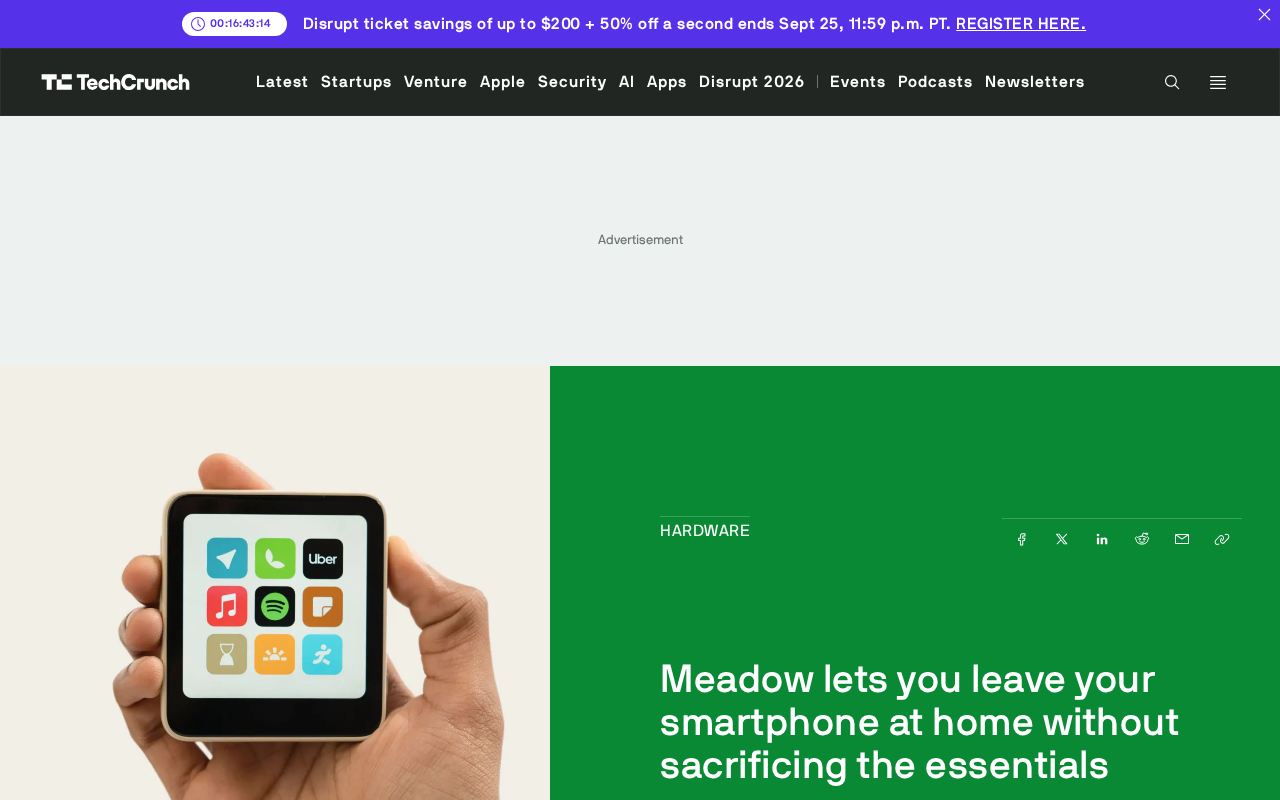
Meadow is a minimalist device that keeps essential features like calls and navigation while deliberately blocking social media.
Meadow, built by 25-year-old founder Shreyas Narlanka, is a minimalist hardware device designed to let users leave their smartphones at home while retaining calls, texts, and navigation — explicitly excluding social media and open web browsing. Narlanka emphasizes the product isn't anti-technology, targeting users who want selective tech use rather than full disconnection. While the minimalist device space has been validated by products like the Light Phone and Punkt, key challenges remain: striking the right balance between feature reduction and real-world usability, and overcoming the deep ecosystem dependencies of payments, maps, and messaging.
When "Digital Minimalism" Meets Hardware Innovation
As smartphones continue to permeate every corner of daily life, a quiet movement to "escape the screen" is gaining momentum. Meadow is one product born from this trend — attempting to solve what seems like a contradictory problem: letting people leave their smartphones at home without sacrificing the functions they genuinely need.
25-year-old founder Shreyas Narlanka is refreshingly direct about the product's positioning: "We're not Luddites — we just don't want social media, web browsing, that kind of stuff." This statement neatly defines Meadow's boundaries. It's not anti-technology; it's anti-attention-hijacking — specifically, the app ecosystem that constantly competes for your focus and manufactures anxiety.
Redefining "Essentials" vs. "Distractions"
At the core of Meadow's philosophy is a thorough rethinking of what a phone is actually for. For most people, a smartphone is simultaneously a communication tool, navigation assistant, and payment wallet — and an endless information vortex. The former set represents the "infrastructure" of modern life; the latter tends to become a black hole for time and focus.
When Narlanka talks about "not sacrificing essentials," he's pointing squarely at things like calls, texts, and navigation — the genuine must-haves. What's explicitly left out are social media and open web browsing — precisely the features most likely to foster addiction and fragment attention.
This subtractive approach runs parallel to the broader "dumbphone" revival. In recent years, a growing number of users have sought out feature-limited, "quieter" devices that preserve basic connectivity while escaping the constant grip of app stores and push notifications.
The dumbphone revival has been backed by data for several years now. According to market research firm Counterpoint Research, global feature phone shipments rebounded around 2022, with a portion of that growth coming from smartphone users voluntarily downgrading — not the traditionally low-income segment. Representative products include the Light Phone II — an E-ink device supporting only calls, texts, podcasts, and maps, priced at around $299 — that has attracted a notable following among tech workers and creatives. Behind this counterintuitive trend is a well-documented correlation between smartphone screen time and user anxiety: Americans unlock their phones more than 96 times per day on average, a significant share of which is triggered by social media notifications. The dumbphone revival is, at its core, the result of a subset of users turning to hardware-level constraints after app-level self-control measures — like screen time limits — proved ineffective.
The Product Philosophy Behind "We're Not Luddites"
The founder's deliberate clarification that he's "not a Luddite" is worth unpacking. Historically, Luddites were those who resisted mechanization and opposed technological progress. By distancing himself from that label, Narlanka is positioning Meadow for a more mainstream audience: not people who reject technology outright, but those who want to use it more selectively and reclaim control over their digital lives.
This positioning matters. It signals that Meadow doesn't intend to drag users back to the feature phone era. Instead, it aims to offer a healthier middle ground between a fully-featured smartphone and complete disconnection. Users can confidently leave their smartphone at home, still handle essential communication and navigation, and avoid being bombarded by relentless information streams.
Opportunities and Challenges in the Minimalist Device Space
From an industry perspective, the "digital wellness" and "minimalist device" segment is heating up. Products like the Light Phone and Punkt have already validated that genuine demand exists — a subset of users is willing to pay for fewer features in exchange for focus and mental clarity.
However, these products all face a shared real-world challenge: finding the right balance between subtraction and practicality. Cut too many features, and users find themselves inconvenienced in everyday situations. Keep too many, and the device risks sliding back toward the smartphone experience it was meant to replace, losing its differentiated value. Meadow's ability to precisely define the boundary of "essentials" will be central to whether it succeeds or fails.
There's also the engineering and business challenge: services like payments, maps, and instant messaging are deeply embedded in the smartphone app ecosystem. Building a standalone minimalist device that offers viable alternatives without tapping into those ecosystems is no small feat.
Payment and mapping dependencies represent the most typical technical barriers for minimalist devices. Take mobile payments: Apple Pay, Google Pay, and similar mainstream solutions are tightly integrated with their respective operating system ecosystems, making them nearly inaccessible to third-party devices. Independent NFC payment solutions require separate negotiations with banks and payment networks — a prohibitively expensive undertaking. Mapping and navigation face the same issue: Google Maps and Apple Maps don't license full offline navigation capabilities to outside parties, and while alternatives like HERE Maps exist, their user experience and data completeness still lag behind. On the messaging front, mainstream apps like WhatsApp and WeChat don't open their interfaces to third-party clients. For a minimalist device to support these services, it would either need to run a full Android environment (contradicting the minimalist premise) or guide users toward open-protocol apps like Signal. These ecosystem walls make the line between "just enough functionality" far more complex in practice than it appears at the concept level.
Final Thoughts
With limited public information available so far, Meadow's exact form factor, feature set, and launch details remain unclear. But from the founder's statements, it's evident that this product is trying to answer a question more and more people are grappling with: Can we enjoy the conveniences of technology without being driven by it?
Regardless of whether Meadow ultimately succeeds, the idea of "intentional technology use" it represents is worth paying attention to. In an era of increasingly fierce competition for human attention, products that deliberately embrace subtraction may be exactly the antidote many people are looking for.
Related articles

5 Practical Ways Real Estate Agents Can Use AI to Boost Efficiency (2026 Edition)
How can real estate agents use AI to boost efficiency? Based on a YouTube walkthrough, this breaks down five methods — ChatGPT for listing descriptions, Canva for marketing materials, forms for open house leads, Zapier for automated follow-up, and seller meeting prep — and flags risk boundaries like fair housing laws, photo authenticity, and price verification.

Grok Bot vs ChatGPT Agent: Which AI Agent Is More Powerful?
How does Grok Bot differ from ChatGPT Agent? This comparison examines how they work: Grok Bot has a cloud computer and runs persistently inside tools to execute multi-step tasks automatically; ChatGPT Agent operates web pages in a browser and is more mature at general tasks. Includes selection advice.

Walmart Agent Gateway: AI Shops for You Automatically—Why Is Amazon Going the Opposite Way?
Walmart's Agent Gateway lets ChatGPT, Gemini and other AI assistants access its product catalog to search, compare and add to cart, with spending limits and per-purchase approval. Amazon blocks external AI agents—two retail giants, opposite paths. Currently US-only, India may follow.