Mecka AI Valuation Approaches $500M: Robot Training Data Becomes the New Battleground
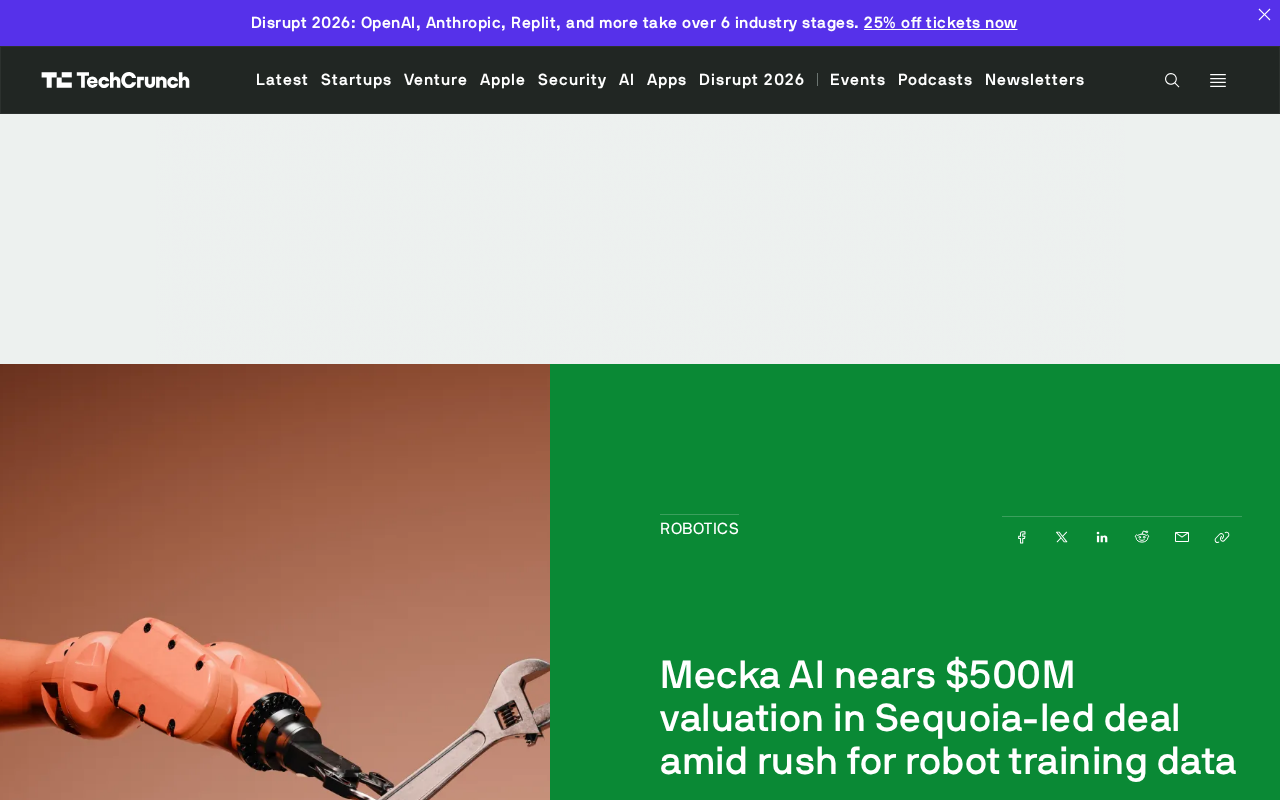
Mecka AI seeks Sequoia-led funding at ~$500M valuation, spotlighting the race for robot training data.
Mecka AI, a two-year-old robot training data startup, is pursuing a new funding round led by Sequoia Capital at a valuation approaching $500 million — just months after closing its Series A. The rapid fundraising pace reflects a structural scarcity in Embodied AI: while LLMs were fueled by vast internet text, the physical-world interaction data robots need barely exists online. Whoever builds a scalable robot training data supply system stands to own critical infrastructure for the embodied AI era. Top-tier VC backing signals the sector has entered an intensive capital window, though a $500M valuation for an early-stage company remains aggressive, and the debate over real-world, teleoperation, versus synthetic data adds further uncertainty.
A Two-Year-Old Startup's Capital Sprint
According to media reports, robot training data startup Mecka AI is pursuing a funding round led by Sequoia Capital, with a valuation approaching $500 million. The company, only two years old, has re-entered fundraising mode just months after announcing its Series A — a pace that reflects intense investor interest in this sector.

Based on public information, the current round is still "coming together," meaning deal terms may still be under negotiation. But Sequoia's role as lead investor is itself a strong signal — a top-tier VC continuing to bet on the robot data niche suggests this is no longer a fringe topic, but is increasingly viewed as critical infrastructure for Embodied AI.
Why Robot Training Data Has Suddenly Become Scarce
Over the past two years, the explosion of large language models was largely fueled by the vast amounts of text and image data available on the internet. But as AI moves from "conversations on a screen" to "actions in the physical world," usable data sources shrink dramatically. Robots need to learn real-world interactions — grasping, moving, manipulating objects — and this kind of high-quality, structured motion and perception data is virtually nonexistent on the public web.
This is precisely where companies like Mecka AI see their opportunity. Whoever can efficiently collect, annotate, and produce robot-ready training data controls the "fuel supply" for scaling Embodied AI. The phrase "rush for robot training data" in the original headline perfectly captures the urgency gripping the industry — data scarcity translates directly into enormous valuation potential.
The Industry Logic Behind the Fundraising Pace
Launching a new round at nearly a $500 million valuation just months after a Series A is unusual even among early-stage deep tech companies. Typically, this signals one of two things: either business growth or customer deal velocity has exceeded expectations, prompting investors to double down; or the sector as a whole is overheating, with capital rushing to secure positions in leading players.
Either way, it reflects a window of intense capital inflow into the robot data space. For NVIDIA, Tesla, and the many humanoid robot manufacturers out there, the training data supply bottleneck is an unavoidable threshold — and Mecka AI is positioning itself at the top of that value chain.
Signals Worth Watching — and Uncertainties to Consider
It's worth keeping a measured perspective: a $500 million valuation for a two-year-old company is quite aggressive, and the deal has not yet been finalized. Embodied AI remains in its early stages, and there is no industry consensus on what the "right form" of data looks like — whether real-world collected data, synthetically simulated data, or teleoperation data will prove most valuable. This leaves all data-focused companies with meaningful technical roadmap uncertainty.
That said, the trend this deal reinforces is hard to ignore: the next wave of AI competition may not center on the models themselves, but on whether you can feed those models the physical-world data they need. Mecka AI's fundraising progress is worth tracking as a bellwether for the robot data sector's momentum.
Related articles
Open-Source Python SDK: Measuring AI Agent Reliability with SRE Principles
Agent Reliability is an open-source Python SDK that applies SRE's SLO and error budget concepts to AI Agent evaluation, with PASS/FAIL/UNKNOWN states, CI assertions, and zero forced dependencies.
MiniMax RefMod: A Complete Guide to Training-Free Reusable Identity Workflows
MiniMax RefMod offers training-free reusable identity workflows for image, video, and audio generation. Includes Runpod template and tutorial for quick setup.

Invalid Source Material Notice
The source material provided lacks substantive information and is unrelated to AI/tech topics, making it impossible to produce a complete professional article.