Meilisearch Launches a Search Rule Engine: Visual Configuration for Pinning, Boosting, and Hiding
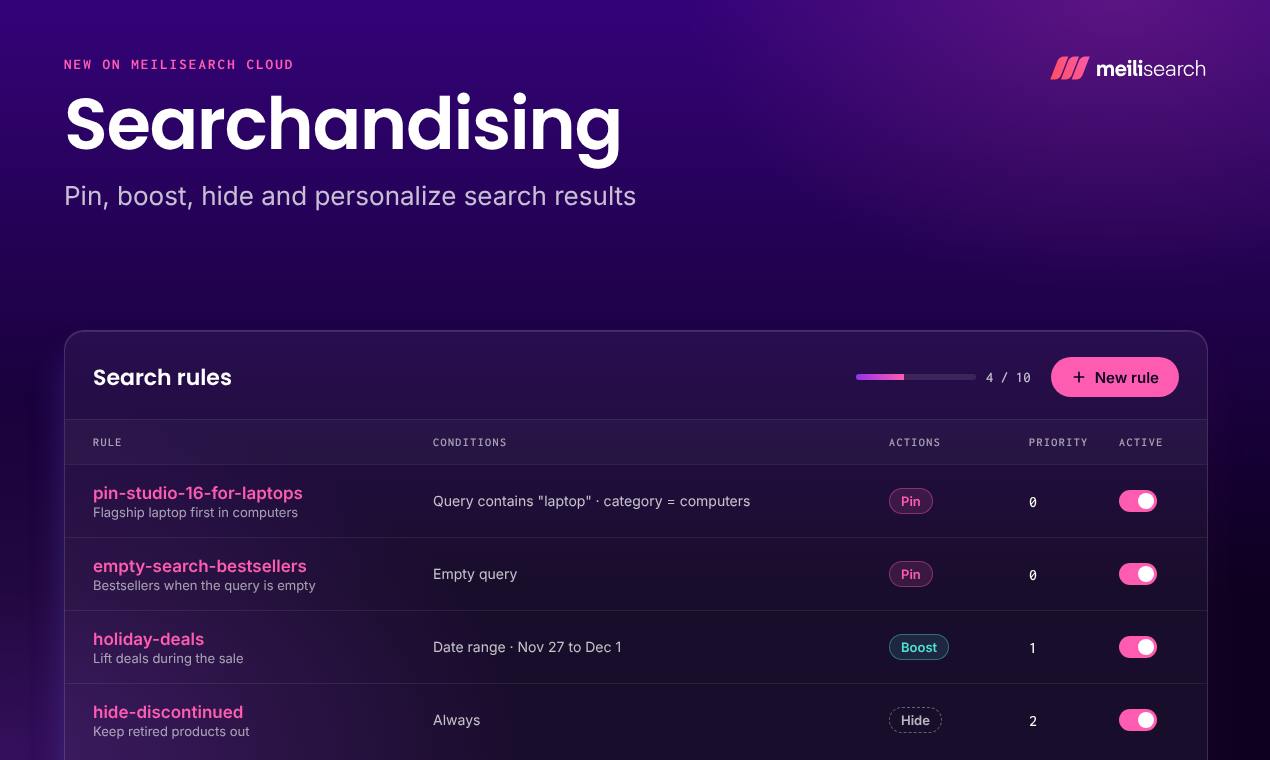
Meilisearch Cloud launches Searchandising, letting operations visually configure search ranking rules.
Meilisearch Cloud has launched Searchandising, transforming search ranking from an engineering task into a self-service product capability for operations. Teams can create rules via a visual editor to pin, boost, deboost, and hide products, triggered by search term, category page, or global query, with scheduling for campaigns. A comparison view enables evaluation without deployment. Rules are also available via API, with 3 free rules per project. Personalized ranking remains experimental and requires an application. It is positioned as a search operations tool rather than a recommendation system, with its core value in compressing the collaboration chain between operations and engineering.
Meilisearch Cloud recently launched a new feature called Searchandising, turning search results from "the algorithm decides" into "operations can manage it." It allows teams to create search rules through a visual editor to pin, boost, deboost, or hide products, supports triggering by query term, category page, or global query, and can also preset schedules for promotional campaigns. The product received 97 upvotes and 12 comments on Product Hunt, ranking 16th, with its category spanning user experience, e-commerce, and search.
Search operations shift from an engineering task to a product capability
Traditionally, adjusting search ranking often requires engineers to modify code, ship a release, and wait for deployment. Meilisearch has now moved rule configuration into a visual interface: operations staff can directly drag a product to the top of results, apply boosts or deboosts based on any filter condition, or hide products they don't want to sell from results. Rules can be bound to specific search terms, category pages, or every query, and also support scheduled activation for periodic marketing campaigns such as Black Friday.
The key to this design is "what you see is what you get." Before rules go live, the system provides a comparison view with and without rules, allowing teams to evaluate the effect without deploying. This lowers the barrier to search tuning and enables operations teams to respond quickly to business needs without relying on engineering resources.
Relevance Ranking is typically determined by a search engine's built-in scoring functions, with common factors including term frequency, field weights, and document freshness. Meilisearch by default uses a rule-based ranking strategy and layers configurable ranking rules on top of it. Searchandising's boost/deboost essentially introduces business weights on top of the base relevance score, while pinning forcibly changes document position and bypasses scoring. This mechanism of "score stacking + position override" has similar implementations in Elasticsearch's pinned query and Algolia's Rules. Understanding this helps more clearly assess priority conflicts when multiple rules overlap—when pinning and deboosting hit the same product simultaneously, the system needs a clear execution order.
Three typical uses of the rule engine
Pin is suited for fixing featured products, new arrivals, or strategic SKUs at the front of results, solving the problem of "good products that can't be found." Boost/Deboost adjusts ranking weights by filter condition, such as elevating high-margin categories or suppressing products with tight inventory. Hide is used to remove products that don't fit the current sales strategy, which is more flexible than delisting them outright.
The trigger mechanism covers three granularities—search terms, category pages, and global queries—plus scheduled scheduling, which basically covers both daily operations and campaign operations scenarios. Rules are also available through an API for easy integration with existing systems. Each project includes 3 free rules, with additional rules billed on demand.
Merchandising is a core concept in e-commerce, referring to the business practice of manually intervening in product display to improve conversion rates and profit. Traditionally it covers offline shelf placement and promotional slot design, and in digital contexts it extends to ranking adjustments in search results and product selection for recommendation slots. Meilisearch named the feature Searchandising, precisely combining "Merchandising" with "Search" to emphasize the commercial operations aspect of search results. This contrasts with pure algorithmic ranking—the latter only optimizes relevance, while the former also balances business goals such as margin, inventory, and promotional cycles. Understanding this background helps judge the feature's positioning: it serves operational controllability rather than replacing relevance algorithms.
Personalized ranking is still experimental
In addition to rule configuration, Meilisearch also offers personalization capabilities that re-rank by user, but it is explicitly marked as an experimental feature and requires an application to enable. This means it is not yet an out-of-the-box standard capability, and teams should treat it as an exploratory direction rather than a stable production feature when evaluating it.
From a product positioning perspective, Searchandising is closer to a "search operations tool" than a "recommendation system." It addresses operational controllability rather than fully automated personalization. For small and medium-sized e-commerce teams, this controllability is often more practical than a black-box algorithm.
Experimental Feature in SaaS products usually means the API may change, performance is not guaranteed, SLA support is lacking, and it may be discontinued at any time. Meilisearch marking re-ranking by user as experimental and requiring an application to enable indicates that this capability is not yet mature across data collection (user behavior signals), model training, and real-time inference pipelines. For production systems, relying on experimental features carries regression risk; teams should use them in exploratory scenarios and keep a fallback plan to rule-based ranking. This also explains why the product is currently positioned more as an "operations tool" than a "recommendation system"—the latter requires a stable personalization pipeline as support.
Impact on e-commerce search workflows
The commercial value of search results has been repeatedly validated in e-commerce scenarios, but adjusting ranking has long been a friction point between engineering and operations. Meilisearch packages rule configuration, effect comparison, and scheduled scheduling into a product module, effectively compressing the chain of "raise a request—schedule—develop—launch."
It is worth noting that the number of rules, the maturity of personalization capabilities, and the handling of priorities when multiple rules overlap will all affect the actual experience. Three free rules are sufficient for small projects, but teams with many rules need to evaluate costs. The visual editor lowers the barrier, which also means its ability to express complex logic may be inferior to pure code solutions.
Overall, Searchandising is a signal that search infrastructure is extending toward the operations layer: search engines no longer only provide relevance ranking but are partially returning control over ranking strategy to the business side.
The search operations workflow typically follows this chain: operations discovers a search problem (e.g., featured products can't be found, slow-moving products occupy the front page) → submits a request to engineering → schedules development of ranking logic → tests and launches. This chain is long, has high communication costs, and every adjustment carries release risk. The value of tools like Searchandising lies in moving "rule configuration" from the code layer up to the configuration layer, enabling operations to complete adjustments self-service and quickly validate them through comparison views. But configuration also brings governance issues: as the number of rules grows, version management, approval flows, and effect attribution become necessary; otherwise, problems such as rules overriding each other and not being cleaned up after campaigns end can easily arise. When evaluating such tools, in addition to the features themselves, attention should also be paid to rule auditing and lifecycle management capabilities.
One-line Summary
Meilisearch Cloud launches Searchandising, letting operations visually configure search ranking rules.
Paragraph Summary
Meilisearch Cloud has launched Searchandising, transforming search ranking from an engineering task into a product capability that operations can configure self-service. Teams can create rules through a visual editor to pin, boost, deboost, and hide products, with rules triggerable by search term, category page, or global query, and supporting scheduled scheduling for promotional campaigns. Before rules go live, a comparison view with and without rules is provided, allowing effect evaluation without deployment. Rules are also available through an API, with each project including 3 free rules. Personalized ranking remains an experimental feature requiring an application to enable. Overall, it is positioned as a search operations tool rather than a recommendation system, with its core value lying in compressing the collaboration chain between operations and engineering.
Related articles

From Pulpit to Senate: A Pastor-Senator on What Sin Is
A pastor-senator at Ebenezer Church reflects on how his Senate experience reshaped his understanding of sin and hubris, making his sermons more powerful—even likening Washington to Sodom and Gomorrah.

TechCrunch Mobility: The A/B Test Pitting Robots Against Humans
TechCrunch Mobility spotlights the future of transportation and AI's role, discussing A/B testing robots vs. humans in mobility scenarios, test design challenges, and industry implications.

Project Leonida: An Open-Source Attempt to Recompile Xbox GTA 6 for PC
Leonida is an open-source project attempting to recompile Xbox GTA 6 to run on PC. We analyze its technical approach, community controversy, and significance for the PC gaming ecosystem.